

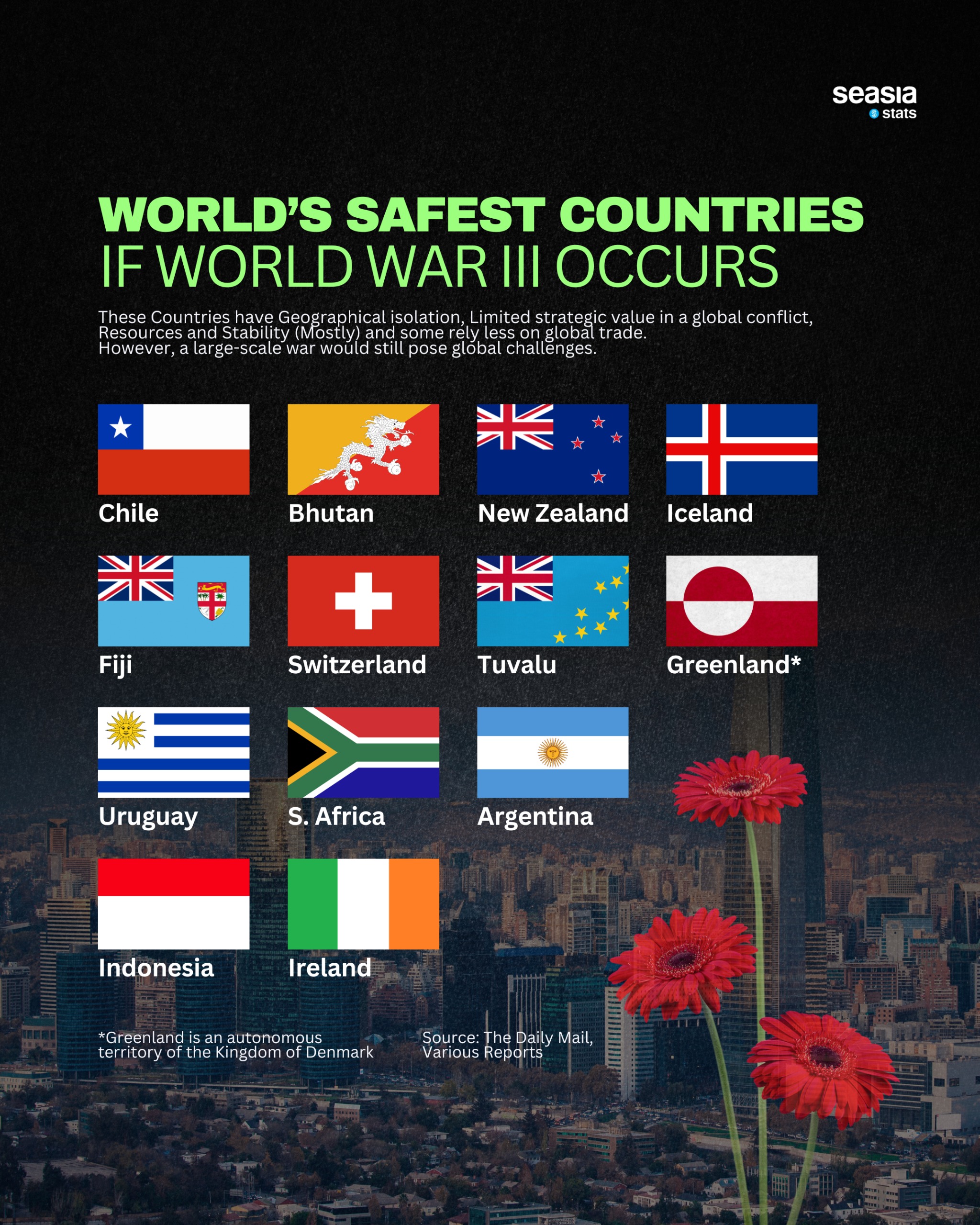
As geopolitical tensions continue to dominate global headlines, a recurring question emerges in public imagination: where would be the safest places to be if a major global conflict erupted? According to recent compilations by Seasia Stats and reports referenced by The Daily Mail in early 2026, a small group of countries consistently appears in survival and resilience rankings. These nations are not necessarily the richest or most powerful—but they share a powerful combination of geographic isolation, political neutrality, and resource self-sufficiency.
Isolation as the First Line of Defense
One of the most important factors in determining safety during a global conflict is simple geography. Countries that are far from strategic flashpoints or military corridors naturally face fewer risks of direct attacks.
Island nations dominate this category. New Zealand, Fiji, Tuvalu, and Iceland all sit far from major global power centers and military alliances. Their remote locations make them difficult to reach and strategically less relevant as targets. Greenland, with its sparse population and extreme climate, also fits into this category of remote, low-priority territory.
Southeast Asia contributes to this list through Indonesia, the world’s largest archipelago. Spread across thousands of islands, Indonesia’s geography provides natural dispersal and resilience, making it harder to target compared to centralized continental nations.
Neutrality and Strategic Irrelevance
Geography alone is not enough—political positioning also plays a crucial role. Countries that maintain long-standing neutrality or non-aligned foreign policies tend to be less involved in military alliances that could draw them into conflict.
Switzerland is the classic example, with centuries of neutrality supported by strong domestic defenses and diplomacy. Ireland also maintains a policy of military neutrality, while New Zealand has historically taken an independent stance in global affairs.
Indonesia’s “free and active” foreign policy echoes this approach in Southeast Asia. The country avoids binding military alliances and instead focuses on diplomatic engagement and regional cooperation through ASEAN. In a global crisis scenario, such positioning reduces the likelihood of becoming a direct target.
Other Southeast Asian nations not on the list—such as Malaysia and Vietnam—also emphasize non-alignment and regional stability, highlighting a broader pattern of strategic neutrality in the region.
Self-Sufficiency and Resource Security
Surviving the aftermath of a global conflict depends heavily on access to food, energy, and raw materials. This is where many of the listed countries stand out.
New Zealand is often considered the gold standard of resilience. It produces far more food than its population consumes, has access to clean water, and is relatively energy secure. Iceland, meanwhile, is almost entirely powered by domestic geothermal and hydroelectric energy—making it largely independent from global energy markets.
In South America, Chile, Uruguay, and Argentina benefit from fertile agricultural land and abundant natural resources. South Africa also stands out as a resource-rich nation capable of sustaining its population.
Indonesia again provides a Southeast Asian example of resilience. With vast agricultural capacity, fisheries, and mineral resources, it has the foundations to maintain internal stability even if global supply chains are disrupted.
The Southeast Asian Perspective
From a regional perspective, Indonesia’s inclusion is significant. It reflects Southeast Asia’s growing recognition as a zone of relative stability and strategic neutrality. While other ASEAN countries may not be listed explicitly, many share similar characteristics—moderate geopolitical positioning, diversified economies, and strong community-based resilience.
A Relative Concept of Safety
While these countries are often cited as “safe havens,” experts consistently emphasize that no place on Earth would be completely untouched by a large-scale global conflict. Economic disruptions, climate impacts, and humanitarian challenges would likely affect all regions.
Still, geography, neutrality, and self-sufficiency offer a powerful combination—and in an uncertain world, these nations represent some of the most resilient corners of the planet.


