

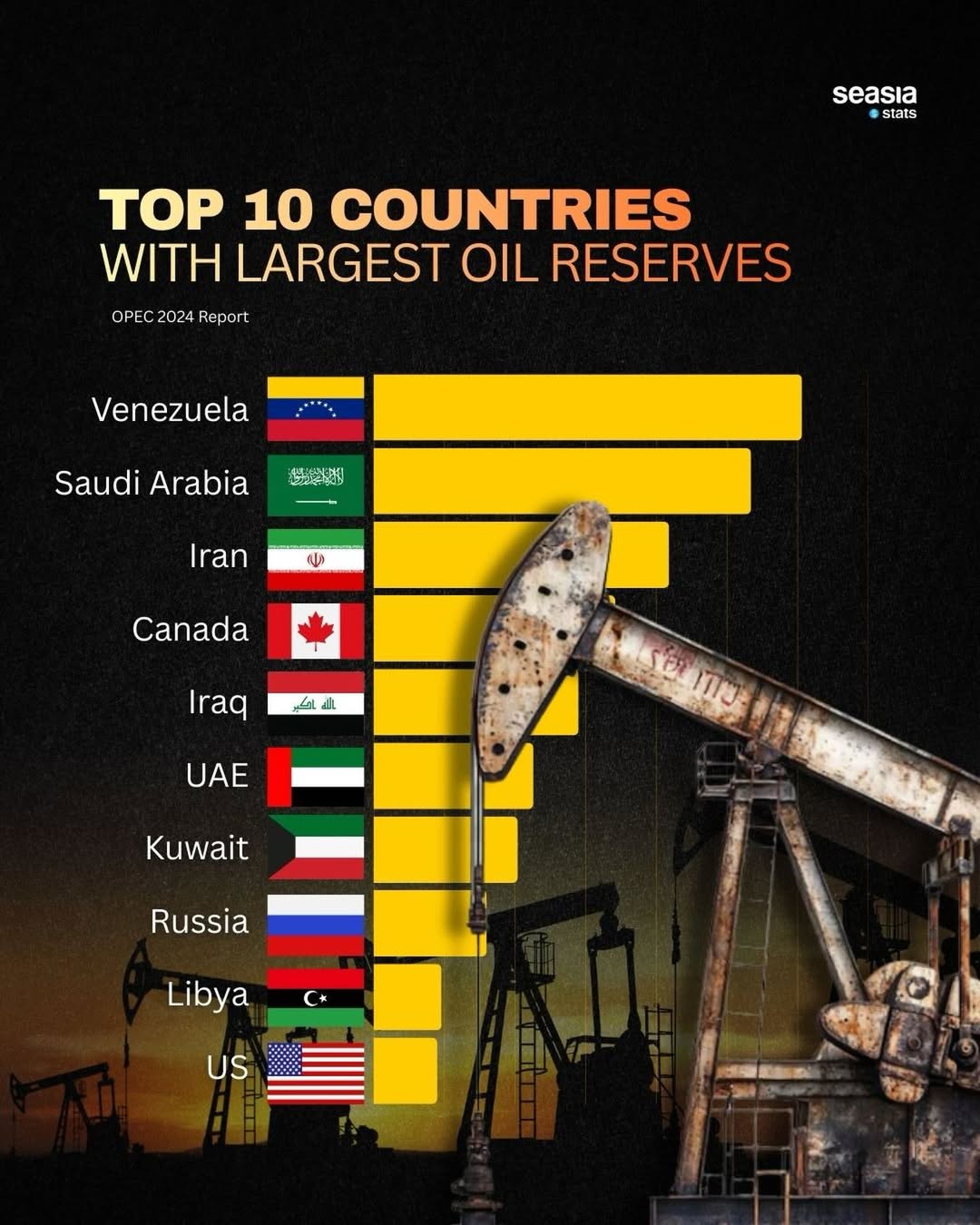
In an era defined by energy security and shifting geopolitical dynamics, the distribution of the world’s oil reserves remains one of the most influential forces shaping global economics. According to the OPEC 2024 Report, the top ten countries alone control roughly 1.5 trillion barrels of proven crude oil reserves, highlighting how a handful of nations continue to dominate the global energy map.
Venezuela Still Sits on the World’s Largest Reserves
At the top of the list is Venezuela, holding an estimated 303 billion barrels, or nearly 20% of global reserves. However, much of this oil lies in the Orinoco Belt and consists of extra-heavy crude. While abundant, it is technically complex and costly to extract and refine, meaning that Venezuela’s production capacity often falls short of its enormous potential.
Middle East Powerhouses Shape Global Energy Markets
Saudi Arabia ranks second with 267 billion barrels, accounting for roughly 17% of global reserves. Its advantage lies in the quality and accessibility of its oil, particularly in giant fields like Ghawar, enabling production costs among the lowest in the world. Iran follows in third place with 209 billion barrels, although sanctions and infrastructure challenges often limit its export potential.
The broader Middle East continues to dominate global reserves. Iraq holds 145 billion barrels, while the United Arab Emirates and Kuwait possess 113 billion and 102 billion barrels respectively. Together, these countries represent a core pillar of global energy supply, influencing both pricing and geopolitical stability.
North America’s Unique Position in the Oil Landscape
Canada, with 171 billion barrels, is the largest reserve holder outside OPEC, thanks largely to Alberta’s oil sands. Meanwhile, the United States—ranking tenth with 45 billion barrels—demonstrates that production power does not always depend on reserve size. Advanced shale extraction technology has enabled the U.S. to become the world’s largest oil producer, even with comparatively smaller reserves.
Southeast Asia’s Role in the Global Oil Equation
Although Southeast Asian nations do not appear in the global top ten, the region remains strategically vital to global energy supply chains. Indonesia, Malaysia, and Brunei are among the key oil and gas producers in ASEAN, supplying regional markets and contributing to export flows. Indonesia alone has long been a significant oil producer in Asia, while Malaysia’s Petronas continues to expand exploration and joint ventures across regional basins, including major offshore developments.
The importance of Southeast Asia lies not only in reserves but also in geography. Critical shipping lanes such as the Strait of Malacca serve as the world’s busiest oil transit route, carrying tens of millions of barrels per day between the Middle East and East Asia. This makes ASEAN nations essential gatekeepers in the global energy supply chain.
Energy Reserves and the Future of Global Power
Ultimately, the global distribution of oil reserves reveals a world still heavily dependent on a few resource-rich regions. From Venezuela’s vast heavy crude reserves to Saudi Arabia’s efficient production systems, these nations continue to anchor global energy markets.
At the same time, Southeast Asia’s growing economies and strategic geography ensure the region will remain deeply connected to the global oil story—whether as producers, transit hubs, or emerging energy consumers. As the world gradually transitions toward renewable energy, these reserves will continue to shape international relations, trade flows, and economic development for decades to come.


