

Asia is home to sprawling giants like China and India, but it also shelters some of the world’s smallest sovereign states—countries whose land areas are tiny yet whose global influence, economic strength, and cultural identity are anything but. From coral atolls to hyper-dense city-states, the continent’s smallest nations demonstrate how geography does not limit ambition.
The Tiny Trio Under 1,000 km²
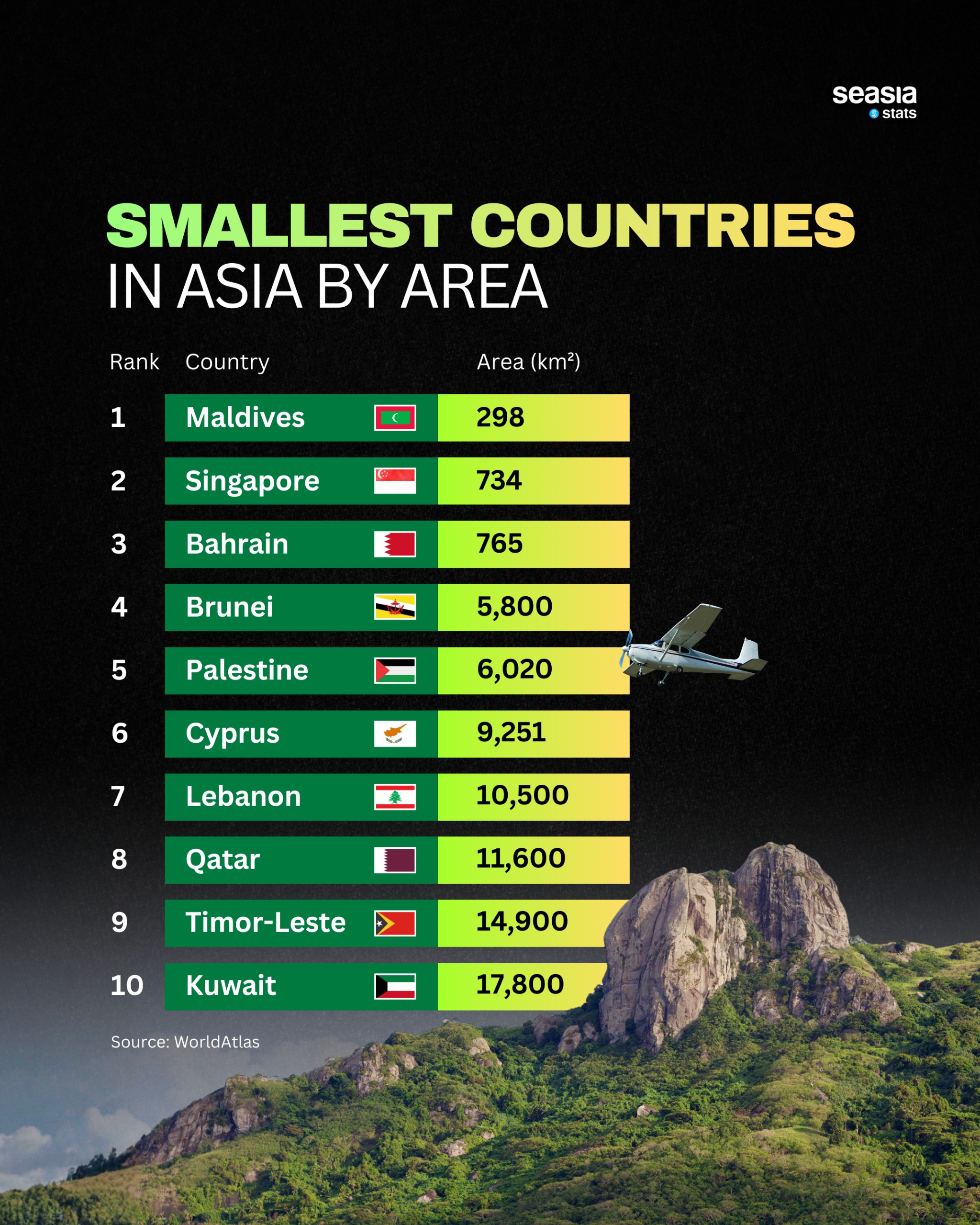
At the very top of the list sits Maldives, covering just 298 km², making it the smallest country in Asia. Scattered across the Indian Ocean, its territory is fragmented into hundreds of coral islands, yet it commands global attention as a luxury tourism powerhouse and climate change frontline.
Next is Singapore at 734 km², a city-state that defies the logic of size. Despite its compact footprint, Singapore is a global financial hub, a logistics superpower, and one of the world’s most advanced urban economies.
Bahrain follows closely with 765 km², leveraging its strategic Gulf location to build a strong banking and services sector.
Southeast Asia’s Compact Economies
Southeast Asia features prominently on this list, proving that small landmass does not mean small impact.
Brunei ranks fourth with 5,800 km², combining a modest geographic size with one of the region’s highest per-capita incomes, thanks largely to its energy resources.
Further down is Timor-Leste, at 14,900 km², one of Asia’s youngest nations. Though still developing, it holds significant potential in energy, agriculture, and tourism, particularly with its pristine coastlines.
These countries highlight Southeast Asia’s geographic diversity—from ultra-dense urban centers to sparsely populated coastal states.
The Middle Tier: Small but Strategically Placed
Between these Southeast Asian nations are several compact states in West Asia and the Mediterranean. Palestine (6,020 km²), Cyprus (9,251 km²), and Lebanon (10,500 km²) demonstrate how small territories often sit at major geopolitical crossroads.
Qatar, with 11,600 km², has transformed its limited land into a global energy and aviation hub, while Kuwait (17,800 km²) plays a similarly outsized role in global oil markets.
Why Size Doesn’t Limit Influence
Many of Asia’s smallest countries have adopted strategies that maximize their geographic constraints:
-
Economic specialization (Singapore in finance and logistics)
-
Resource optimization (Brunei and Qatar in energy)
-
Tourism-driven growth (Maldives and increasingly Timor-Leste)
-
Strategic positioning along major trade routes
High population density, efficient infrastructure, and strong governance often allow small states to outperform larger neighbors in key economic indicators.
Lessons from Southeast Asia’s Small States
For ASEAN, these compact nations offer important policy lessons. Singapore demonstrates how human capital and connectivity can outweigh land constraints. Brunei shows the value—and risks—of resource dependence, while Timor-Leste represents the development opportunities facing emerging micro-states.
As regional integration deepens, smaller countries are increasingly able to plug into larger supply chains, digital markets, and tourism networks, reducing the traditional disadvantages of limited territory.
A Continent of Contrasts
Asia’s smallest countries remind us that geography tells only part of a nation’s story. Whether through financial innovation, natural beauty, or strategic resource management, these compact states punch far above their weight—proving that influence is measured not in square kilometers, but in vision and adaptability.


