

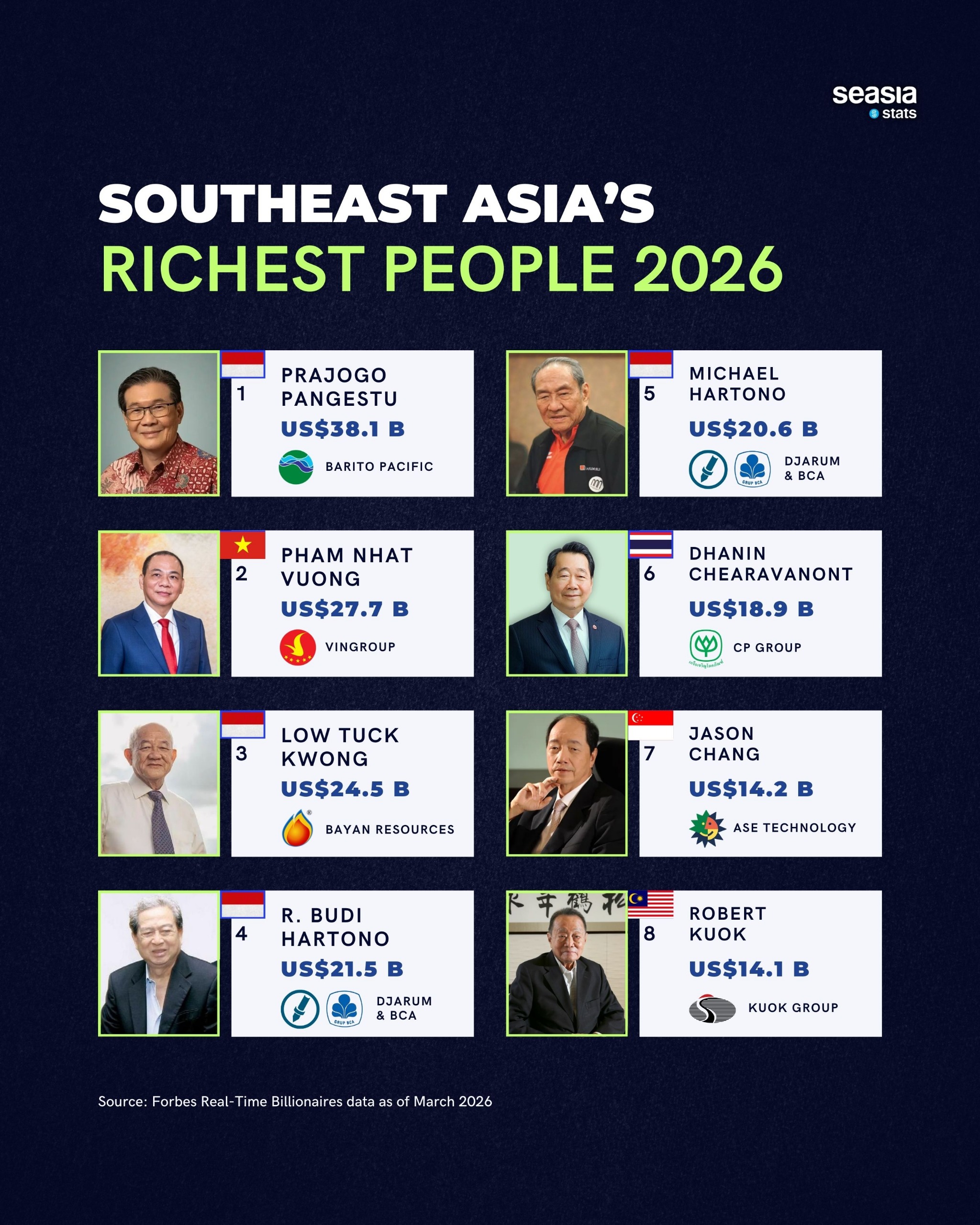
Wealth in Southeast Asia has always told a story—not just about individuals, but about industries, timing, and the economic DNA of each country. The 2026 ranking of the region’s richest individuals offers a snapshot of how power, resources, and ambition intersect across ASEAN’s fast-changing economies.
A New Peak in Regional Wealth
According to Seasia Stats and Forbes Real-Time Billionaires (March 2026), Prajogo Pangestu sits at the top as Southeast Asia’s richest individual, with an estimated net worth of US$38.1 billion. His empire, built through Barito Pacific, reflects the enduring importance of energy and petrochemicals in the region’s growth story.
Right behind him is Pham Nhat Vuong, Vietnam’s most prominent business figure, with US$27.7 billion. As the founder of Vingroup, Vuong represents a newer wave of Southeast Asian wealth—one tied to urban development, consumer markets, and electric mobility ambitions.
In third place is Low Tuck Kwong, with US$24.5 billion, whose fortune stems from Bayan Resources, a major coal producer. His presence highlights a key reality: despite the global push toward clean energy, fossil fuels remain deeply embedded in Southeast Asia’s economic structure.
Indonesia’s Dominance and Industrial Roots
One of the clearest patterns in the ranking is Indonesia’s dominance. Four of the top five names are Indonesian, including R. Budi Hartono and Michael Hartono, whose combined wealth exceeds US$42 billion. Their fortunes are tied to Djarum and Bank Central Asia, one of the country’s most influential financial institutions.
This concentration reflects Indonesia’s scale. As Southeast Asia’s largest economy, it offers the domestic market, natural resources, and financial ecosystem needed to build massive conglomerates. As Bloomberg once observed about Indonesian tycoons, “scale is the region’s greatest competitive advantage—and Indonesia has it in abundance.”
Indonesia’s wealth is still heavily anchored in resources, banking, and legacy conglomerates, but it is increasingly intersecting with newer sectors like digital finance and downstream industrial processing.
Thailand, Vietnam, and Singapore: Different Paths to Power
While Indonesia dominates in numbers, other Southeast Asian economies reveal different models of wealth creation.
Thailand’s Dhanin Chearavanont, ranked sixth, built his fortune through CP Group, one of Asia’s largest agribusiness and retail empires. His success reflects Thailand’s strength in food production, supply chains, and regional retail networks.
Vietnam’s rise, meanwhile, is embodied by Pham Nhat Vuong. His position signals how Vietnam is transitioning from a manufacturing base into a consumer-driven and innovation-oriented economy.
From Singapore comes Jason Chang, whose wealth is tied to ASE Technology. His presence highlights Singapore’s role as a technology and financial hub, where wealth is often built through high-value industries rather than natural resources.
Legacy Wealth and Regional Influence
Rounding out the list is Robert Kuok, one of Southeast Asia’s most enduring business figures. Through the Kuok Group, his influence spans commodities, logistics, hospitality, and real estate across decades.
Kuok represents a different era of Southeast Asian capitalism—one built on trading, regional networks, and long-term diversification. As The Financial Times once described him, he is “a symbol of Asia’s first generation of global business builders.”
What This Wealth Really Means
Beyond the numbers, this ranking reveals a deeper pattern. Southeast Asia’s richest individuals are not concentrated in a single sector or country. Instead, they reflect a hybrid economic identity:
– Resource-driven wealth in Indonesia
– Consumer and industrial expansion in Vietnam
– Agribusiness and retail dominance in Thailand
– Technology and finance leadership in Singapore
– Legacy conglomerates in Malaysia
Together, they form a portrait of a region that is still evolving—balancing old industries with new ambitions.
And perhaps that is the most important takeaway. Southeast Asia’s wealth is not static. It is still being built, reshaped, and redefined—one industry, one market, and one generation at a time.


