

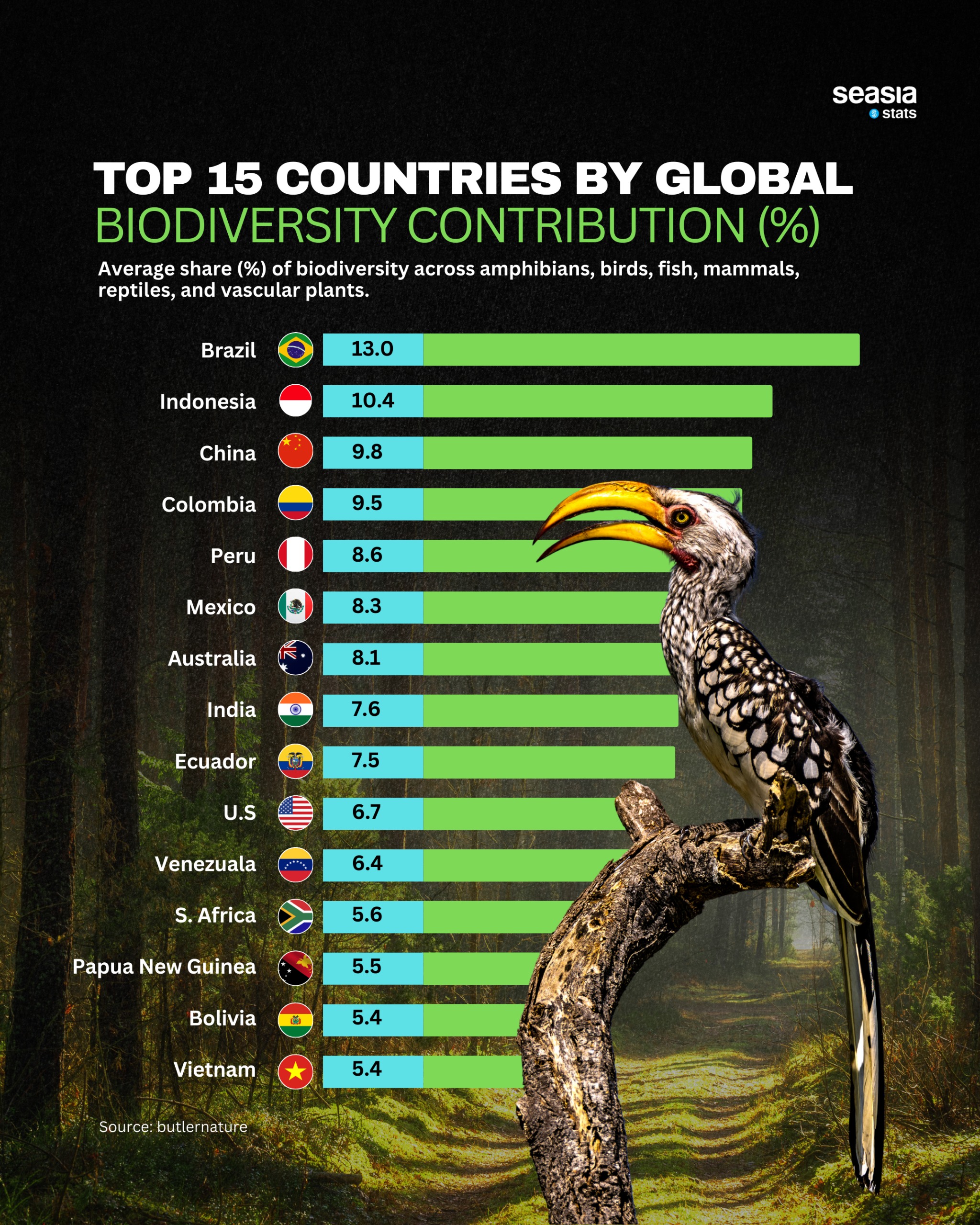
From the teeming rainforests of the Amazon and Southeast Asia to the sprawling ecosystems of Africa and Oceania, life on Earth is beautifully diverse—but not evenly spread. According to global biodiversity data compiled by Butlernature, a handful of countries account for a disproportionately large share of the world’s biological richness. This ranking reflects the average share (%) of biodiversity across amphibians, birds, fish, mammals, reptiles, and vascular plants, offering a broad look at where nature’s variety is most abundant on the planet.
South American Giants and Tropical Wonders
At the top of the list sits Brazil, contributing an impressive 13.0% of global biodiversity on average. Brazil’s rich tapestry of life is fueled by the Amazon rainforest, the Pantanal wetlands, the Atlantic Forest, and other unique biomes that together host thousands of species found nowhere else on Earth.
Just behind Brazil is Indonesia, which contributes 10.4%, making it the most biodiverse country in Southeast Asia. Indonesia’s sprawling archipelago, which includes the islands of Borneo, Sumatra, and New Guinea, lies at the heart of the Coral Triangle and boasts incredible diversity of fish, mammals, plants, and more.
Completing the top three is China, at 9.8%. Though better known for its size and human population, China’s vast landscapes—from tropical forests in the south to alpine ecosystems in the Himalayas—support a remarkable variety of species.
Beyond the Top Three: Tropical, Temperate, and Unique Habitats
Following close behind are several other countries rich in natural variety. Colombia holds 9.5%, driven by its complex mix of Andean, Amazonian, and Caribbean ecosystems. Peru contributes 8.6%, while Mexico sits at 8.3% with deserts, forests, and mountain ranges all supporting diverse life.
Australia, with its unique marsupials and reef ecosystems, follows at 8.1%, and India adds 7.6% thanks to varied biomes like the Western Ghats and Eastern Himalayas. All these nations are considered biodiversity hotspots because they contain extraordinary numbers of species across multiple taxa.
Smaller but still significant contributors include Ecuador (7.5%) and the United States (6.7%), whose diverse habitats—from tropical islands to temperate forests—boost overall species counts. Venezuela and South Africa round out the middle of the top 15 with sizeable shares.
Southeast Asia’s Continued Role
Toward the bottom of the top 15, Papua New Guinea, Bolivia, and Vietnam each contribute around 5.4–5.5%, underscoring the importance of tropical regions in sustaining global biodiversity. Southeast Asia’s position in the ranking reflects the region’s status as a biodiversity hotspot—with old-growth rainforests, coral reefs, and mountain ecosystems providing habitats for countless species.
Why It Matters
Understanding where biodiversity is most concentrated isn’t just an academic exercise—it’s a crucial guide for conservation priorities. The countries topping this list host ecosystems under threat from deforestation, climate change, and development pressures. Protecting these biodiverse regions is key to ensuring that future generations can enjoy the full richness of life on Earth—whether it’s the vibrant bird life of Indonesia’s jungles or the majestic species of Brazil’s rainforests.


