

Global economic growth in the coming decade is expected to be shaped by a mix of established superpowers and fast-rising emerging markets. As countries recover from recent global disruptions and accelerate investment in technology, infrastructure, and green industries, economists are increasingly focusing on which nations will contribute the most new economic value to the world economy.
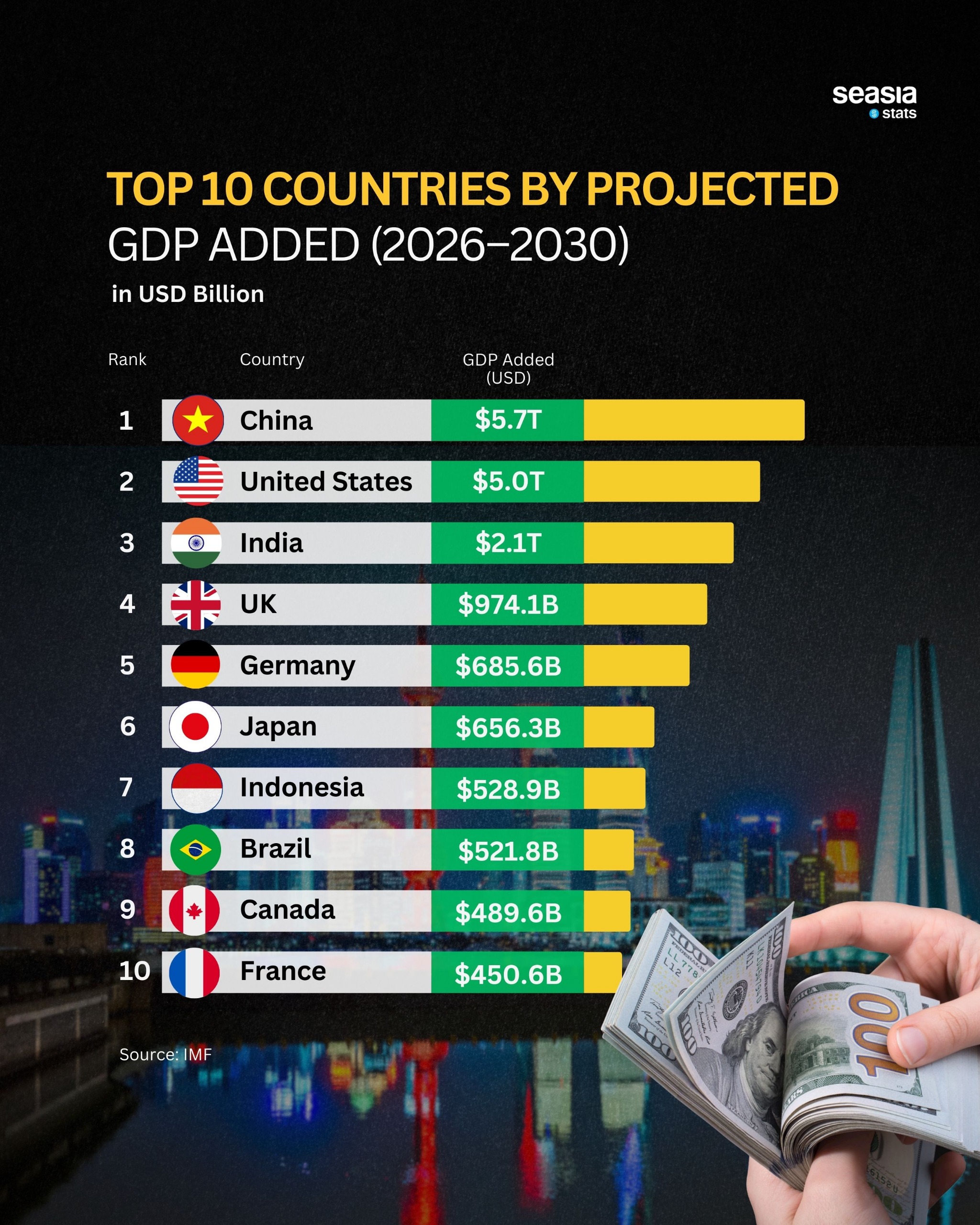
According to data from the International Monetary Fund (IMF) highlighted by Seasia Stats, the global economic landscape between 2026 and 2030 will be driven primarily by a handful of large economies. The top ten countries projected to add the most GDP during this period reveal both the continued dominance of major economic powers and the growing influence of emerging markets—especially in Asia.
China and the United States Lead Global Growth
At the very top of the rankings is China, projected to add an extraordinary $5.7 trillion to its economy by 2030. Despite facing demographic challenges and structural adjustments, China’s vast industrial base, expanding domestic market, and technological investments continue to position it as a major engine of global growth.
Close behind is the United States, expected to contribute $5.0 trillion in additional GDP. The U.S. economy remains highly resilient, supported by innovation-driven sectors such as artificial intelligence, digital technology, advanced manufacturing, and renewable energy. Together, China and the United States are forecast to account for a massive share of global economic expansion over the next several years.
India’s Rapid Rise
One of the most significant stories of the coming decade is the continued rise of India, which ranks third with an expected $2.1 trillion in added GDP. India’s large population, expanding middle class, and strong growth in digital services and manufacturing have made it one of the fastest-growing major economies in the world.
Many analysts see India as a key driver of global economic momentum in the coming decades, particularly as multinational companies diversify supply chains and invest more heavily in South Asia.
Europe and Japan Maintain Steady Growth
The middle tier of the ranking is dominated by mature industrial economies, which continue to expand at a steady pace even if their growth rates are lower than emerging markets.
The United Kingdom ranks fourth, projected to add $974.1 billion to its GDP. Despite economic uncertainties in recent years, London remains a major global financial hub with strong service-sector growth.
Germany, Europe’s largest economy, follows with $685.6 billion in projected expansion. Known for its advanced manufacturing and export-driven economy, Germany continues to play a central role in global trade and industrial production.
Meanwhile, Japan ranks sixth with expected GDP growth of $656.3 billion. Although Japan faces demographic pressures from an aging population, its strengths in technology, robotics, and high-value manufacturing remain globally competitive.
Indonesia and Emerging Economies Gain Momentum
Among emerging markets, Indonesia stands out as a major rising force in Southeast Asia. Ranked seventh globally, the country is projected to add $528.9 billion to its economy between 2026 and 2030.
Indonesia’s strong demographic advantage, expanding infrastructure, and growing consumer market have made it one of the most promising economies in the region. As the largest economy in ASEAN, Indonesia is increasingly seen as a future global economic heavyweight.
Other Southeast Asian countries are also showing strong growth potential. Vietnam, the Philippines, and Malaysia have been experiencing rapid industrialization, digital transformation, and increased foreign investment. These trends suggest that Southeast Asia will play a larger role in global economic expansion in the coming decades.
A Diverse Global Growth Landscape
The remaining positions in the top ten highlight the diversity of the world’s economic engines.
Brazil ranks eighth with projected growth of $521.8 billion, reflecting the importance of Latin America’s largest economy in agriculture, energy, and natural resources.
Canada follows with $489.6 billion, benefiting from its stable financial system and strong resource sector. Finally, France completes the list with projected GDP growth of $450.6 billion, supported by its diversified economy and leadership in aerospace, luxury goods, and tourism.
The Future of Global Economic Power
Taken together, these projections reveal an evolving global economic landscape. While traditional economic powers like the United States, Europe, and Japan remain influential, emerging markets—particularly in Asia and Southeast Asia—are becoming increasingly central to global growth.
Over the next decade, the balance of economic influence is likely to continue shifting toward the Indo-Pacific region, where demographic momentum, urbanization, and technological innovation are creating new engines of prosperity for the global economy.


