

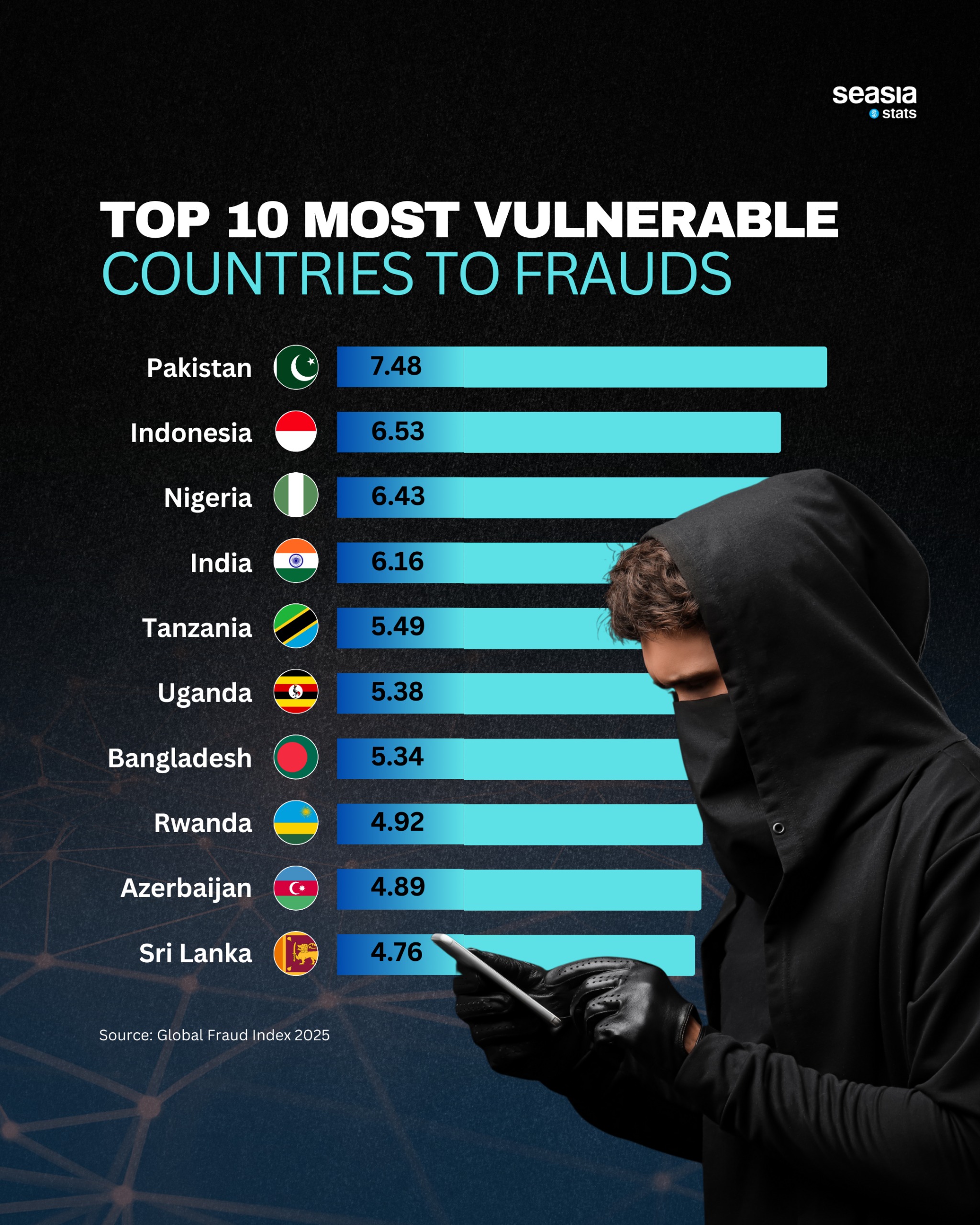
As more countries race toward digital transformation, a darker trend is keeping pace: fraud. The Global Fraud Index 2025, compiled by Sumsub and visualized by Seasia Stats, highlights which nations are most vulnerable to fraudulent activities. The findings reveal a complex mix of rapid digital adoption, uneven financial literacy, and regulatory gaps that create fertile ground for scams, identity theft, and online financial crime.
Fraud is no longer confined to backroom schemes—it now thrives in apps, online marketplaces, and mobile banking platforms.
Pakistan and Indonesia Lead the Risk Rankings
At the top of the list is Pakistan, with a vulnerability score of 7.48, marking the second consecutive year it has ranked as the most fraud-susceptible country globally. Analysts point to systemic enforcement challenges, expanding fintech ecosystems, and limited digital awareness among segments of the population as contributing factors.
Close behind is Indonesia, scoring 6.53, making it the most vulnerable nation in Southeast Asia. Indonesia’s digital economy is booming, particularly in urban hubs such as Jakarta and Surabaya. E-wallets, online banking, and peer-to-peer payment systems have become mainstream. However, consumer education and cybersecurity enforcement mechanisms have struggled to keep pace with this explosive growth.
The result? A digital marketplace filled with opportunity—but also risk.
A Global Pattern Beyond Southeast Asia
Fraud vulnerability is far from a regional issue. Nigeria ranks third globally with a score of 6.43, reflecting similar pressures in a rapidly expanding digital financial landscape.
India follows at 6.16, where massive digital inclusion initiatives and fintech adoption have created both empowerment and exposure. Meanwhile, Tanzania (5.49) and Uganda (5.38) underscore how emerging digital markets can face growing cybercrime risks if regulatory frameworks lag behind innovation.
The remaining countries in the top 10—Bangladesh (5.34), Rwanda (4.92), Azerbaijan (4.89), and Sri Lanka (4.76)—illustrate that fraud vulnerability spans continents and income levels.
Southeast Asia: Innovation Meets Exposure
Within Southeast Asia, Indonesia’s ranking raises broader regional questions. Neighboring economies such as Philippines, Vietnam, Thailand, and Malaysia are also experiencing rapid fintech expansion. Super apps, QR-based payments, cross-border e-commerce, and digital banking licenses are transforming how millions transact daily.
However, fraudsters are evolving just as quickly—leveraging phishing schemes, social engineering tactics, fake investment platforms, and identity spoofing techniques.
Singapore, often regarded as the region’s regulatory benchmark, has strengthened anti-scam laws and introduced coordinated response frameworks. Yet even advanced systems remain under pressure from increasingly sophisticated cybercrime networks.
The Way Forward: Prevention, Education, Enforcement
Experts emphasize that fraud vulnerability does not necessarily mean inevitability. Countries that invest in digital literacy campaigns, enforce strict know-your-customer (KYC) regulations, and strengthen cross-border cybersecurity cooperation can significantly reduce exposure.
Public awareness is equally critical. Many fraud schemes succeed not because systems are weak—but because individuals are unaware of the risks.
The Global Fraud Index 2025 serves as a wake-up call: in an era where smartphones double as wallets and banks fit in our pockets, trust is the most valuable currency. Protecting it requires vigilance from governments, financial institutions, and citizens alike.


