

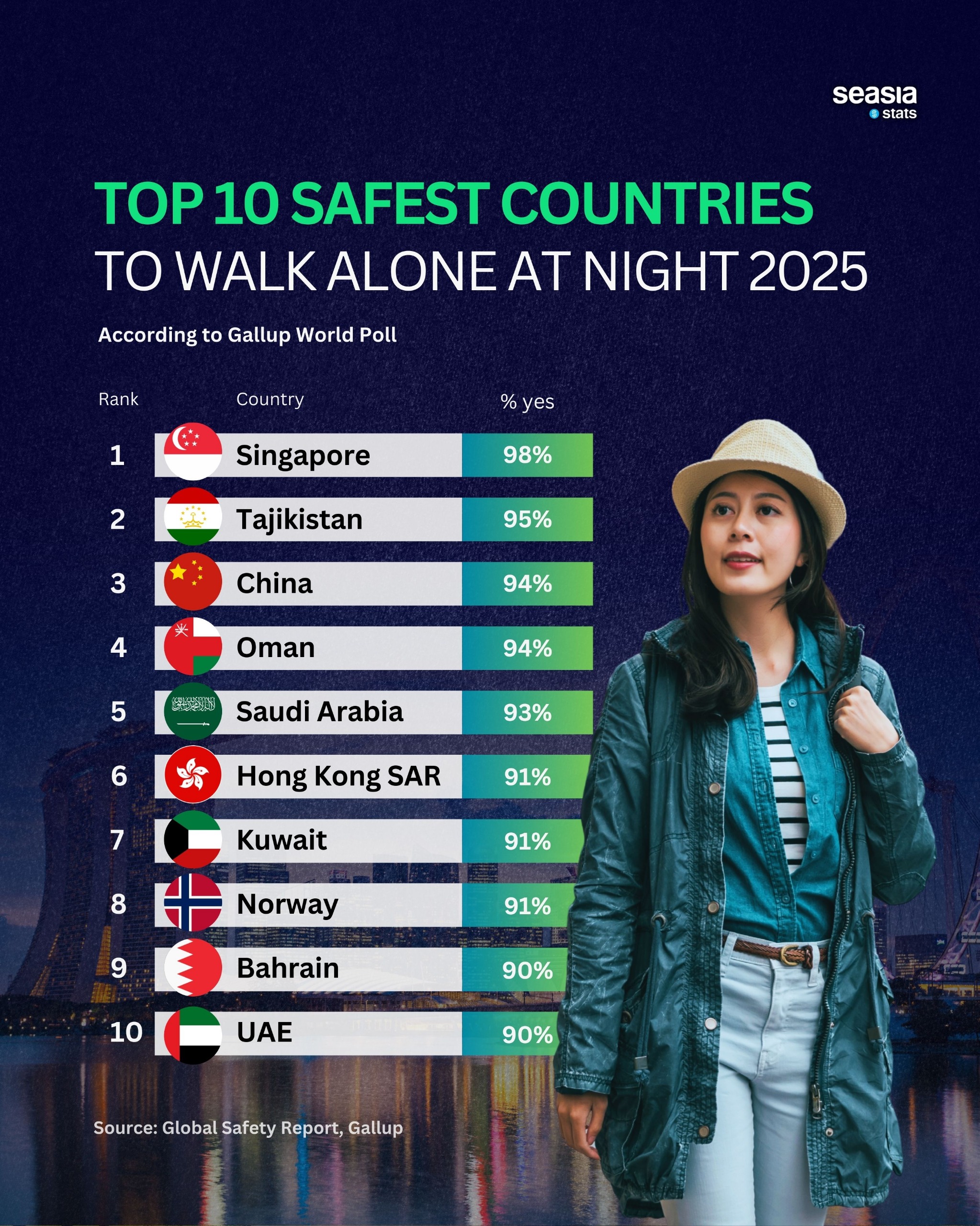
In an age where safety increasingly shapes travel choices and quality of life, the simple question—“Can you walk alone at night?”—has become a powerful global benchmark. The latest Gallup World Poll data for 2025 offers a revealing snapshot of how people across different societies perceive their personal security after dark.
A Global Leader in Urban Safety
At the very top of the rankings stands Singapore, where an extraordinary 98% of respondents say they feel safe walking alone at night. This is not just a statistic; it reflects decades of consistent policy, urban planning, and social trust. Low crime rates, strict law enforcement, and efficient public infrastructure have combined to make Singapore one of the safest urban environments in the world.
As The Economist has previously observed, “Singapore’s success lies not only in enforcement but in a broader culture of order and predictability.” The result is a city-state where safety is not perceived as a privilege, but as a norm embedded in everyday life.
Asia and the Middle East Set the Standard
Following Singapore, countries like Tajikistan, China, and Oman dominate the upper tier of the rankings, each recording confidence levels above 90%. These results highlight a broader regional trend: across much of Asia and the Gulf, strong state presence and social cohesion often translate into high perceptions of personal safety.
Further down the list, Saudi Arabia, Hong Kong SAR, Kuwait, and Bahrain reinforce this pattern. Even United Arab Emirates, a global tourism hub, maintains a strong 90% safety perception, underscoring how public security has become a cornerstone of national branding in these regions.
Interestingly, Norway is the only European country in the top ten, suggesting that while Europe is generally safe, fewer countries reach the exceptionally high perception levels seen in parts of Asia and the Middle East.
Southeast Asia Beyond Singapore
Singapore may lead the world, but the broader Southeast Asian region presents a more nuanced picture. Countries like Malaysia, Thailand, and Vietnam are often considered relatively safe by travelers, particularly in major urban and tourist areas. However, their absence from the top ten reflects varying levels of urban inequality, traffic safety concerns, and differences in law enforcement visibility.
In cities such as Kuala Lumpur, Bangkok, and Ho Chi Minh City, safety perceptions can differ widely depending on neighborhood, time, and individual experience. While violent crime rates remain comparatively low, issues like petty theft or traffic-related risks often shape how safe people feel after dark.
Indonesia, the region’s largest country, reflects another layer of complexity. In metropolitan areas like Jakarta, safety has improved significantly over the years, yet perceptions still vary across districts. This diversity is a reminder that Southeast Asia cannot be measured by a single narrative when it comes to security.
Safety as a Measure of Trust
Ultimately, these rankings are not just about crime—they are about trust. Trust in institutions, trust in communities, and trust in the predictability of daily life. As Gallup has noted in its global safety reporting, “perceived safety is closely tied to confidence in local governance and social stability.”
For Southeast Asia, Singapore’s position at the top offers both inspiration and a benchmark. It shows what is possible when infrastructure, governance, and public culture align. At the same time, the broader regional picture highlights the ongoing journey toward safer, more inclusive cities.
In a world where mobility and freedom increasingly define modern living, the ability to walk alone at night—without fear—remains one of the clearest indicators of a society’s success.


