

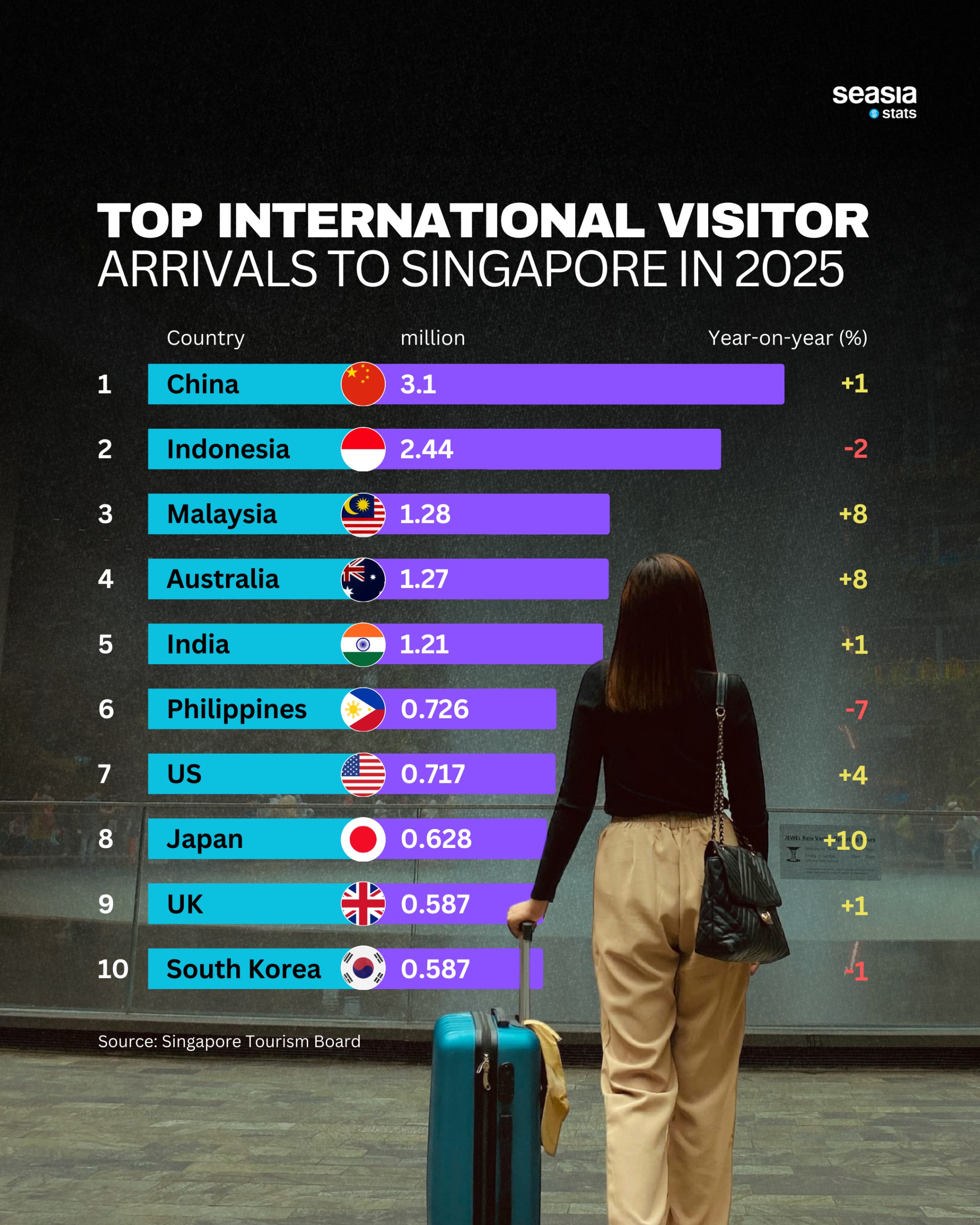
Few cities embody global connectivity quite like Singapore. Compact yet cosmopolitan, the city-state continues to punch well above its weight as a tourism and business hub. In 2025, international travel momentum remains firmly in Singapore’s favor, with visitor arrivals projected to reach 13.635 million from the top 10 source countries alone, according to data from the Singapore Tourism Board. The numbers reveal not just recovery, but a reshaping of travel patterns—one that underscores Asia-Pacific’s growing influence on global tourism flows.
China and Indonesia Lead the Pack
At the top of the list is China, projected to send 3.1 million visitors to Singapore in 2025. A modest 1% year-on-year increase reflects steady demand driven by leisure travel, business ties, and family visits. Despite economic headwinds at home, China remains Singapore’s single largest tourism market, thanks to close air links and enduring cultural connections.
Close behind is Indonesia, with 2.44 million arrivals, even as the market records a 2% dip compared to the previous year. Given Indonesia’s proximity and deep people-to-people ties with Singapore, it continues to be a cornerstone of the city’s tourism ecosystem—supporting retail, healthcare travel, and short-stay leisure visits.
Southeast Asia’s Strong Showing
Beyond Indonesia, Malaysia stands out with 1.28 million visitors, posting an impressive 8% growth year-on-year. Cross-border travel, concerts, shopping weekends, and food tourism all fuel this surge. Together with Indonesia, Malaysia highlights how Southeast Asia remains Singapore’s most reliable and resilient visitor base.
The Philippines, while still contributing a substantial 726,000 arrivals, saw a 7% decline, reflecting shifting travel priorities and economic pressures. Still, Filipinos remain a vital part of Singapore’s tourism and labor-linked travel flows.
Taken together, Southeast Asian countries account for a significant share of Singapore’s inbound travel, reinforcing the city’s role as the region’s de facto crossroads.
Australia, India, and the Western Connection
Rounding out the top four is Australia, with 1.27 million visitors and a strong 8% growth rate. Long-stay leisure travelers, students’ families, and business visitors continue to anchor Australia’s importance to Singapore’s tourism mix.
India follows with 1.21 million arrivals, up 1%, driven by corporate travel, weddings, and a fast-growing middle class eager for international experiences. Meanwhile, the United States contributed 717,000 visitors, growing 4%, underlining Singapore’s continued appeal as a gateway to Asia for Western travelers.
Japan’s Standout Growth Story
One of the most eye-catching trends in 2025 is Japan’s 10% growth, the fastest among the top 10 markets, reaching 628,000 arrivals. Improved air connectivity and pent-up outbound demand are bringing Japanese tourists back in force.
The list is completed by the UK and South Korea, tied at 587,000 arrivals each, with only marginal year-on-year changes—signaling stable, mature travel markets.
What the Numbers Really Say
Beyond rankings and percentages, these figures tell a deeper story: Singapore’s tourism future is increasingly Asia-centric, with Southeast Asia and the wider Asia-Pacific region driving growth. At the same time, steady arrivals from Western countries ensure a balanced, globally diversified visitor profile.
As Singapore continues to invest in events, attractions, and seamless travel experiences, its role as Asia’s most connected city shows no sign of fading—welcoming millions, one arrival at a time.


