

In an increasingly uncertain geopolitical environment, many analysts and observers frequently ask a simple but unsettling question: where would be the safest places if a global conflict were to erupt? While no location on Earth can be considered completely immune to the consequences of a large-scale war, certain countries are often viewed as relatively safer due to their geography, neutrality, political positioning, or resource independence.
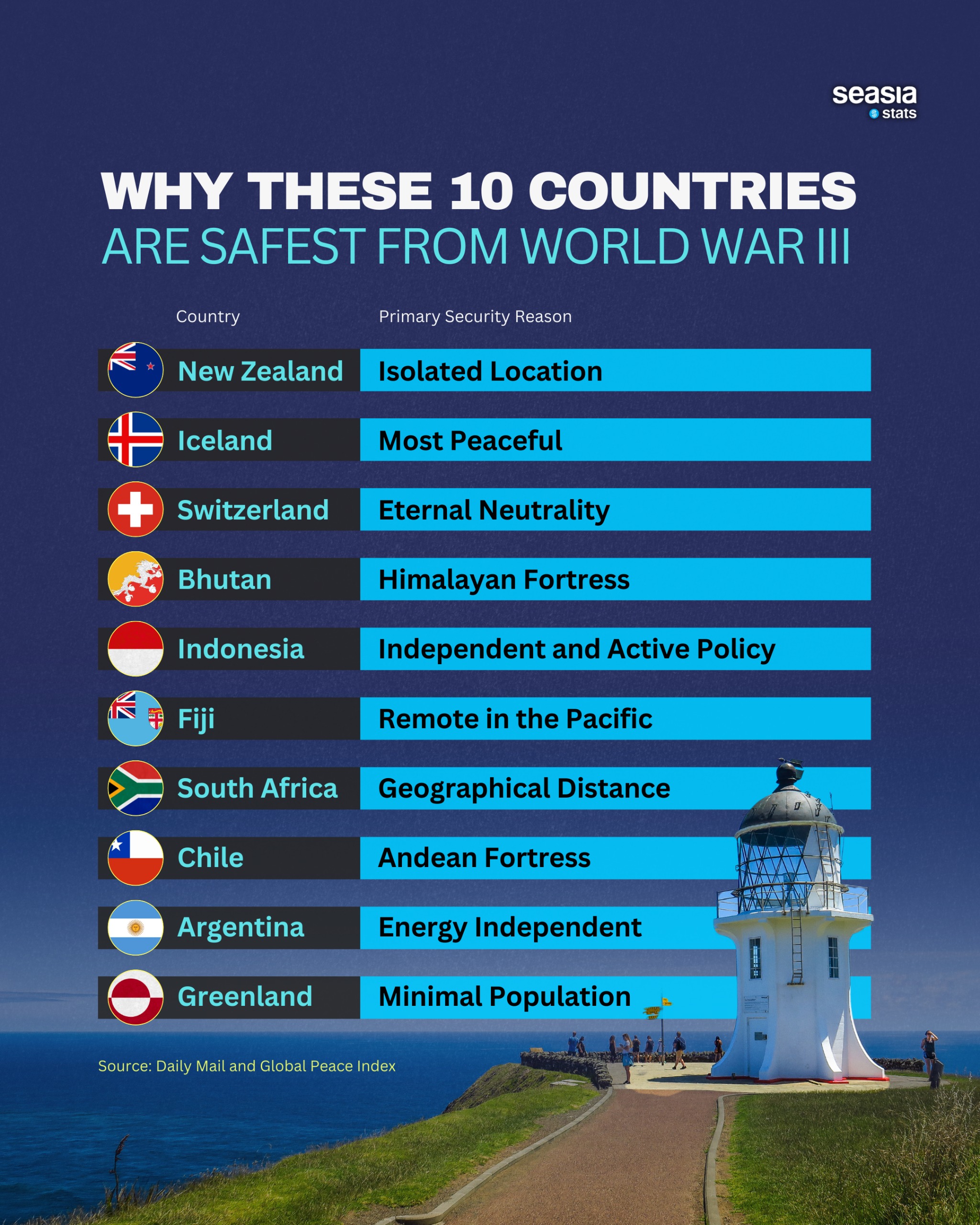
An infographic highlighted by Seasia Stats, drawing on data from the Daily Mail and the Global Peace Index, identifies ten countries that could be among the safest during a hypothetical World War III scenario. The reasons vary—from geographic isolation and political neutrality to strategic self-sufficiency.
Geography as the Ultimate Shield
One of the most powerful factors contributing to safety in times of global conflict is geographic isolation. Countries located far from major military powers or strategic conflict zones are less likely to become immediate targets.
At the top of the list is New Zealand, whose remote position in the South Pacific places it far from the primary geopolitical flashpoints of Europe, Asia, and the Middle East. This distance alone gives the country a unique strategic advantage.
Iceland ranks second, largely due to its consistent position as one of the world’s most peaceful nations. Despite being part of NATO, Iceland has no standing army and maintains a strong diplomatic tradition of peaceful cooperation.
Meanwhile, Switzerland continues its centuries-old policy of neutrality. Combined with its mountainous terrain and highly developed civil defense infrastructure, Switzerland’s geopolitical stance makes it one of the most resilient nations during periods of international tension.
Natural Barriers and Strategic Autonomy
Another common factor among countries on the list is the presence of natural geographic barriers that make military access difficult.
Bhutan, nestled deep in the Himalayas, benefits from one of the most formidable natural fortresses on Earth. Surrounded by towering mountains and maintaining a cautious diplomatic approach, the kingdom remains relatively insulated from global power struggles.
Indonesia is also highlighted in the ranking due to its long-standing doctrine of “independent and active” foreign policy. As the world’s largest archipelagic nation, Indonesia occupies a strategic yet balanced position in international politics. Jakarta maintains diplomatic ties with multiple global powers while avoiding formal military alliances that could pull it directly into large-scale conflicts.
Within Southeast Asia, other countries also maintain similar balancing strategies. Malaysia, Vietnam, and Thailand, for example, often pursue pragmatic foreign policies aimed at maintaining strong relations with multiple global partners without becoming overly dependent on any single bloc.
Remote Nations in the Southern Hemisphere
Several countries on the list are located in the Southern Hemisphere, far removed from the historical centers of global warfare.
Fiji represents one such example. Its remote location in the Pacific Ocean places it thousands of kilometers away from major geopolitical rivalries. Similarly, South Africa benefits from its geographic distance from many of the world’s traditional conflict zones.
While no nation can remain entirely isolated in a globalized world, these distances may reduce the likelihood of direct military engagement.
Resource Security and Natural Defenses
In addition to geography, resource independence can play a crucial role in national resilience during global crises.
Chile, described as an “Andean fortress,” benefits from the natural barrier of the Andes Mountains along much of its eastern border. These rugged landscapes historically made large-scale invasions difficult.
Neighboring Argentina is highlighted for its energy independence, a significant advantage if global supply chains were disrupted during wartime. Access to domestic energy resources can help maintain economic and social stability during international crises.
Finally, Greenland rounds out the list. With its extremely small population and vast icy landscape, the territory presents little strategic incentive for large-scale military operations.
Safety in a Complex World
While the idea of “safe countries” in a world war scenario remains largely speculative, the list highlights several important patterns. Geographic isolation, diplomatic neutrality, natural barriers, and resource independence all contribute to a nation’s ability to remain relatively insulated from major conflicts.
For Southeast Asia, Indonesia’s inclusion reflects the region’s growing role in global geopolitics. With its strategic location and balanced foreign policy, the country continues to position itself as a stabilizing force in international affairs.
Ultimately, the lesson from such rankings is clear: in a complex and interconnected world, peaceful diplomacy and international cooperation remain the most reliable safeguards against global conflict.


