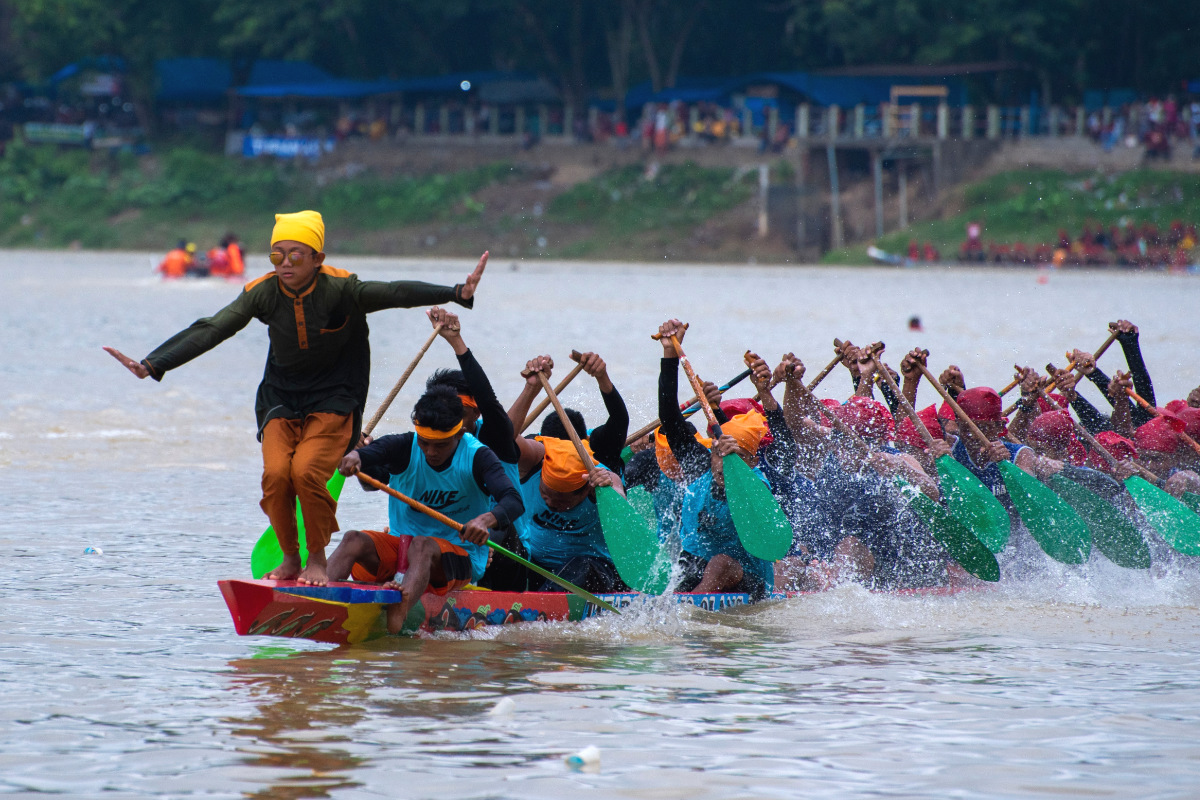
On the banks of the Kuantan River in Riau, Indonesia, a thundering rhythm rises each year—not from drums or gamelan, but from the synchronized splash of dozens of wooden paddles slicing through the water. As ornately carved boats glide with breathtaking speed, cheers erupt from thousands of spectators lining the riverbanks.
This is Pacu Jalur—a spectacle that may look like a race, but holds far more than meets the eye. Rooted in centuries of tradition, this annual event is a vibrant expression of community, spirituality, and identity. It is not just about winning; it is about remembering, honoring, and belonging.
Rooted in the River: The Origin of Pacu Jalur
Long before it became a grand spectacle, Pacu Jalur began as a humble means of transport. In the heart of Kuantan Singingi, Riau, the Jalur–longboats carved from whole tree trunks—were used to navigate the winding Batang Kuantan River, especially from the upstream regions of Hulu Kuantan to Cerenti.
At a time when land transportation was still undeveloped, these boats played a crucial role in daily life. They were used to carry agricultural produce such as local fruits, sugarcane, and other essential goods from village to village. Over time, this practical function evolved into a form of celebration and communal pride.
By the 17th century, Pacu Jalur had become part of local festivities. These longboats, often able to carry 40–60 people, were integral to river life—especially in the absence of developed land routes. Over time, villagers began to decorate them with carvings of tigers, crocodiles, and serpents, as well as ornaments such as colorful umbrellas, streamers, and a central mast (gulang-gulang)—signifying the boat’s spiritual and communal role.
By the early 20th century, these boats were raced during major Islamic holidays such as Maulid Nabi and the Islamic New Year, turning transport into a celebration of agility, strength, and honor. During the Dutch colonial period, races were also held to commemorate the birthday of Queen Wilhelmina (31 August).
Following Indonesia’s independence, Pacu Jalur was officially recognized as an annual tradition celebrated every August–on or around Independence Day—continuing the legacy of uniting people through sport, tradition, and cultural pride.
But Pacu Jalur is more than just a race. It is a harmonious blend of physical strength, artistic expression, and spiritual depth. Each Jalur is not merely built with technical precision—it is part of a cultural process steeped in tradition. From the selection of the wood, the carving of the boat, its launching, and finally the race itself, every stage is accompanied by traditional rituals.
United by the Paddle: The Spirit of Collectivity
In Pacu Jalur, no paddler stands out. There are no individual victories, no personal glory. Instead, there is rhythm—dozens of bodies moving as one, guided by a single voice, driven by a shared pulse. This deep sense of collectivity is at the heart of what makes Pacu Jalur more than a race.
Each boat, stretching up to 40 meters, carries not just the strength of its rowers but the hopes of an entire village. Behind every team is a long chain of preparation: months of training, nightly gatherings, repairs done by hand, rituals led by elders, meals prepared by families. It is a communal endeavor, where success belongs to all, and so does the joy.
The race itself becomes a metaphor for how the community lives—rooted in cooperation, synchronized by trust, and held together by a shared cultural heartbeat. The Pawang Jalur, or spiritual guide, not only ensures the boat’s physical alignment but also its emotional and spiritual balance.
In this way, Pacu Jalur speaks to something greater than competition. It celebrates the power of togetherness: a community’s ability to move forward not through force, but through unity.
Read also: Pacu Jalur: Indonesia’s 700-Year-Old Boat Race That’s Going Viral on TikTok
More Than a Race: Pacu Jalur in the Modern Era
Pacu Jalur has recently captured global attention—not through formal promotion, but through the organic power of social media. A video of a young Tukang Tari (A dancer at the front of the boat whose role is to set a steady rhythm and signal the position of the team during the race) confidently dancing at the bow of a racing boat went viral on TikTok and Instagram, sparking the global trend known as “Aura Farming.”
The dance’s bold yet graceful energy resonated across cultures, leading to recreations by netizens, athletes, and even football clubs like PSG and AC Milan, and K-pop idols like Enhypen.
Far beyond entertainment, this moment introduced the world to the deeper story behind the tradition: a centuries-old race rooted in community, art, and spiritual heritage. Social media didn’t just spread the image—it carried the soul of Pacu Jalur across borders, proving that even the most local traditions can find universal meaning when shared with authenticity.
Today, the Pacu Jalur Festival is held every August in Teluk Kuantan, Kuantan Singingi Regency, Riau. The festival usually takes place around Indonesia’s Independence Day (August 17th) and spans several days, featuring not only the main boat races but also cultural parades, traditional music, and local crafts.
This article was created by Seasians in accordance with the writing rules on Seasia. The content of this article is entirely the responsibility of the author.