


Among the vast diversity of Australia’s unique wildlife, the quokka has earned global attention not just for its cuteness but for its perpetual smile, which has led to its nickname as “the happiest animal in the world.”
These small marsupials, native to a few isolated regions of Western Australia, have captured hearts worldwide with their friendly expressions and photogenic charm.
But beyond the smile lies a fascinating creature with remarkable behavior, biological uniqueness, and growing conservation challenges.
What is a Quokka?

The quokka (Setonix brachyurus) is a small, herbivorous marsupial that belongs to the same family as kangaroos and wallabies.
Adults typically weigh between 2.5 to 5 kilograms and stand about 40 to 54 centimeters tall. Quokkas have compact, rounded bodies, short ears, and a distinctive tail, which is relatively short compared to other macropods.
Their fur is coarse and grayish-brown, and their facial structure gives them the appearance of constantly smiling.
This expression, combined with their generally friendly nature, has turned them into viral sensations on social media, with thousands of tourists visiting quokka habitats to snap the perfect “quokka selfie.”
Natural Habitat

Quokkas are found mainly in a few locations in Western Australia, with the most famous and stable population residing on Rottnest Island, just off the coast of Perth.
The name “Rottnest” itself comes from Dutch explorer Willem de Vlamingh, who in 1696 mistook the quokkas for giant rats and named the island “Rattennest,” meaning “rat’s nest” in Dutch.
Besides Rottnest Island, smaller populations exist on Bald Island and in limited areas of the mainland. On the mainland, quokkas face greater environmental pressures and habitat fragmentation, making their island populations crucial for their continued survival.
Behavior and Diet

Quokkas are primarily nocturnal and crepuscular, meaning they are most active during the night and at dawn or dusk. During the day, they tend to rest in the shade of dense vegetation to avoid the heat.
They are highly adaptable and can survive on a variety of plant materials, including grasses, leaves, stems, and bark. On Rottnest Island, they often forage near human activity, which sometimes leads to unfortunate interactions, such as being fed inappropriate food.
Socially, quokkas are relatively solitary but can be found in loose groups, especially in resource-rich areas. Unlike many other wild animals, quokkas show a curious and relatively fearless attitude toward humans, which has contributed to their friendly reputation.
The Captivating Smile
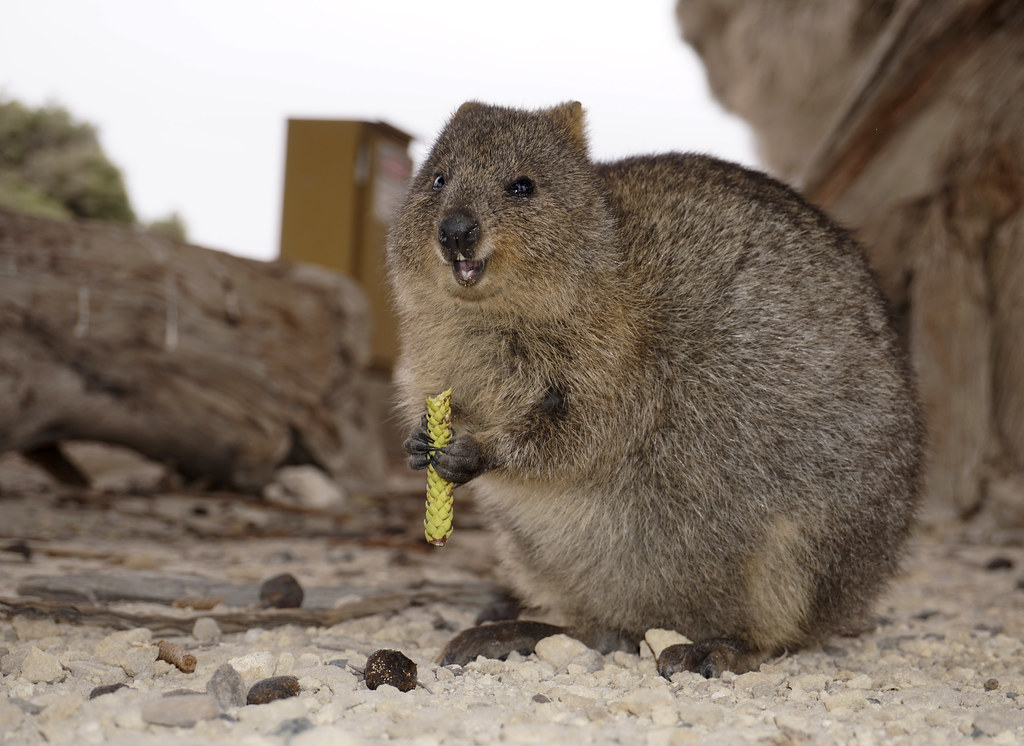
What truly sets quokkas apart from other animals is their facial structure, which gives them a constant smiling appearance. This illusion of happiness is due to the natural shape of their mouths and cheeks, but the effect is undeniably charming.
In the age of viral content and Instagram-worthy moments, quokkas quickly became international stars.
The “quokka selfie” phenomenon took off around 2013, with celebrities and tourists alike traveling to Rottnest Island specifically to get a photo with the beaming marsupials.
However, while the attention has raised awareness about the species, it has also posed challenges. Wildlife authorities have had to remind visitors not to touch or feed quokkas, as doing so can cause them harm.
Interactions with humans must be respectful and regulated to preserve both the health of the animals and the integrity of their habitat.
Conservation Status and Challenges

Despite their popularity, quokkas face several conservation issues. They are classified as “Vulnerable” by the International Union for Conservation of Nature (IUCN).
The primary threats to quokkas include habitat destruction due to land clearing, introduced predators such as foxes and cats, and changes to fire regimes that affect the vegetation they rely on for food and shelter.
While Rottnest Island provides a relatively safe environment free of predators, mainland populations are declining.
Conservation efforts are ongoing, including habitat restoration, predator control, and public education. Rottnest Island has also implemented strict rules to minimize harmful human impact on quokka populations.
More Than Just a Pretty Face

While their smile has made them famous, quokkas are far more than just adorable animals. They play an important ecological role in their environments and represent the fragile balance of Australia’s unique ecosystems.
Their resilience, adaptability, and increasing visibility offer hope for conservation and greater public interest in protecting lesser-known wildlife species.
The quokka’s rise to fame has given conservationists a new tool to engage the public. As people fall in love with this cheerful-looking creature, awareness and funding for conservation have increased.
In this way, the quokka has become not only a symbol of happiness but also a symbol of how human fascination with animals can lead to real-world efforts to protect them.
Whether it’s their innocent expression, their gentle demeanor, or the joy they spark in people who see them, the quokka continues to embody a rare and beautiful intersection between nature, happiness, and hope.