


No one planned for Krakatoa to become a milestone in the history of journalism. No editor assigned correspondents to the Sunda Strait, and no photo desk waited for images from the scene.
What happened instead was that a volcano erupted with a force never before recorded, while the newly established telegraph network was suddenly forced to prove its capability.
As a result, for the first time in history, a natural disaster became known to the entire world almost simultaneously.
On August 27, 1883, the eruption of Krakatoa in Indonesia was heard as far away as Madagascar, Alice Springs, and Rodrigues Island in the Indian Ocean, more than 4,800 kilometers away.
Its atmospheric pressure waves circled the Earth seven times and affected more than 10 percent of the planet’s surface. Scientists later described it as the loudest sound ever recorded in human history.
The eruption was not entirely unexpected. Since May 1883, merchant ships passing through the area had reported ash clouds, explosive noises, and vast fields of pumice floating on the sea. Local residents even treated it as a fascinating spectacle at first, before realizing that it was only the beginning.
Destruction That Nearly Wiped Out Civilization
Within two days, Krakatoa hurled 21 cubic kilometers of material into the atmosphere. Two-thirds of the island disappeared.
Ash blanketed 800,000 square kilometers and plunged the region into complete darkness for two and a half days. Pyroclastic flows, reaching temperatures of up to 700 degrees Celsius, moved at speeds exceeding 80 kilometers per hour, destroying nearly everything in their path.
The deadliest force, however, was not the lava, but the tsunami.
Waves as high as 41 meters struck the coast of Banten. Of the 36,000 recorded deaths, more than 34,000 were caused by the tsunami alone. The town of Anjer was virtually erased from the map, leaving behind only an undersea cable buoy and the foundations of its lighthouse.
The waves did not stop at the strait. Krakatoa’s tsunami was recorded in Mauritius, the Seychelles, South Africa, and even the Pacific Islands on the very same day. Sea disturbances were reportedly detected as far away as Hawaii and South America.
Meanwhile, the atmospheric shockwaves circled the Earth repeatedly and were recorded by barometers in St. Petersburg, Valencia, Coimbra, and various other locations across Europe.
In St. Petersburg, the barometer needle suddenly rose and fell on August 27. Two hours and twenty-five minutes later, the same phenomenon was recorded again in Valencia, Ireland, 1,350 miles away.
When Disaster Forced the World to Connect
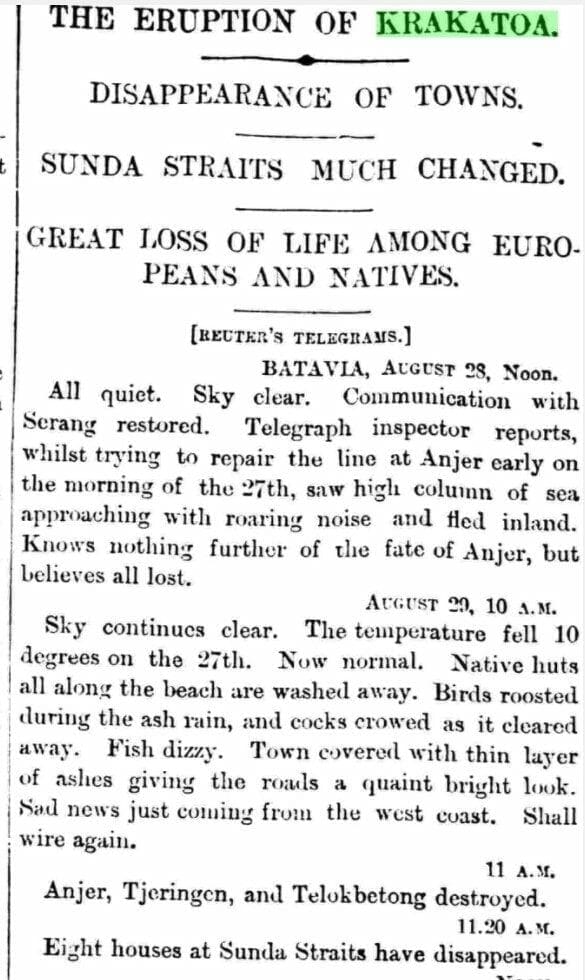
An article published by the Morning Post on August 30, 1883, explicitly cited Reuters telegrams as its source, only three days after the largest explosion occurred. This was no coincidence. Since the first transatlantic telegraph cable successfully connected America and Ireland in 1858, global communication networks had expanded rapidly.
Krakatoa became their first true test on a disaster scale. The result was unprecedented: newspapers from London to Milwaukee published detailed reports within days, turning Krakatoa into the first truly global media event in history.
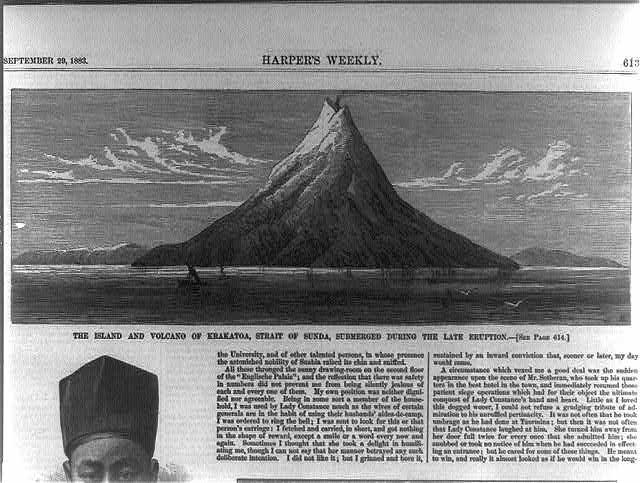
Another factor that amplified its reach was the context of the Age of Imperialism. Batavia in Java was the capital of the Dutch East Indies, while British and French traders also held major interests throughout the region.
Krakatoa also became the first volcanic eruption to be comprehensively documented through modern scientific research. In 1888, the Royal Society of London published a 565-page report covering everything from the distribution of eruptive material to magnetic phenomena associated with the eruption.
The data gathered from Krakatoa later became an essential reference for understanding subsequent major eruptions, including Mount St. Helens.
Krakatoa itself never truly fell silent. In the 1920s, renewed volcanic activity within the caldera left by the 1883 eruption formed a new volcanic cone known as Anak Krakatau.
In December 2018, Anak Krakatau once again triggered a tsunami that killed at least 437 people and injured more than 30,000 others. In an active tectonic region like this, the question is not whether another eruption will occur, but when.


