Here's what it means for AirAsia, Southeast Asia, and the people who still believe flying should be for everyone. There's a specific type of person who, when told the house is on fire, immediately asks where they should put the extension.
Tony Fernandes is that person.
On May 7, 2026, standing in Mirabel, Quebec, having just signed what Canadian Prime Minister Mark Carney described as the single largest purchase of Canadian-made commercial aircraft in history — a US$19 billion deal for 150 Airbus A220 jets — Fernandes did what Fernandes does. He made the news cycle look small.
In a video interview from Montreal, he casually dropped that AirAsia is preparing to launch an entirely new airline. The announcement, he said, would come within the next month or two. Aircraft are already being repositioned for the venture.
No name. No route map. No splashy branding deck. Just: watch this space.
And if you've been watching this man for any length of time, you already know - you watch the space.
… because context matters enormously here.
The global aviation industry right now is not in good shape. That is a polite way of putting it.
Iran closed the Strait of Hormuz to "enemy ships" in response to the US-Israeli war, cutting off roughly 20% of global crude supply, sending oil above $100 a barrel and sending jet fuel costs into territory that most airline CFOs didn't model for in any stress test they'd run.
Fernandes himself told the Financial Times that jet fuel had gone up almost three times, calling it "much worse" than COVID-19. "You wake up one day and your major cost has tripled," he said.
Roughly 13,000 flights vanished from global May schedules, removing nearly two million seats.
Spirit Airlines — the seventh-largest passenger carrier in North America - shut down entirely, leaving around 17,000 people without work. Fernandes himself warned that Spirit won't be the last.
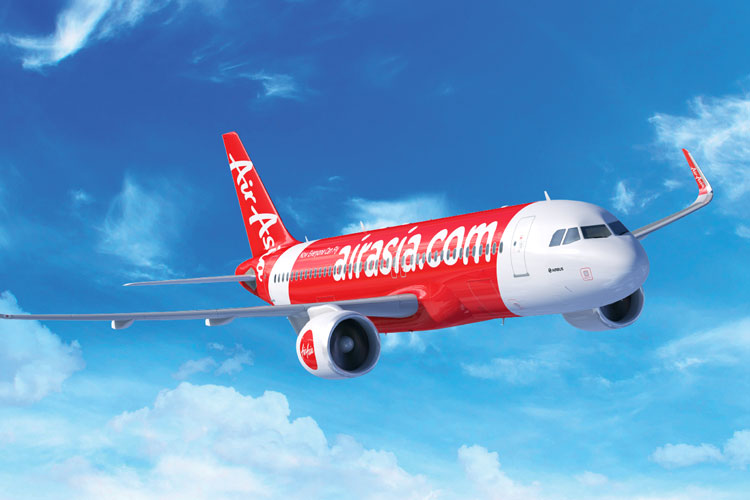
AirAsia's own shares have fallen about 35% since the Iran conflict began, making it the worst performer on the Bloomberg World Airlines index during the period. The group is unlikely to meet its initial profit targets this year and is preparing to sell up to US$600 million in bonds while negotiating a sizeable refinancing facility with Malaysian banks.
Most executives in this situation call their advisors, lock the doors and wait.
Fernandes ordered 150 planes, announced a new airline, and booked meetings with Canadian pension funds.
The aircraft itself is worth understanding
The A220 is not a headline-grabbing widebody that gets photographed on runways with politicians. It's a narrow-body, a regional workhorse - and that is precisely the point.
AirAsia is the global launch customer for the A220's new high-density 160-seat configuration, a version that adds an extra overwing exit on each side and squeezes more passengers in without sacrificing the aircraft's range credentials.
Airbus CEO Lars Wagner said the A220 will "open up new routes across Asia that were not feasible before," and once deliveries begin from 2028, AirAsia's existing larger aircraft can be redirected to long-haul routes toward North America, Australia and Europe.
This is not a vanity order. This is a network architecture decision. Shukor Yusof from Endau Analytics put it cleanly: Fernandes is "betting that this aircraft is going to be useful for AirAsia for when 2030 and onwards arrive."
The 2030 bet. That's the language of someone who is not operating in the present tense.
The new airline: what we know, what we don't and why it matters anyway
The details are thin, deliberately so. AirAsia has been linked to possible expansion in Vietnam, and has separately announced plans to launch flights from Bahrain as part of establishing a Gulf-based operation.
Whether the unnamed new carrier is connected to either of these threads, or represents something else entirely, nobody outside Fernandes' inner circle appears to know for certain.
What is confirmed: planes are being moved. The announcement window is weeks, not months … and AirAsia currently operates across Malaysia, Thailand and Indonesia with a fleet of about 250 mostly single-aisle aircraft — the new order expands its backlog to around 550 jets.
That's not a company contracting. That's a company drawing new maps.
From where I sit, writing this from the perspective of someone who covers this region not just as a journalist but as someone who lives inside the everyday texture of Southeast Asian life — I want to say something that doesn't usually make it into business coverage.
There is something culturally significant about the way Fernandes builds.
He bought AirAsia in 2001 for one ringgit. One ringgit.
With two aircraft and debt that most rational people would have walked away from. He turned it into the carrier that told an entire generation of Malaysians, Indonesians, Thais — people who had never been on a plane in their lives — that they could go somewhere.
That flying wasn't only for people in business class with corporate accounts.
That story doesn't live in the spreadsheets. It lives in the memory of every first-time flyer who showed up at KLIA2 with a carry-on bag and the sense that the world had just gotten a little bigger.
And now, in the middle of a genuine industry crisis — with Spirit collapsed — he's doing it again. Not from comfort. Not from surplus. From exactly the kind of moment where most people press pause.
"Why waste a crisis? There are opportunities in a crisis," he said in Montreal.
It sounds like a corporate soundbite until you realise it's actually how the man has run his entire career.
From Malaysia, this reads differently than it might from elsewhere.
We tend, in this part of the world, to have a complicated relationship with our success stories. We celebrate them and scrutinise them in equal measure, which is probably healthy. Tony Fernandes has attracted both in abundance.
But here's what's difficult to argue with; at a moment when a global crisis is reshaping which airlines survive and which don't, the Malaysian-anchored carrier is not retreating to defend what it has. It's planting new flags.
In the Gulf. Possibly in Vietnam. Definitely with 150 new aircraft and a new airline entity that doesn't yet have a name but already has planes assigned to it.
For a country that is simultaneously navigating its EV ambitions, its ASEAN positioning, its complex dance between national champions and foreign capital, there's a parallel here worth naming. The instinct to build when it's uncomfortable. The refusal to let crisis become an excuse for contraction.
Whether the new airline succeeds, whether the A220 bet pays off, whether the hedging philosophy holds over the long arc - none of that is settled. The world is genuinely chaotic right now, and with Brent crude still above $100 despite ceasefire signals and inventories remaining low, nobody should pretend this resolves cleanly in the near term.
But the announcement itself, made from a factory floor in Quebec, in front of 4,000 workers, with a Canadian Prime Minister in the frame and a new airline waiting in the wings — told you something about what kind of operator this is.
He doesn't build when it's easy.
He builds when it costs something.
That, for whatever it's worth, is the part that stays with me.
The writer is at seasia.co covering Southeast Asian business, culture, and the things that happen in between. She has a known weakness for underdogs and long-haul window seats.