


As the sun set on the final day of the Islamic year, the call to prayer echoed from thousands of mosques across Southeast Asia. From the villages of Java and the cities of Malaysia to the grand mosques of Brunei Darussalam, Muslims gathered not for celebration in the festive sense, but for something deeper: reflection, gratitude, and renewal.
The arrival of 1 Muharram 1448 AH marked the beginning of a new chapter in the Islamic calendar. Rooted in the Hijrah—the migration of Prophet Muhammad ﷺ from Mecca to Medina—the occasion has long symbolized transformation, resilience, and hope. Across Southeast Asia, home to more than 280 million Muslims, the Islamic New Year continued to serve as a moment to look inward before moving forward.
Remembering the Spirit of Hijrah
Unlike Eid al-Fitr or Eid al-Adha, the Islamic New Year has traditionally been observed with quiet reverence. The focus is not on festivities but on muhasabah, the practice of self-reflection. Muslims use the occasion to evaluate their actions, strengthen their faith, and renew their intentions for the year ahead.
The renowned scholar Imam Al-Ghazali once wrote, “The successful person is the one who takes account of himself before he is taken to account.” This timeless reminder echoed through sermons and religious gatherings held throughout the region as communities reflected on the deeper meaning of Hijrah—not merely as a physical migration, but as a journey toward becoming better individuals.
A Shared Faith Across Southeast Asia
Southeast Asia remains one of the world's most significant centers of Islam. Indonesia is home to approximately 240 million Muslims, making it the largest Muslim-majority country on Earth. Malaysia's Muslim population exceeds 20 million people, representing more than 60 percent of its citizens, while Brunei Darussalam is overwhelmingly Muslim, with Islam serving as the foundation of the nation's philosophy of Melayu Islam Beraja.
Although united by faith, each country has developed its own distinctive traditions surrounding the Islamic New Year.
In Indonesia, communities across Java and Sumatra welcomed Muharram through pawai obor, or torchlight parades. Children and families carrying bamboo torches walked through neighborhoods while reciting prayers and religious songs. In Yogyakarta and Surakarta, the Islamic New Year coincided with the Javanese observance of 1 Suro. Ancient palace traditions such as the Mubeng Beteng procession and the famous Kirab Kebo Bule reflected the harmonious blending of Islamic values with centuries-old Javanese cultural heritage.
Community, Knowledge, and Service
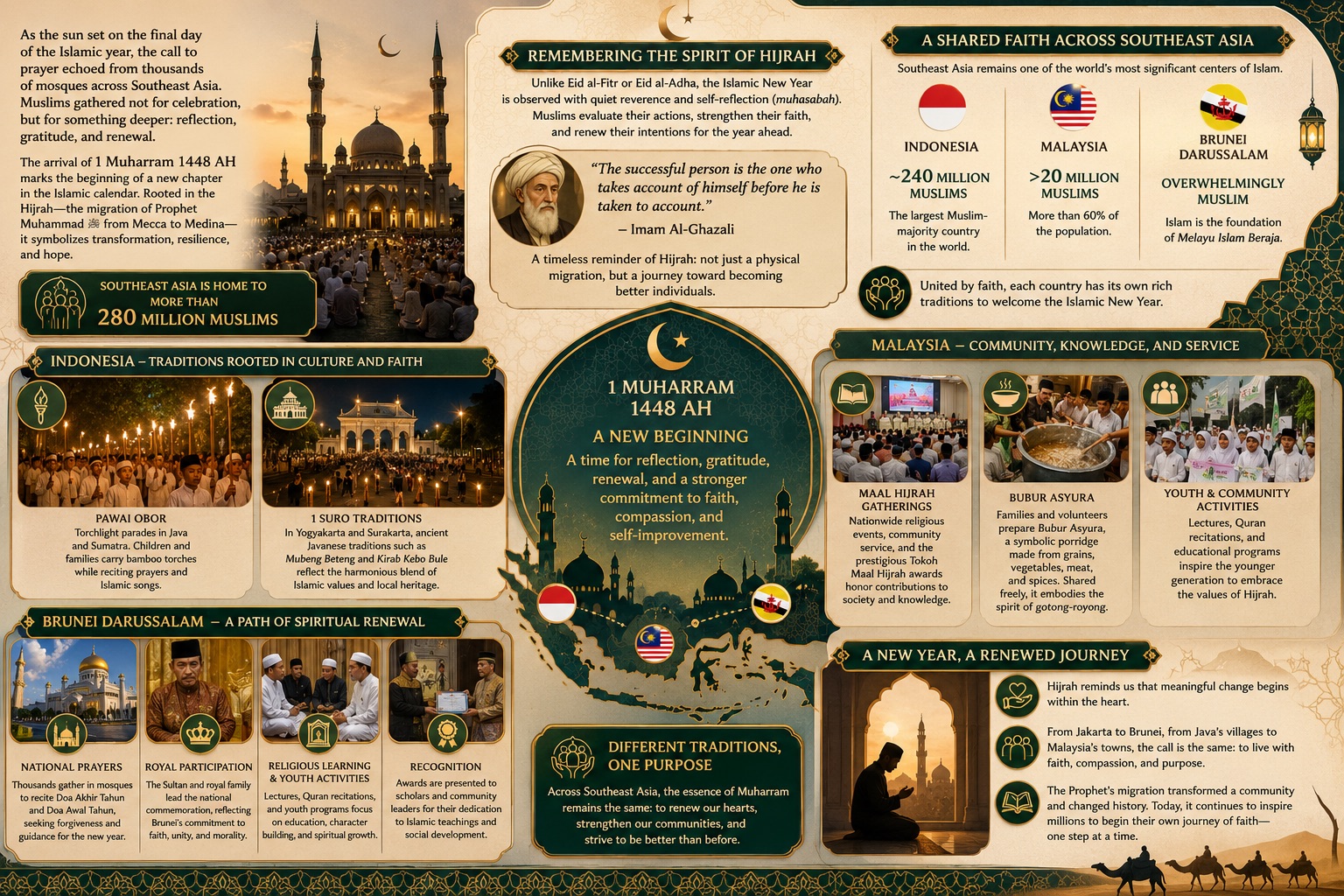
In Malaysia, the occasion was known as Maal Hijrah and was commemorated through nationwide religious gatherings, community service activities, and the prestigious Tokoh Maal Hijrah awards. The annual recognition celebrated individuals whose contributions to scholarship, science, social development, and community service embodied the values of Hijrah in contemporary society.
Across towns and villages, another cherished tradition brought communities together. Families and volunteers spent hours preparing Bubur Asyura, a symbolic porridge made from grains, vegetables, meat, and spices. Shared freely among neighbors, the dish reflected the spirit of gotong-royong and reminded communities that blessings are multiplied when shared.
Brunei's Path of Spiritual Renewal
In Brunei Darussalam, the Islamic New Year was observed with solemn dignity. Thousands gathered at mosques throughout the Sultanate to recite the Doa Akhir Tahun and Doa Awal Tahun, prayers seeking forgiveness for the past year and guidance for the one ahead.
The national commemoration was attended by Sultan Haji Hassanal Bolkiah and members of the royal family, reinforcing the country's commitment to faith, unity, and moral development. Religious lectures, Quran recitation programmes, and youth activities focused on helping the younger generation understand the relevance of Hijrah in modern life.
Rather than emphasizing public spectacle, Brunei's observance highlighted education, character building, and spiritual growth.
A New Year, A Renewed Journey
The Islamic New Year has always been about more than marking the passage of time. It is a reminder that meaningful change begins within the human heart. Whether through prayers in Jakarta, torchlight processions in Java, communal cookouts in Malaysia, or mosque gatherings in Brunei, the essence of Muharram remains the same: a commitment to becoming better than we were the year before.
As Southeast Asia entered another Islamic year, the lesson of Hijrah continued to resonate across generations. The migration of the Prophet ﷺ transformed a community and changed the course of history. More than fourteen centuries later, it continues to inspire millions to embark on their own journeys of faith, compassion, and self-improvement—one step at a time.


