


On August 15, 2026, World Honey Bee Day draws attention to some of Southeast Asia’s smallest yet most valuable workers. Across forests, farms and city gardens, native bees sustain food production, rural livelihoods and tropical biodiversity—often without receiving the recognition given to the region’s larger wildlife.
Small Wings, Bigger Harvests
Bees support many crops that define Southeast Asian agriculture, including mangoes, rambutan, coffee, coconut, dragon fruit and numerous vegetables. Globally, up to 30 percent of food consumption comes from plants that depend on bees and other insect pollinators. Healthy pollinator populations can improve not only crop yields but also fruit size, quality and genetic diversity.
Research led by the University of the Philippines Los Baños found that native stingless bees could increase mango harvests by as much as 49 percent. For smallholder farmers, this natural service reduces dependence on costly manual pollination while making farms more productive and resilient.
The relationship extends beyond cultivated land. Pollinated forest plants produce the seeds and fruits that feed birds, mammals and other wildlife. Protecting bees therefore supports an entire ecological chain stretching from rural orchards to ASEAN’s remaining rainforests.
Meet Southeast Asia’s Native Pollinators
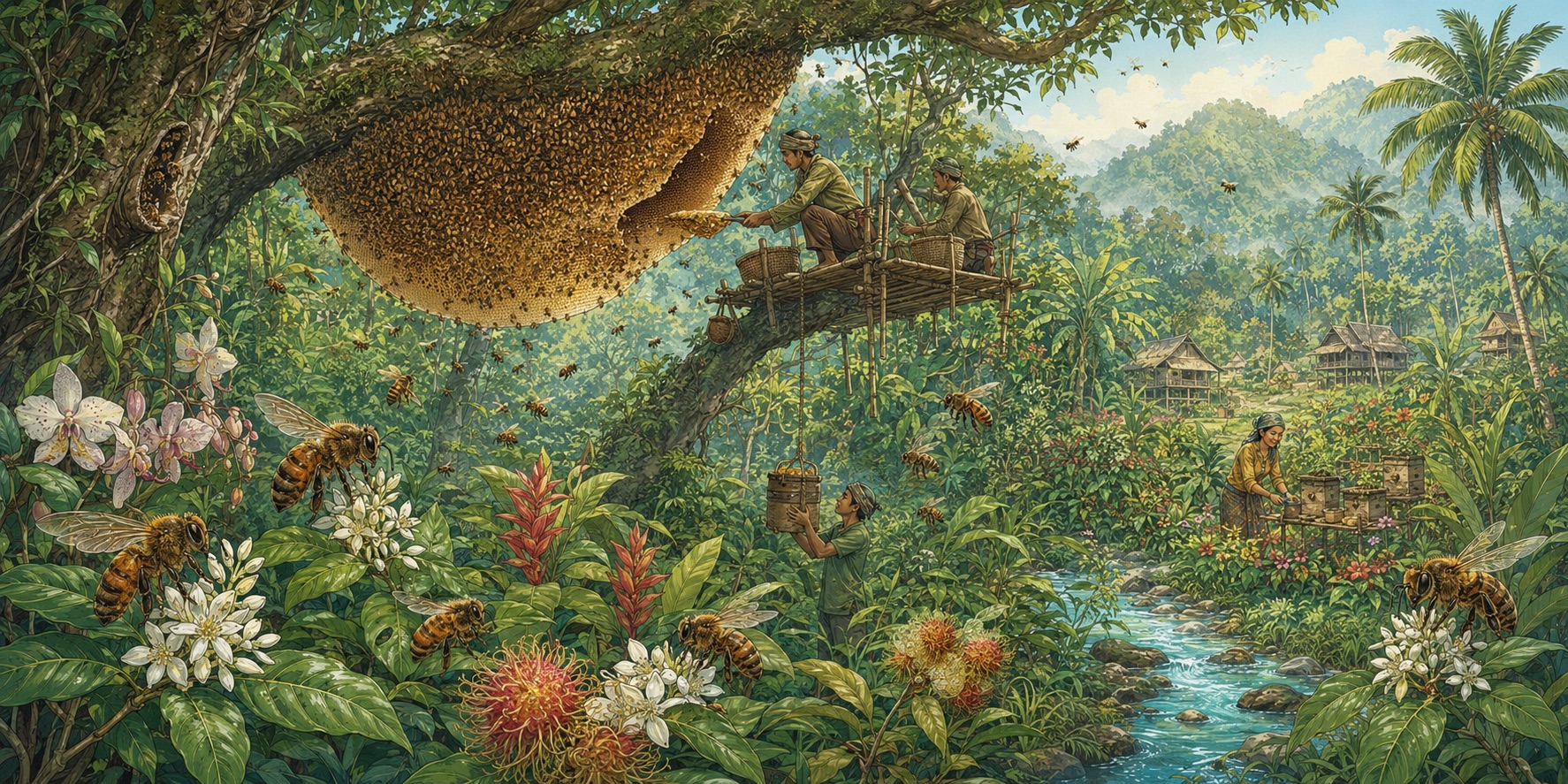
Southeast Asia is home to eight native honeybee species and about 80 species of stingless bees. Among the most spectacular is Apis dorsata, the giant Asian honeybee. Its colonies construct enormous exposed combs beneath cliffs and the branches of tall forest trees.
In Riau, Indonesia, the bees often nest in trees locally called sialang, with combs reaching approximately 1.5 metres across. Colonies may migrate over considerable distances as flowering seasons change, connecting forest ecosystems through pollination.
The region’s smaller stingless bees are known as kelulut in Malaysia and parts of Indonesia, and kiwot or lukot in the Philippines. Their tangy honey commands premium prices, but their greater value may lie in pollinating fruit trees, vegetables and native plants.
Thai native-bee specialist Dr Orawan Duangphakdee has observed that “native bees are much more resilient than Apis mellifera,” the introduced European honeybee. That resilience makes local species especially important as temperatures, rainfall patterns and flowering seasons become less predictable.
Honey Traditions Protect the Forest
From Sumatra and Kalimantan to Cambodia and the Philippines, forest communities have collected wild honey for generations. Traditional harvests involve climbing tall trees or approaching colonies at night, sometimes accompanied by chants, rituals and knowledge passed between generations.
These practices are evolving toward greater sustainability. Around Indonesia’s Ujung Kulon National Park, Koperasi Hanjuang has trained harvesters since 2016 to remove only the honey-bearing section of a comb while leaving the brood intact. This allows colonies to reproduce while providing families with income during difficult farming seasons.
Stingless-bee farming is also expanding into urban areas. During a 2025 expedition in Putrajaya, researchers confirmed three native species in one city park. Universiti Malaysia Terengganu’s Professor Shamsul Bahri Abd Razak said the aim was “to map the presence of native stingless bee species” and create “mutual learning between scientists and community practitioners.”
Turning Threats into Bee-Friendly Landscapes
Deforestation remains one of the greatest dangers. When mature nesting trees disappear, giant honeybees lose the elevated branches they need, while cavity-nesting species lose shelter. Monoculture plantations may provide abundant nectar briefly but leave bees without diverse food for the rest of the year.
Pesticides add another invisible threat. Bees exposed while foraging can become disoriented, fail to return to their colonies or carry contaminated pollen home. Forest and peatland fires compound the pressure by destroying flowers, nesting sites and migration routes.
Solutions are already emerging. Farmers can maintain flowering borders, adopt integrated pest management and protect trees used by wild colonies. Cities can expand pesticide-free gardens and map native bees through citizen science. Honey cooperatives can introduce traceability systems, while eco-tourism businesses can ensure that tasting tours directly support responsible beekeepers.
World Honey Bee Day is ultimately about more than honey. Protecting Southeast Asia’s native bees means securing harvests, strengthening rural economies and keeping forests capable of renewing themselves—one pollinated flower at a time.


