


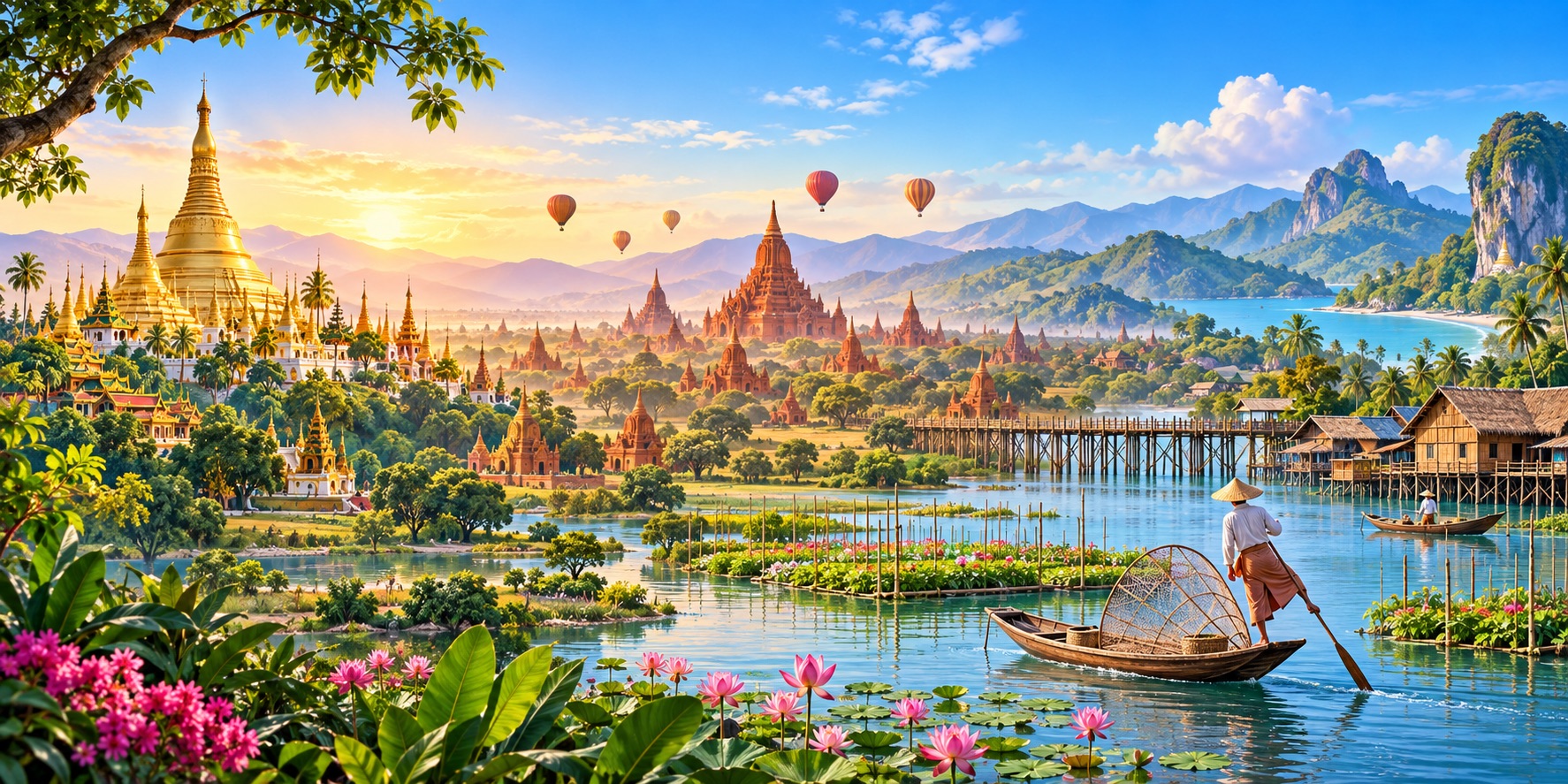
As daylight fades over Yangon, the Shwedagon Pagoda begins to glow above a city scented with incense, jasmine and tea. Farther north, Bagan’s brick temples stretch across the dry plain, while wooden boats continue to pass between floating gardens on Inle Lake. Myanmar retains one of Southeast Asia’s most extraordinary cultural landscapes, but experiencing it today requires honesty about the country’s difficult circumstances.
Beauty and Reality in the Same Frame
Myanmar welcomed 973,263 international visitors in 2025, down from more than 1.06 million in 2024 and far below the approximately 4.36 million recorded in 2019. Arrivals increased modestly during the first half of 2026, reaching 530,973 compared with 500,125 during the same period in 2025.
“We hope to welcome more foreign tourists in the coming years,” said U Myo Win Nyunt, deputy permanent secretary at the Ministry of Hotels and Tourism. He added that work was underway to renovate hotels and improve employee training.
Those ambitions exist alongside armed conflict, transportation disruptions and the continuing recovery from the devastating March 2025 earthquake. Tourism services may operate in several established destinations, but accessibility should never be mistaken for safety or stability.
Travel writer Merald Ayson captured this tension after visiting in late 2025: “Myanmar is one of the most beautiful places I’ve ever been. It is also one of the hardest.”
Yangon Shines Through Its Spiritual Heart
Yangon provides one of the most compelling introductions to Myanmar. Its streets combine Buddhist monasteries, colonial-era buildings, lively markets and teahouses where conversations unfold over small cups of sweet milk tea.
Rising 99 metres above the city, Shwedagon Pagoda remains its spiritual centre. The gold-covered stupa appears especially luminous around sunset, when worshippers walk barefoot across the marble platform, families light candles and devotees pour water over planetary posts associated with the day of their birth.
Beyond the pagoda, Yangon’s character emerges in local details: vendors preparing mohinga before sunrise, commuters dressed in longyi and residents wearing thanaka paste in delicate patterns across their cheeks. These everyday scenes give the city an identity that no monument can convey alone.
The pilgrimage site of Kyaiktiyo, known internationally as Golden Rock, adds another dimension to Myanmar’s sacred geography. The gilded boulder appears to balance above a mountain cliff, surrounded by pilgrims who arrive to pray, apply gold leaf and witness the landscape disappear into evening mist.
Bagan Carries a Thousand-Year Horizon
Across the central plains, Bagan remains Myanmar’s defining heritage destination. More than 2,000 surviving temples, stupas and monasteries form an archaeological landscape shaped by the kingdom that flourished between the 11th and 13th centuries.
At dawn, red-brick monuments gradually appear through the haze. By late afternoon, the plain turns shades of amber and terracotta. The experience is not confined to a single landmark; it comes from moving slowly between monumental temples, quiet village monasteries, lacquerware workshops and smaller structures standing almost alone among tamarind and palm trees.
Bagan’s tourism economy once supported large numbers of guides, drivers, artisans, restaurant workers and family-run guesthouses. Its decline therefore represents more than a loss of visitors. It has reduced incomes for communities whose livelihoods depend on sharing and protecting the region’s heritage.
Responsible tourism in Bagan should strengthen those local connections. Employing knowledgeable guides, purchasing directly from craftspeople and choosing locally operated services can keep a greater share of visitor spending within the community.
Traditions Continue Around Mandalay and Inle Lake
Mandalay has long been regarded as Myanmar’s cultural heartland. Its monasteries, workshops and former royal spaces preserve traditions of woodcarving, gold-leaf production, puppetry and Buddhist scholarship.
At Kuthodaw Pagoda, 729 marble slabs inscribed with Buddhist teachings are housed in individual white shrines, collectively celebrated as the “world’s largest book.” South of the city, U Bein Bridge crosses Taungthaman Lake on weathered teak posts. Its familiar silhouettes of monks, cyclists and villagers at sunset have become one of Myanmar’s most recognizable images.
The wider Mandalay region was heavily affected by the 2025 earthquake, making heritage restoration and community recovery central to its current story. Prospective visitors should verify the condition of individual sites and transportation services rather than relying on older itineraries.
Inle Lake presents a gentler rhythm. The Intha people are known for steering boats with one leg wrapped around an oar, leaving their hands free to handle fishing nets. Villages stand above the water on stilts, while floating gardens produce tomatoes and other crops from beds of vegetation anchored to the lake floor.
Traditional workshops add depth to the journey. Artisans transform fibres taken from lotus stems into rare textiles, while nearby communities maintain distinctive weaving, silversmithing and agricultural traditions. Protecting the lake’s water quality is essential if these livelihoods and cultural practices are to endure.
Wider Landscapes Await Safer Days
Myanmar’s tourism potential extends far beyond its best-known cultural circuit. Kalaw’s pine forests and cooler mountain air once made the former hill station a popular starting point for treks toward Inle Lake. Hpa-An offers limestone mountains, rice fields and sacred cave systems, including Sadan Cave, where passages lined with Buddhist images open toward a hidden lake.
Along the Bay of Bengal, Ngapali became known for its long beaches, coconut palms and fishing villages. Farther south, the Mergui Archipelago encompasses hundreds of islands, coral environments and the maritime heritage of Moken communities.
These regions remain important parts of Myanmar’s long-term tourism future, but present-day access can be limited or unsafe. Conflict, checkpoints, restricted areas, damaged infrastructure and seasonal weather may transform a familiar itinerary without warning. They should therefore be understood as cultural and natural assets awaiting safer conditions, not promoted uncritically as routine holiday routes.
A Country Experienced Through Its People
Myanmar’s strongest tourism stories often begin away from celebrated monuments. They unfold in tea shops, neighbourhood markets, workshops and family kitchens.
Mohinga, a fragrant fish-and-rice-noodle soup, is commonly eaten for breakfast but appears throughout the day. Lahpet thoke combines fermented tea leaves with garlic, sesame seeds, cabbage, tomatoes and crunchy pulses, creating one of the region’s most distinctive salads. Shan noodles, coconut noodle soup and regional curries reveal the country’s position between South, East and Southeast Asia.
The familiar longyi and fragrant thanaka paste similarly express traditions that remain part of contemporary life. When visitors approach these practices respectfully, cultural encounters can become exchanges rather than performances created only for tourism.
Responsible Travel Begins with Honest Information
As of September 2026, several governments continue to advise their citizens against travel to Myanmar because of armed conflict, arbitrary detention, landmines, limited healthcare and unpredictable restrictions. Australia advises travellers not to visit the country, while the United States and Canada maintain similarly strong warnings.
Anyone considering a journey should consult the latest official travel advice, confirm each route immediately before departure and obtain insurance that explicitly covers the destination and planned activities. Travellers should avoid political gatherings, military facilities, conflict-affected regions and unauthorized border routes.
Ethical spending also deserves consideration. Choosing independent guides, family-run restaurants, community enterprises and locally owned accommodation can direct more income toward ordinary people. Visitors should remain aware, however, that taxes, entrance fees and government-linked businesses may contribute revenue to state institutions. There is no completely simple choice, but informed decisions are better than treating the country’s political reality as invisible.
Myanmar’s temples, lakes, forests and living traditions have lost none of their ability to inspire. Yet the country’s tourism renewal ultimately depends on more than promotional campaigns or arrival targets. It requires peace, safer mobility, restored heritage and opportunities that genuinely benefit local communities. Until then, Myanmar’s golden horizons should be approached with admiration, patience and an unwavering respect for the people living beneath them.


