


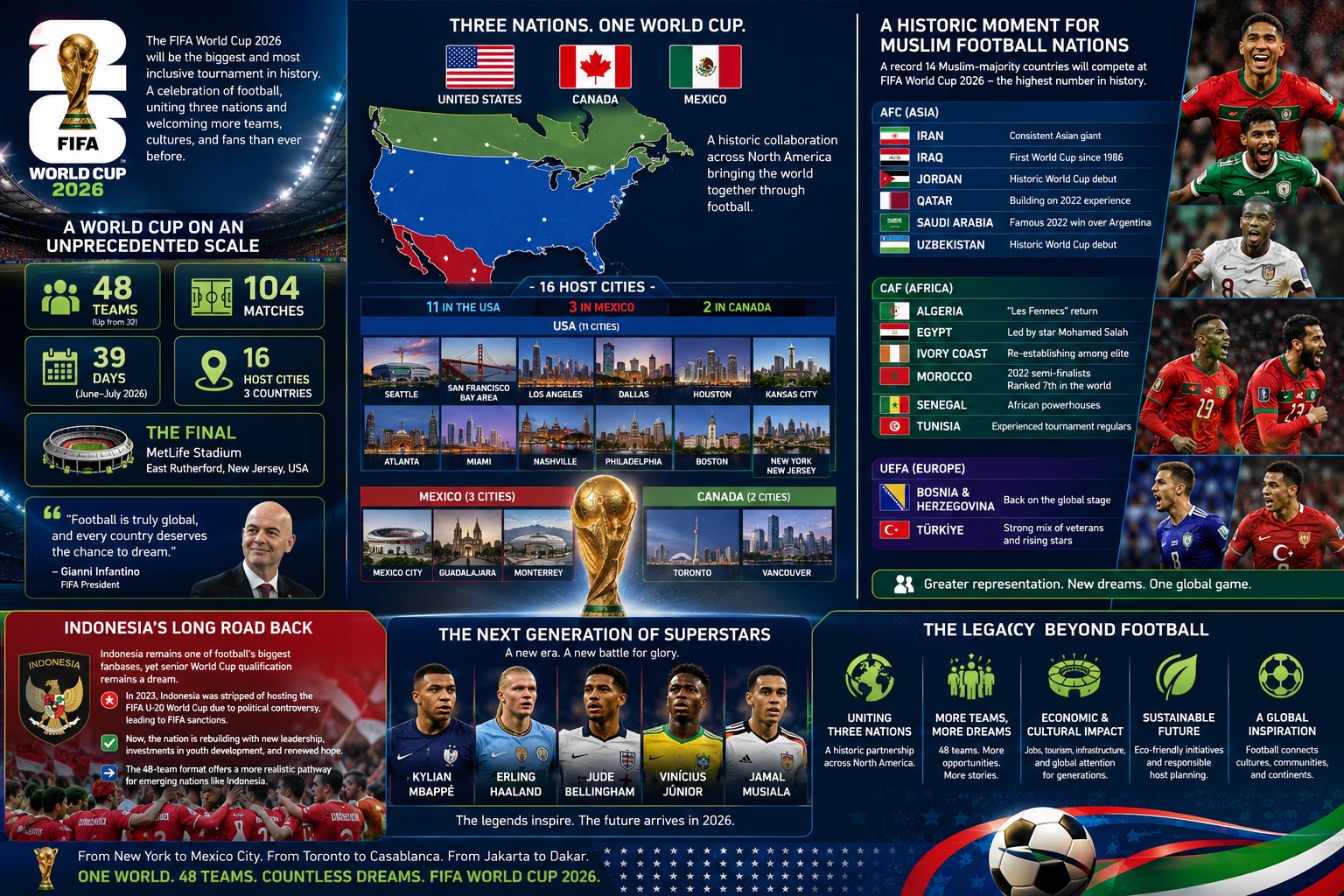
When the FIFA World Cup kicks off in June 2026, football will enter a new era unlike anything the sport has witnessed before. Stretching across three nations, sixteen host cities, and featuring a record 48 teams, the tournament will be the largest and most ambitious World Cup in history.
Hosted jointly by the United States, Canada, and Mexico, the 2026 edition represents more than an expansion of the competition. It reflects football's continuing transformation into a truly global game, one that increasingly embraces new nations, new cultures, and new generations of supporters.
For millions of fans around the world, the road to the World Cup has always been about dreams. In 2026, more countries than ever before will have the opportunity to live them.
A World Cup on an Unprecedented Scale
The numbers alone are staggering. The tournament will feature 48 national teams, up from the traditional 32, resulting in 104 matches played over 39 days across North America. Sixteen host cities will welcome supporters from every corner of the globe, while the final will be staged at MetLife Stadium in East Rutherford, New Jersey.
FIFA President Gianni Infantino has repeatedly described the tournament as an opportunity to make football more inclusive and accessible. "Football is truly global, and every country deserves the chance to dream," he remarked when defending the expansion.
Supporters of the new format argue that it opens the door to emerging football nations that previously struggled to qualify. Critics worry about competitive balance and scheduling demands. Yet regardless of where one stands in the debate, the expanded format has already produced one undeniable outcome: greater representation.
Nowhere is that more evident than among the growing number of Muslim-majority nations heading to the tournament.
A Historic Moment for Muslim Football Nations
The FIFA World Cup 2026 will feature a record 14 Muslim-majority countries, the highest number in World Cup history.
The list spans three continents and includes Iran, Iraq, Jordan, Qatar, Saudi Arabia, Uzbekistan, Algeria, Egypt, Ivory Coast, Morocco, Senegal, Tunisia, Bosnia and Herzegovina, and Türkiye.
Several of these stories are historic. Jordan and Uzbekistan have qualified for their first-ever FIFA World Cup, marking a breakthrough moment for two nations that have spent decades developing their football programmes.
For Iraq, qualification represents a return to football's biggest stage for the first time since 1986. For Morocco, expectations are extraordinarily high after becoming the first African and Arab nation to reach the semi-finals of a World Cup during Qatar 2022.
Moroccan star Achraf Hakimi once said, "We showed the world that dreams can come true." That sentiment continues to resonate throughout the footballing world.
The strong presence of Muslim-majority nations also reflects broader shifts in global football. Investments in youth development, coaching infrastructure, and professional leagues across Asia, Africa, and the Middle East have begun producing tangible results on the international stage.
North America Takes Center Stage
For the host nations, the World Cup is expected to generate enormous economic and cultural benefits.
Millions of international visitors are projected to travel throughout the United States, Canada, and Mexico during the tournament. Cities are investing heavily in transportation, security coordination, and stadium infrastructure to accommodate the largest sporting event ever held on the continent.
Canadian Prime Minister Justin Trudeau previously described the World Cup as "an opportunity to showcase Canada's diversity and openness to the world," while Mexican leaders have emphasized the country's long football tradition dating back to its hosting duties in 1970 and 1986.
The tournament will also serve as a platform for a new generation of football superstars. As icons such as Lionel Messi and Cristiano Ronaldo approach the final chapters of their careers, players like Kylian Mbappé, Jude Bellingham, Erling Haaland, Vinícius Júnior, and Jamal Musiala are expected to define the next era of the sport.
Indonesia's Long Road Back
For Indonesia, the World Cup carries a particularly emotional significance.
The country remains one of football's largest fan bases, yet qualification for the senior FIFA World Cup remains an unfulfilled dream. Indonesian football supporters also remember the disappointment of 2023, when FIFA removed Indonesia as host of the FIFA U-20 World Cup following political controversy surrounding the participation of Israel.
The decision resulted in sanctions from FIFA and dealt a major setback to Indonesia's ambitions of becoming a regional football hub.
Yet Indonesian football has continued moving forward. The national team's recent progress under new leadership, combined with growing investments in youth development and infrastructure, has reignited optimism among supporters.
The expanded 48-team format may also provide emerging football nations such as Indonesia with a more realistic pathway toward future qualification.
The Legacy Beyond Football
Every World Cup leaves a legacy. Some are remembered for unforgettable goals, dramatic upsets, or legendary players. Others are remembered for changing the sport itself.
The FIFA World Cup 2026 may ultimately be remembered for expanding football's horizons.
It is a tournament that connects three countries, welcomes more nations than ever before, and gives new football cultures an opportunity to compete on the world's biggest stage. It demonstrates that football's future is increasingly diverse, global, and inclusive.
As the world prepares for kickoff, one thing is already certain. Whether in New York, Mexico City, Toronto, Casablanca, Amman, Tashkent, Jakarta, or Dakar, millions of people will share the same hope.
That for a few weeks in the summer of 2026, football can once again unite the world through a common language of passion, pride, and possibility.


