


At the 10th ASEAN Media Forum's closing panel, industry, law and scholarship converged on one point: the region's economic future runs through waters it does not fully control.
"No shipping, no shopping." It is a line Mohamed Safwan bin Othman, chairman of the Federation of ASEAN Shipowners' Associations (FASA), said is used often in his industry, and one that understates a straightforward fact: more than 80 percent of global merchandise trade by volume moves by sea.
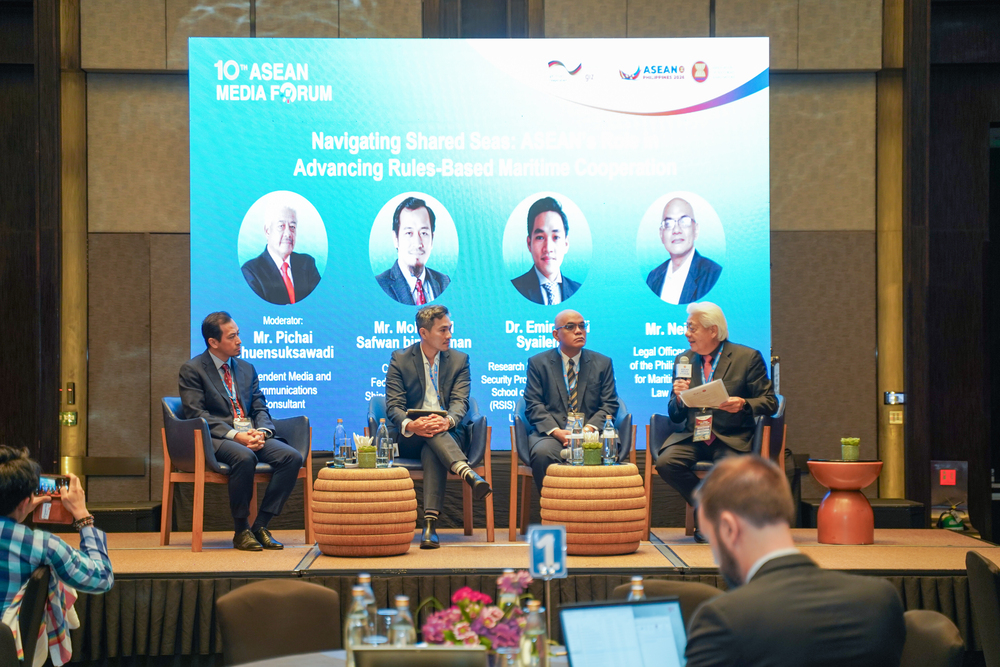
Safwan opened with it at the close of the 10th ASEAN Media Forum, held July 29 to 30, 2026 at the Hilton Manila Newport World Resorts. The forum's final session of the two day programme, "Navigating Shared Seas: ASEAN's Role in Advancing Rules Based Maritime Cooperation," moderated by Pichai Chuensuksawadi, former editor in chief of the Bangkok Post, turned from politics to the sea, pairing Safwan's industry view with a maritime security scholar and a maritime law specialist to unpack how ASEAN manages a domain it depends on more than it governs.
The trillion dollar backbone
FASA's presentation put ASEAN's stake in concrete terms. The region's trade is valued at roughly USD 4.4 trillion, moved in large part by a fleet FASA estimates at around 10,000 merchant vessels. Shipping and its supporting industries employ an estimated 1.5 million people region wide and run through more than 500 seaports, according to figures FASA cited from the UN Economic and Social Commission for Asia and the Pacific (August 2025). The Philippines alone accounts for close to 18 percent of the world's seafaring workforce, and together with Indonesia and other member states, ASEAN supplies close to a quarter of the world's maritime labor force.
Safwan's framing was that shipping functions for ASEAN's economy the way roads, power grids and digital networks function on land: unglamorous infrastructure that everything else depends on.
A stress test from the Middle East
Recent disruptions in the Gulf and Red Sea gave the panel a live case study. As vessels diverted around the Cape of Good Hope to avoid security risks, global ton mile demand, a measure combining cargo volume and distance, rose nearly 6 percent in 2024. FASA's presentation cited a roughly threefold increase in container freight rates over the same period, alongside oil supply controls and rationing in affected markets. The disrupted routes carried a significant share of global trade in crude oil and fertilizer, underscoring how a conflict outside ASEAN's waters can still reach its food and energy security.
The panel's read on the episode was not alarmist. The consistent point, across FASA and the scholarly and legal speakers, was that resilience comes from diversification and coordinated planning before a disruption hits, not after.
The choke point beneath the slogan
Much of the discussion centered on the Straits of Malacca and Singapore, the passage FASA's presentation credited with carrying 28 percent of global trade, roughly 90,000 vessel transits a year, and about 35 percent of the world's seaborne oil, citing Deloitte & Touche (2026). Separate figures raised elsewhere in the discussion put the straits' share of world trade above 20 percent and yearly transits near 100,000, a reminder that estimates vary by methodology even when the conclusion, that this is one of the world's most consequential shipping lanes, does not.
Panelists also broadened what a "choke point" means beyond geography. Insurance markets concentrated in London, cyber infrastructure and information systems were described as functional choke points of their own: single points of failure that can disrupt shipping without a ship ever changing course. Speakers pointed to piracy and armed robbery incidents in the Malacca and Singapore straits, which have trended down over roughly five to six years, as evidence that information sharing centers, technical working groups and trilateral cooperation between Indonesia, Malaysia and the Philippines can produce measurable results even without a regional treaty behind them.
The legal contest over restraint
Neil Silva, legal officer at the University of the Philippines Institute for Maritime Affairs and Law of the Sea, centered his contribution on what the 2016 arbitral ruling in the Philippines v. China case actually settled, and what it left open. The tribunal invalidated certain expansive maritime claims and clarified how features should be classified under the UN Convention on the Law of the Sea (UNCLOS), which the panel described as the foundational legal framework for maritime rights and dispute resolution. What the ruling did not do was resolve underlying territorial sovereignty disputes. Silva's point was that this distinction, entitlement disputes as separate from sovereignty disputes, is what gives claimant states room to negotiate over overlapping waters without having to resolve who owns what first.
That legal segmentation also underpins the idea of the South China Sea as a "semi enclosed sea" under UNCLOS Part IX, a classification that creates a basis for regional cooperation on environmental and fisheries issues independent of the territorial disputes layered on top.
Silva's broader argument concerned what a Code of Conduct needs to get right rather than just how it starts. In his view, a workable CoC has to reinforce UNCLOS rather than work around it: it should preserve access to third party dispute settlement, avoid carving out alternative legal norms, and stop short of reopening questions the 2016 tribunal already settled. Get that wrong, he suggested, and the CoC risks becoming a vehicle for renegotiating maritime rules through power politics rather than reinforcing the legal order already in place.
Dr. Emirza Adi Syailendra, research fellow at the Maritime Security Programme of the S. Rajaratnam School of International Studies (RSIS), Nanyang Technological University, pushed back on how the Code of Conduct (CoC) negotiations are typically covered. His argument was that portraying ASEAN as a passive party waiting on great power dynamics understates the extent to which the bloc is already writing practical rules through arbitration driven legal practice and parallel cooperation mechanisms. He cited a recent case, a Jakarta based conference that reportedly lost government sponsorship after perceived pressure from Beijing, as an example of a story often told as evidence of external leverage over ASEAN, when panelists argued the more significant story is how much regional rule making activity continues regardless.
Much of the CoC's difficulty, the panel agreed, comes down to a single word: restraint. Three competing readings surfaced in discussion. One treats restraint historically, as a claim that things "could have been worse," a framing ASEAN states have generally rejected as insufficient. A second, associated with smaller claimant states such as the Philippines, calls for an outright elimination of the use of force. A third, described as "bounded resistance," would allow states to continue advancing claims but within agreed limits, a position some claimants see as more realistic. Until negotiators converge on one of these, panelists suggested, the CoC's drafting will keep stalling on language rather than intent.
Cooperation that does not wait for a treaty
The panel's more optimistic thread was that ASEAN does not need the CoC finished to keep cooperating. The blue economy, covering non-living resource extraction, fisheries, offshore energy, tourism and maritime trade, was cited as an area where externally financed programs, such as Global Environment Facility funding for South China Sea projects, can advance biodiversity and habitat protection without reopening territorial arguments. Existing legal tools, including ASEAN mutual legal assistance arrangements and ReCAAP style information centers, already support cross border investigation and prosecution of maritime crime syndicates.
Decarbonization was flagged as the harder near term test. The International Maritime Organization's net zero framework will apply to ships responsible for roughly 85 percent of international shipping emissions, and FASA noted that more than half of new vessel orders are now capable of running on alternative fuels. Progress, the panel agreed, depends on fuel availability, port readiness and regulatory alignment across ASEAN moving at the same pace as the ships themselves.
The line that outlasted the panel
The session closed on Safwan's own summary: that shipping connects ASEAN economically, socially and strategically, and that safeguarding sea lanes is inseparable from safeguarding the region's shared future. It is a tidier version of the same point the panel spent ninety minutes making from three different disciplines: the law can segment disputes, the industry can diversify routes and suppliers, and cooperation can run ahead of unresolved politics. But none of it changes the basic arithmetic Safwan opened with. No shipping, no shopping.
Figures on trade volumes, fleet size and chokepoint traffic are as presented at the forum by FASA, sourced to UNESCAP (August 2025) and Deloitte & Touche (2026) in the original presentation. Worth independent verification against the primary reports before publication.


