


Today, Laos is the only country in Southeast Asia without a coastline, landlocked between five neighbors: China, Viet Nam, Cambodia, Thailand, and Myanmar. Covering 236,800 square kilometers and home to around eight million people, it is one of the least densely populated countries in the region.
The image commonly associated with Laos is that of a small, mountainous, and landlocked nation.
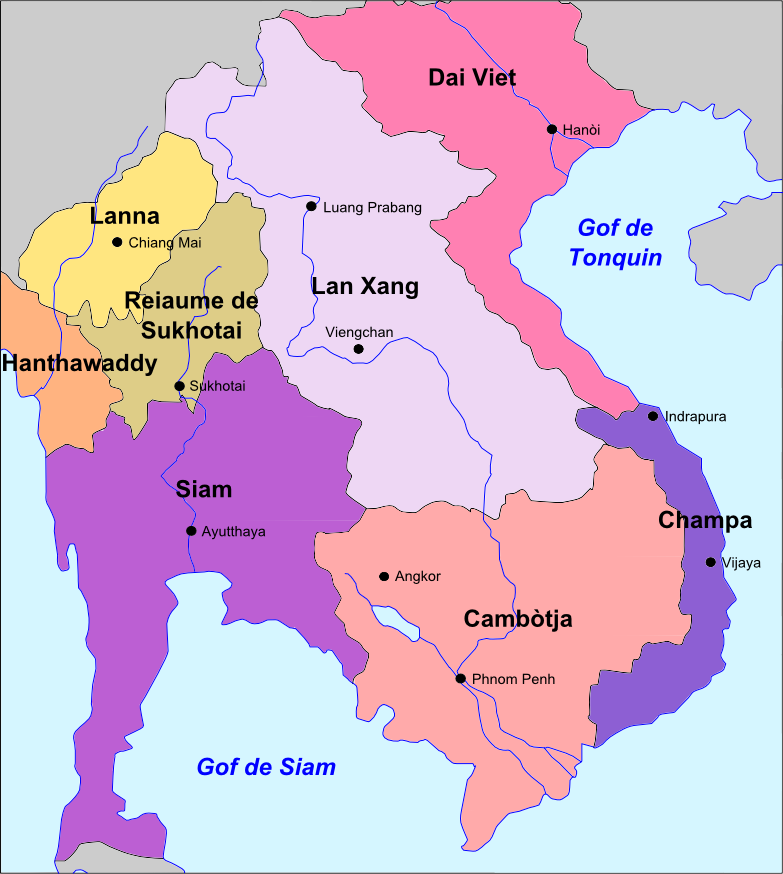
But six centuries ago, the map looked very different. From Luang Prabang, an exiled prince named Fa Ngum established a kingdom whose authority extended across territories that today belong to several of its neighboring states.
The kingdom was called Lan Xang, meaning "The Land of a Million Elephants." The territory once governed from the banks of the Mekong River is now divided among multiple modern countries.
The Birth of Lan Xang
Fa Ngum was born in 1316 as the grandson of the ruler of Muang Swa, later known as Luang Prabang. Following a royal court dispute, his family fled to the Khmer capital of Angkor, where Fa Ngum was raised and later married a Khmer princess.
Around 1350, he and his father assembled an army in Cambodia and began conquering a series of small kingdoms across the central and southern Mekong Valley.
In 1353, Fa Ngum captured Muang Swa, forced his grandfather to abdicate, and proclaimed himself king of the expanded realm he named Lan Xang. For the first time, a unified Lao state appeared on the map.
| Credit: Public Domain
Under Fa Ngum, the kingdom became wealthy and powerful, encompassing much of what is now Thailand and Laos. Its influence stretched from the border with China in the north to the lower Mekong in the south, and from the Viet Namese frontier in the east to the Khorat Plateau in the west, making it one of the largest kingdoms in Southeast Asia at the time.
Over the following two centuries, the kingdom continued to expand under Fa Ngum's successors. In the sixteenth century, King Setthathirat played a major role in establishing Buddhism as the kingdom's dominant religion.
For more than three and a half centuries, Lan Xang remained one of the principal powers of mainland Southeast Asia.
The End of an Empire
By the seventeenth century, Lan Xang had begun to decline. Dynastic disputes and conflicts with neighboring states weakened the kingdom from within.
The once-unified realm eventually fragmented into three principalities centered on Luang Prabang in the north, Vientiane in the center, and Champasak in the south. These smaller kingdoms continued to compete with one another throughout the eighteenth century, and their disunity ultimately left them vulnerable to domination by Siam by the end of that century.
In 1827, King Anouvong launched a rebellion against Siam with the aim of reunifying the former territories of Lan Xang.
The uprising failed. Vientiane was destroyed, and in 1828 the city was incorporated as a province of Siam.
Several decades later, a new power arrived. France, which had already established a protectorate over Viet Nam, began expanding into Lao territories on the grounds that it had inherited Viet Nam's claims to those states.
In 1893, French warships demonstrated their military strength off the coast of Bangkok, compelling Siam to withdraw from the eastern bank of the Mekong River and recognize a French protectorate over the region.
The annexation was completed through further agreements with Siam in 1904 and 1907. The Kingdom of a Million Elephants was transformed into a colonial territory divided and redrawn by outside powers.
The Laos we know today emerged from that process: a landlocked country covering 236,800 square kilometers, far smaller than the territory once governed from Luang Prabang. A kingdom that had once extended into lands now belonging to its neighbors became one of the smallest and least densely populated states in Southeast Asia.


