


As global power dynamics continue to evolve, ASEAN and Russia marked an important milestone in their relationship at the ASEAN–Russia Summit held in Kazan, Russia, from 17–19 June 2026. Celebrating the 35th anniversary of ASEAN–Russia relations, the gathering brought together leaders and senior officials from across Southeast Asia and Russia to reaffirm their commitment to dialogue, cooperation, and a shared vision for a more balanced international order.
Held in the historic city of Kazan, the summit highlighted both the achievements of the past three and a half decades and the opportunities that lie ahead. Against a backdrop of geopolitical uncertainty, economic transformation, and technological disruption, ASEAN and Russia demonstrated their willingness to deepen engagement while preserving their respective strategic interests.
Thirty-Five Years of Partnership
Established in 1991, ASEAN–Russia relations have evolved from diplomatic dialogue into a multifaceted partnership spanning political cooperation, trade, education, culture, science, and security. The 2026 summit was co-chaired by Russian President Vladimir Putin and Philippine President Ferdinand Marcos Jr., whose country currently holds the ASEAN Chairmanship.
The meeting was attended by leaders and representatives from ASEAN member states, including newly admitted Timor-Leste. Indonesia was represented by Foreign Minister Sugiono, while Myanmar participated at the level of a Ministry of Foreign Affairs official in line with ASEAN's existing consensus regarding the country's political situation.
In his remarks, President Putin reiterated Russia's commitment to ASEAN, noting that the organization remains "one of the key centers of a multipolar world order." His statement reflected Moscow's long-standing view that Southeast Asia plays an increasingly important role in shaping the future global landscape.
The Kazan Declaration and a New Roadmap
One of the summit's most significant outcomes was the adoption of the Kazan Declaration 2026, titled "ASEAN–Russian Federation: Unity in Diversity – 35 Years Together." The document outlined a shared vision for strengthening cooperation based on international law, sovereign equality, mutual respect, and peaceful dialogue.
Leaders also endorsed the Comprehensive Plan of Action 2026–2030, a five-year roadmap designed to accelerate cooperation across political-security, economic, and socio-cultural pillars. The plan provides a framework for expanding engagement in areas ranging from trade and investment to education, innovation, and cultural exchange.
Additional sectoral statements focused on energy cooperation and cultural collaboration, reflecting a growing recognition that sustainable development and people-to-people ties are essential components of long-term partnership.
From Energy Security to Digital Transformation
Economic resilience emerged as one of the summit's central themes. With global supply chains facing continued disruptions, ASEAN and Russia discussed ways to strengthen cooperation in food security, fertilizer supplies, sustainable agriculture, and energy diversification.
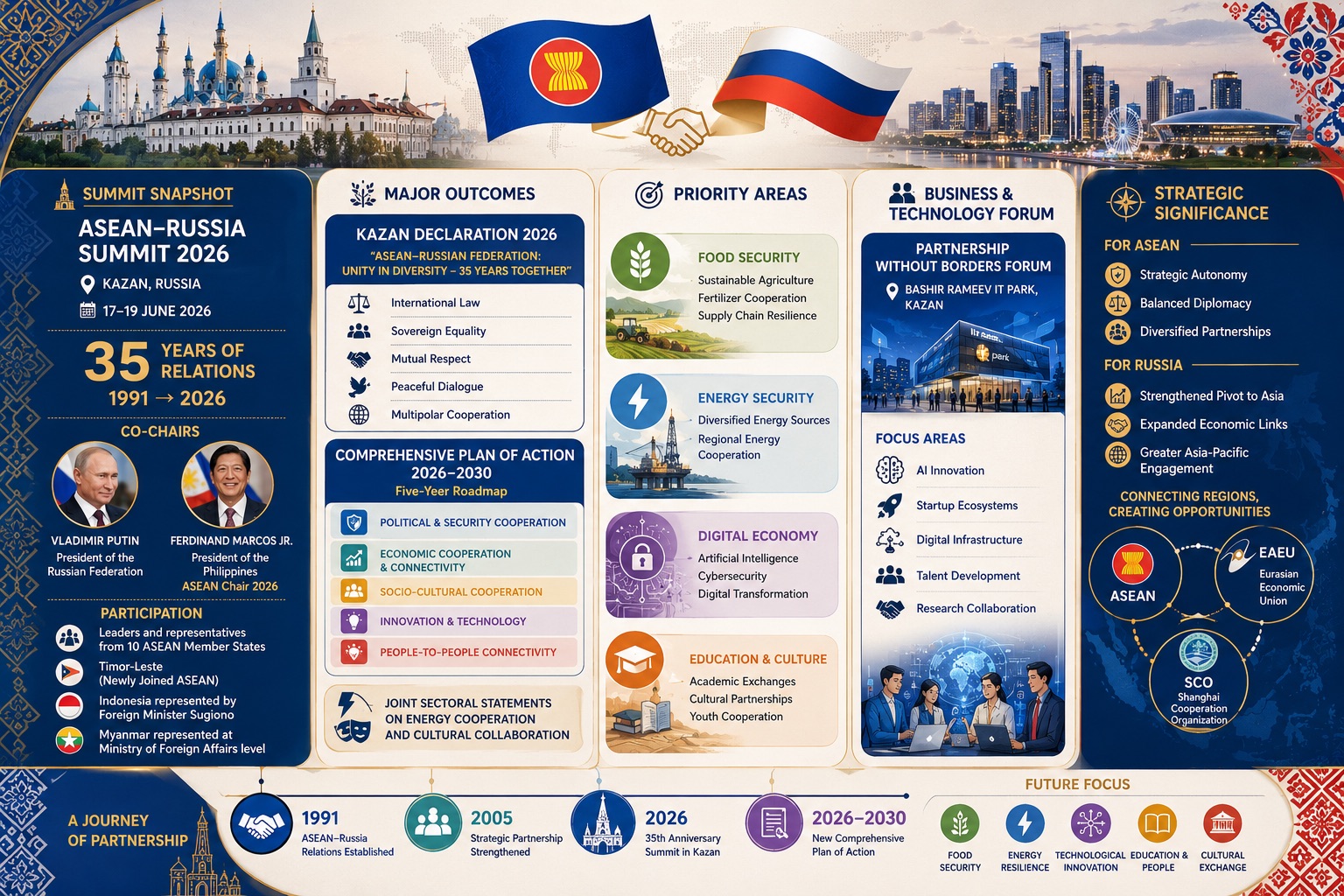
At the same time, technology featured prominently on the agenda. Discussions were preceded by the "Partnership Without Borders" business forum at Kazan's Bashir Rameev IT Park, where government officials, technology leaders, and entrepreneurs explored opportunities in artificial intelligence, cybersecurity, and digital transformation.
These conversations reflected a growing understanding that future competitiveness will increasingly depend on innovation and technological collaboration. For ASEAN's rapidly growing digital economy and Russia's expanding technology sector, new opportunities are emerging in research, talent development, and digital infrastructure.
Strategic Autonomy in a Multipolar World
Beyond economics, the summit also carried significant geopolitical implications. For ASEAN, engagement with Russia reflects the region's long-standing commitment to strategic autonomy and balanced diplomacy. As competition between major powers continues to intensify, Southeast Asian nations have consistently sought to maintain constructive relations with multiple partners rather than align exclusively with any single bloc.
For Russia, the summit represented another step in its broader pivot toward Asia. The strong participation in Kazan demonstrated that Moscow continues to view ASEAN as a valuable partner in its efforts to expand economic and diplomatic engagement across the Asia-Pacific region.
The discussions also highlighted increasing dialogue between ASEAN and Eurasian institutions such as the Eurasian Economic Union and the Shanghai Cooperation Organization, opening new possibilities for connectivity and economic cooperation across a wider Eurasian landscape.
Charting the Next Chapter of ASEAN–Russia Cooperation
While challenges remain—including geopolitical uncertainties, trade barriers, and differing national priorities—the atmosphere in Kazan suggested that both ASEAN and Russia see considerable value in strengthening their partnership.
As they enter their fourth decade of cooperation, ASEAN and Russia appear increasingly focused on practical collaboration in areas that directly affect the lives of their citizens: food security, energy resilience, technological innovation, education, and cultural exchange. The Kazan Summit demonstrated that despite a rapidly changing international environment, dialogue remains an essential tool for building trust and identifying common interests.
Thirty-five years after establishing relations, ASEAN and Russia continue to chart a partnership that is evolving with the times. The road ahead may be complex, but the foundations laid in Kazan suggest that both sides are prepared to explore new opportunities together in an increasingly interconnected and multipolar world.


