Indonesia and Thailand share a common feature on their three-wheeled auto rickshaw. Both vehicles utilize the same basic three-wheeled blueprint to cut through dense urban traffic, but they actually have significantly different vibes.
The design choices, driving styles, and daily roles of the Indonesian Bajaj and the Thai Tuk-Tuk have created two distinct street cultures.
Enclosed Protection vs Open Air Freedom
The most striking difference lies in their physical construction. Indonesia’s Bajaj features a highly enclosed cabin with a solid wateproof canvas material roof.
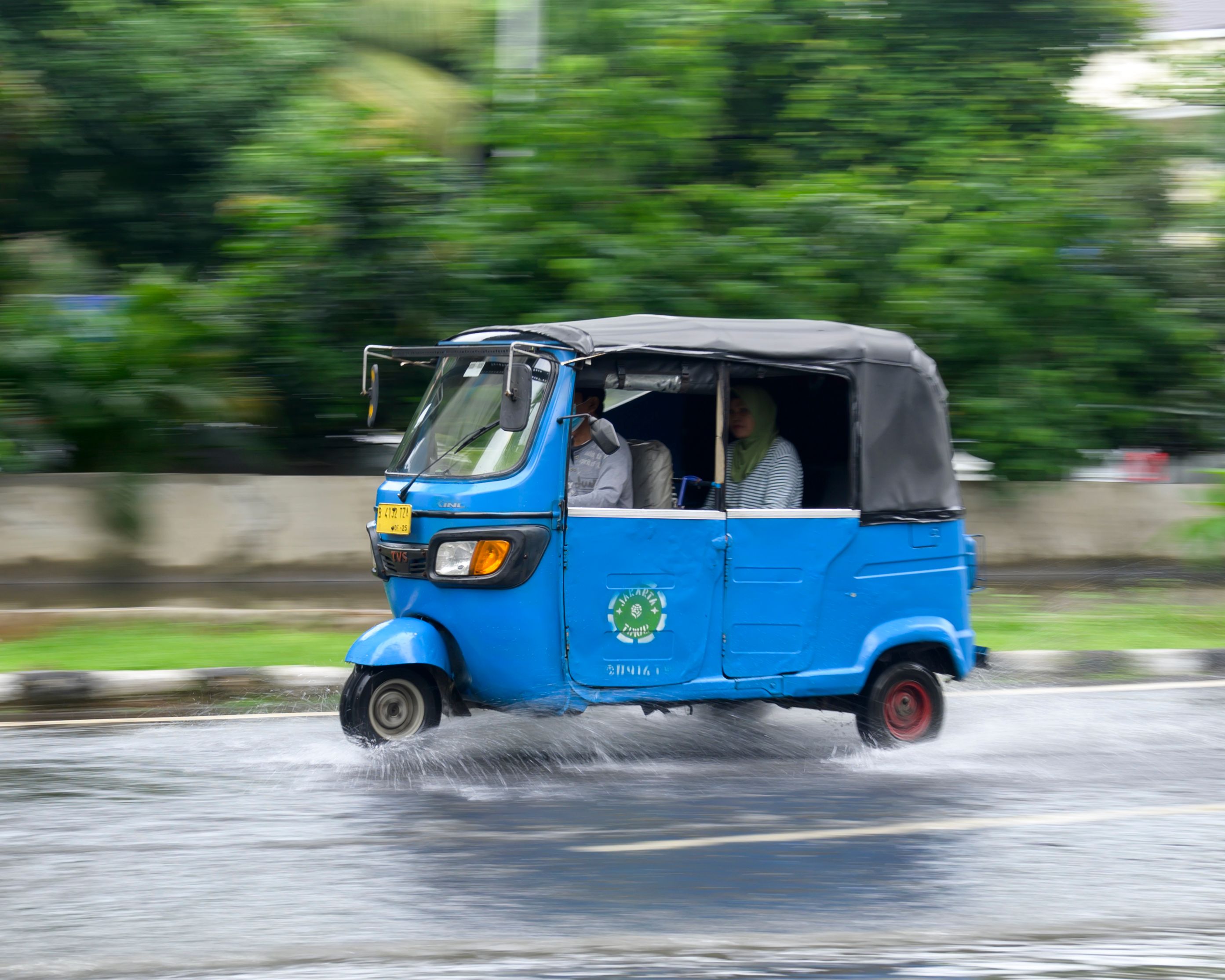
The built-in frame acts as a compact weather shield against unpredictable tropical downpours while serving as a safety standard to keep passengers securely inside during sudden turns. Drivers often customize these small windows with dark tint to block out the intense midday sun.

Thailand’s Tuk-Tuk rejects this enclosed approach entirely. It commonly opts for a wide, open-air chassis completely devoid of side doors, paired with a passenger seat positioned slightly high under a sweeping canopy.
Tuk-Tuk design deliberately allows the city breeze to rush over passengers, offering an immersive but exposed ride. The exterior is usually coated in bright, dual-tone metallic paint jobs, making them instantly stand out against the standard city traffic.
Local Alley Crawlers vs High Speed Adrenaline
On the road, these two auto rickshaws serve two very different commuting styles. The Bajaj is the ultimate master of shortcuts, built specifically to weave between tightly packed cars and slip through the narrowest residential alleys.
@bang_jay84 Dah Lama gak pernah naik bajaj,sekalinya naik bajaj malah bajaj racing.....😅😅😅
♬ original sound - Yama Lover 🛵
The Tuk-Tuk, on the other hand, operates with a much more aggressive street presence. Its drivers are notoriously famous for being highly daring speedsters, maneuvering through major intersections with incredible skill.
Instead of crawling through quiet neighborhoods, the Tuk-Tuk commands the main avenues, offering a high-pitched engine roar that doubles as an adrenaline rush for anyone on board.
Practical Drops vs Premium Tourist Packages
The way these vehicles do business also sets them apart. The Bajaj works as a practical, short-distance carrier within local commercial zones.
Passengers routinely bargain face-to-face with the driver right on the pavement before stepping into the cramped cabin with a very traditional way. It functions strictly as a no-frills tool for point-to-point urban transit.
Conversely, the Tuk-Tuk has significantly shifted into a premium recreational experience tailored for global travelers. Fares are significantly higher than standard public transport like Songthaew. In some occasions, Tuk-Tuk rides are also frequently bundled into specialized tour packages.
Urban Workhorse vs Cultural Icon
@berkah_abadi_bajaj night ride bajaj orange jalan jalan.. . . . . . . . . . . . #bajajorange #bajajrephilipines #bajajrodatiga #bajajthailook🔥🇹🇭🇹🇭🇹🇭 #bajajpastilebihkuat #bajajjakarta #bajajmerahwarnanya #bajajrejakarta #servicebajajorange #indonesia🇮🇩 #bajajjakartapusat #bajajbajuri #endemicjakarta #berkahabadibajaj #bajajjakartapusat #bajajorange2tak #bajajorangebandung #bekasiorasepele ♬ GOAT - Bazanji
This visual gap becomes even more obvious after sunset. Nighttime in Indonesia sees the Bajaj fading quietly into the background of commuter traffic, its standard headlights just clearing the way as a simple tool to get from one block to the next.
@jeremy.stowell first tuk tuk ride in bangkok.. #thailand🇹🇭 #bangkok #tuktuk ♬ Good Day - Nappy Roots
Thailand tells a completely different story on the pavement. The Tuk-Tuk transforms into a moving light show under the neon signs of the city, where pink and blue lights reflect off the shiny metal body. This has become a part of the city’s nightlife marketing.