


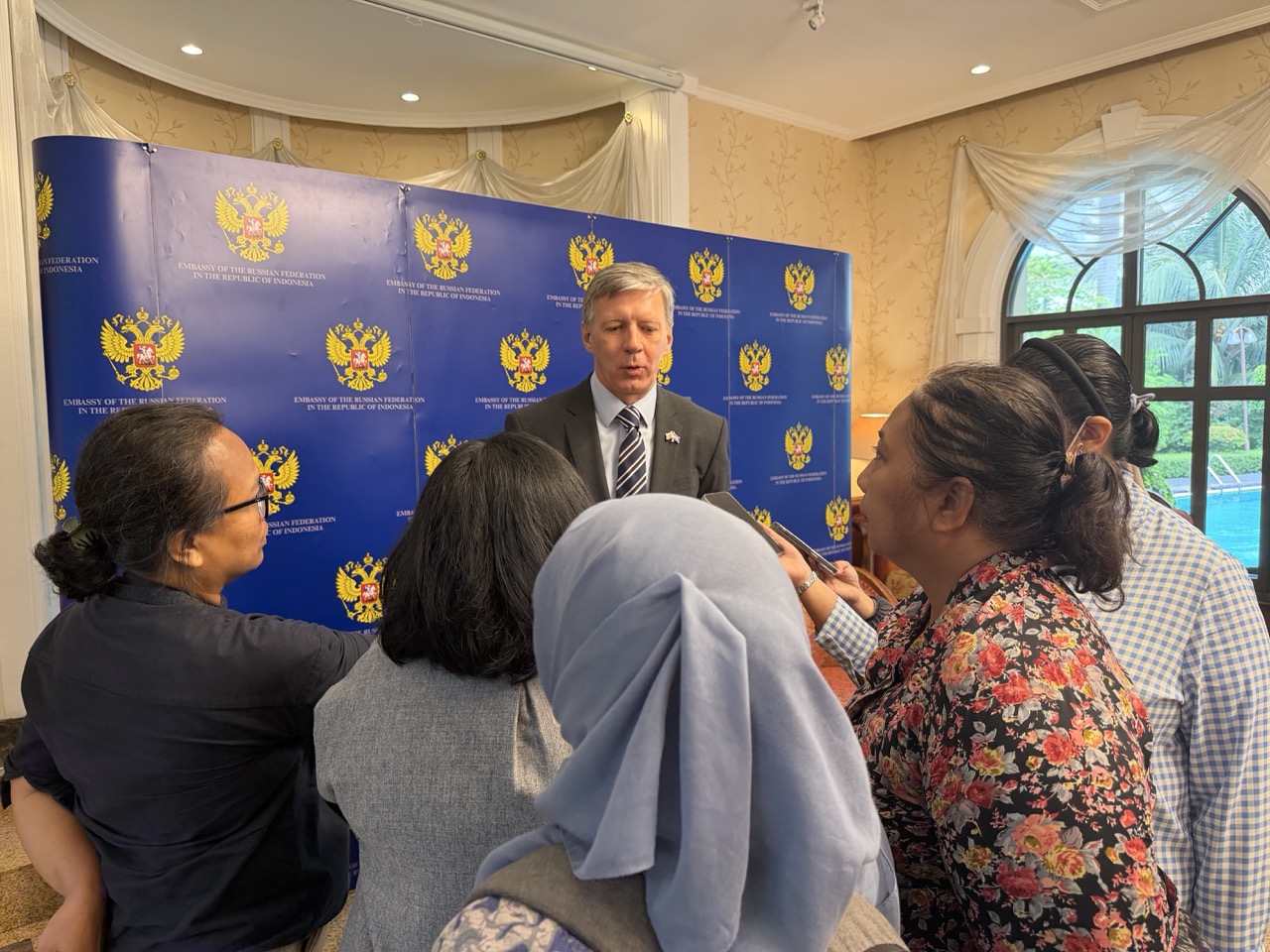
As media workers and journalists gathered at the Residence of the Ambassador of the Russian Federation to Indonesia on June 24, 2026—alongside the two ambassadors and Russian diplomats—the joint briefing by Russian Ambassador to Indonesia Sergei Tolchenov and Russian Ambassador to ASEAN Evgeny Zagaynov reflected more than a routine diplomatic engagement. It highlighted a relationship that has gained remarkable momentum throughout the first half of 2026, with Indonesia and Russia expanding cooperation across politics, trade, energy, education, defense, and regional diplomacy, while ASEAN-Russia relations entered a new chapter through an ambitious long-term partnership agenda.
The briefing came at a time when both bilateral and multilateral engagements have accelerated significantly, underscoring Russia's growing engagement with Southeast Asia and Indonesia's increasingly active role in shaping regional cooperation amid a rapidly evolving global landscape.
From Diplomatic Friendship to Strategic Partnership
The first six months of 2026 marked one of the most active periods in Indonesia-Russia relations in recent decades. The year also commemorated the 76th anniversary of diplomatic relations between the two countries, providing fresh momentum for cooperation built on decades of mutual respect.
A major milestone occurred in April when President Prabowo Subianto met President Vladimir Putin at the Kremlin. During their extensive discussions, both leaders reaffirmed their commitment to elevating Indonesia-Russia relations into a stronger strategic partnership, emphasizing cooperation in trade, industrial development, infrastructure, defense, education, energy, and technology.
President Putin described Indonesia as "one of Russia's key partners in the Asia-Pacific region," while expressing confidence that bilateral cooperation would continue expanding across strategic sectors.
President Prabowo similarly emphasized Indonesia's commitment to strengthening practical cooperation with Russia, noting that both countries possess significant opportunities to work together in achieving sustainable economic growth and regional stability.
The presidential meeting set the tone for an exceptionally active diplomatic calendar that followed.
Expanding Economic and Industrial Cooperation
Economic cooperation has become one of the fastest-growing pillars of Indonesia-Russia relations.
The Seventh Working Group on Trade, Investment, and Industry held in Jakarta mapped out new collaboration in agriculture, manufacturing, logistics, and industrial supply chains. At the same time, Indonesia intensified preparations as the official Partner Country for INNOPROM 2026, Russia's flagship international industrial exhibition.
Indonesia confirmed that approximately 200 representatives from government institutions and private industries would participate in the exhibition, showcasing national strengths in manufacturing, downstream industries, agro-processing, electronics, and advanced technologies.
Cooperation also expanded through the BRICS Forum on Partnership on New Industrial Revolution in Xiamen, where Indonesian officials expressed appreciation for Russia's support regarding Indonesia's growing engagement with BRICS cooperation frameworks.
Trade relations continue to show considerable potential. While bilateral trade has yet to fully reflect the size of both economies, officials from both countries have repeatedly emphasized the importance of increasing investment, diversifying exports, and improving connectivity between Russian and Indonesian businesses.
Energy, Defense and New Strategic Priorities
Energy security emerged as another major area of cooperation during the first half of 2026.
Indonesia has begun exploring collaboration with Rosatom regarding floating nuclear power plants as part of its long-term strategy to diversify clean energy sources while supporting ambitious economic growth targets. Discussions have focused on advanced nuclear technologies, including Small Modular Reactors and floating nuclear facilities, while maintaining strict commitments to international safety standards.
Meanwhile, cooperation in conventional energy also expanded as Indonesia explored mechanisms for importing Russian crude oil amid global supply uncertainties.
Defense relations likewise continued to mature.
Following the visit of Russian naval vessels to Jakarta earlier this year, preparations advanced for Exercise "Oruda 2026," during which Indonesian naval vessels are expected to participate alongside the Russian Pacific Fleet in Vladivostok. Discussions also covered military technology cooperation, personnel exchanges, and technical training programmes designed to strengthen defense capabilities through practical collaboration.
Legal cooperation also reached an important milestone with the signing of a bilateral agreement between Indonesia's Ministry of Law and the Prosecutor General of the Russian Federation to enhance judicial cooperation, legal research, information exchange, and implementation of the Mutual Legal Assistance framework.
ASEAN-Russia Partnership Enters a New Era
The first half of 2026 also witnessed significant progress in ASEAN-Russia relations.
The 35th ASEAN-Russia Partnership Summit, held in Kazan on June 17–18 under the theme "Unity in Diversity – 35 Years Together," brought together ASEAN leaders and Russian President Vladimir Putin to chart the next phase of cooperation.
Representing President Prabowo, Indonesian Foreign Minister Sugiono participated alongside fellow ASEAN ministers in endorsing the Comprehensive Plan of Action (CPA) 2026–2030 and the Kazan Declaration.
The new framework outlines cooperation in digital transformation, artificial intelligence, smart cities, biological security, cybersecurity, disaster resilience, education, culture, food security, energy transition, and stronger connectivity between ASEAN and the Eurasian Economic Union (EAEU).
Ambassador Evgeny Zagaynov emphasized that ASEAN remains one of Russia's most important partners in the Asia-Pacific, highlighting the importance of practical cooperation based on equality, mutual respect, and shared interests. He noted that the Comprehensive Plan of Action provides a roadmap for expanding collaboration across innovation, economic development, science, education, and people-to-people exchanges.
Among the summit's most notable outcomes were agreements to strengthen cooperation on energy security, sustainable development, cultural exchanges, biological security, academic mobility, and emerging technologies while reinforcing dialogue on regional stability.
The summit also demonstrated Russia's growing engagement with Southeast Asia beyond ASEAN's larger member states. On the sidelines of the meeting, President Vladimir Putin held his first-ever bilateral talks with Timor-Leste Prime Minister Xanana Gusmão, marking a historic milestone as both countries prepare to commemorate the 25th anniversary of diplomatic relations.
The leaders agreed to accelerate bilateral engagement across strategic sectors while their foreign ministries began preliminary discussions on a series of new agreements covering energy, mineral resource development, tourism, education, and broader economic cooperation.
A particularly significant outcome was the announcement that Timor-Leste is preparing to establish its first resident embassy in Moscow. In parallel, Russia is exploring the establishment of a permanent embassy in Dili. At present, Russia manages diplomatic relations with Timor-Leste through its non-resident ambassador based in Jakarta, underscoring Indonesia's continuing role as an important diplomatic hub for Russia's engagement with Southeast Asia.
The diplomatic breakthrough also reflects Timor-Leste's growing international profile following its participation in its first Senior Officials' Meeting within the ASEAN-Russia partnership framework. As Southeast Asia's newest ASEAN member moves closer toward full regional integration, expanding diplomatic relations with Russia signals its intention to strengthen cooperation with major global partners while contributing more actively to ASEAN's external relations.
Investing in People-to-People Connections
Beyond government agreements, humanitarian and cultural cooperation has continued expanding.
Russian universities increased scholarship opportunities for Indonesian students through the "Explore Study in Russia" initiative, while leading higher education institutions participated prominently in education exhibitions in Jakarta.
Youth diplomacy also gained momentum through preparations for the International Festival of Youth in Yekaterinburg and expanded participation in cultural forums, including the KazanForum, where Indonesian artists, academics, and creative professionals established new partnerships with Russian counterparts.
These initiatives reflect a shared understanding that long-term partnerships are strengthened not only through diplomacy and trade but also through education, culture, innovation, and exchanges between younger generations.
Future Outlook
The joint media briefing by Ambassadors Sergei Tolchenov and Evgeny Zagaynov illustrated how Indonesia-Russia bilateral relations and ASEAN-Russia cooperation are increasingly moving beyond traditional diplomacy toward broader strategic engagement.
From industrial modernization and clean energy to higher education, maritime cooperation, digital transformation, legal collaboration, and cultural exchange, the first half of 2026 demonstrated that both bilateral and regional partnerships are becoming more comprehensive and forward-looking. The parallel expansion of Russia's engagement with Timor-Leste further highlighted Moscow's broader commitment to strengthening ties across Southeast Asia as the region assumes a more prominent role in an increasingly multipolar international order.
As Indonesia pursues its national development priorities and ASEAN continues strengthening its central role in global affairs, cooperation with Russia is expected to remain an important component of regional dialogue.
The growing intensity of engagements throughout 2026 suggests that Indonesia, Russia, ASEAN, and increasingly Timor-Leste are entering a new phase of collaboration—one built not only on shared interests, but also on a common aspiration to foster sustainable development, regional stability, technological innovation, and stronger people-to-people connections for the years ahead.


