


Across the Philippines, creativity rarely stays behind gallery walls. It is woven into abaca cloth, tapped onto skin, painted across jeepneys, performed on neighborhood stages and streamed through millions of phones. Rooted in Indigenous knowledge and shaped by Spanish, American and Asian influences, the country’s arts scene is both emotionally expressive and confidently contemporary.
Where Dreams Become Cultural Heritage
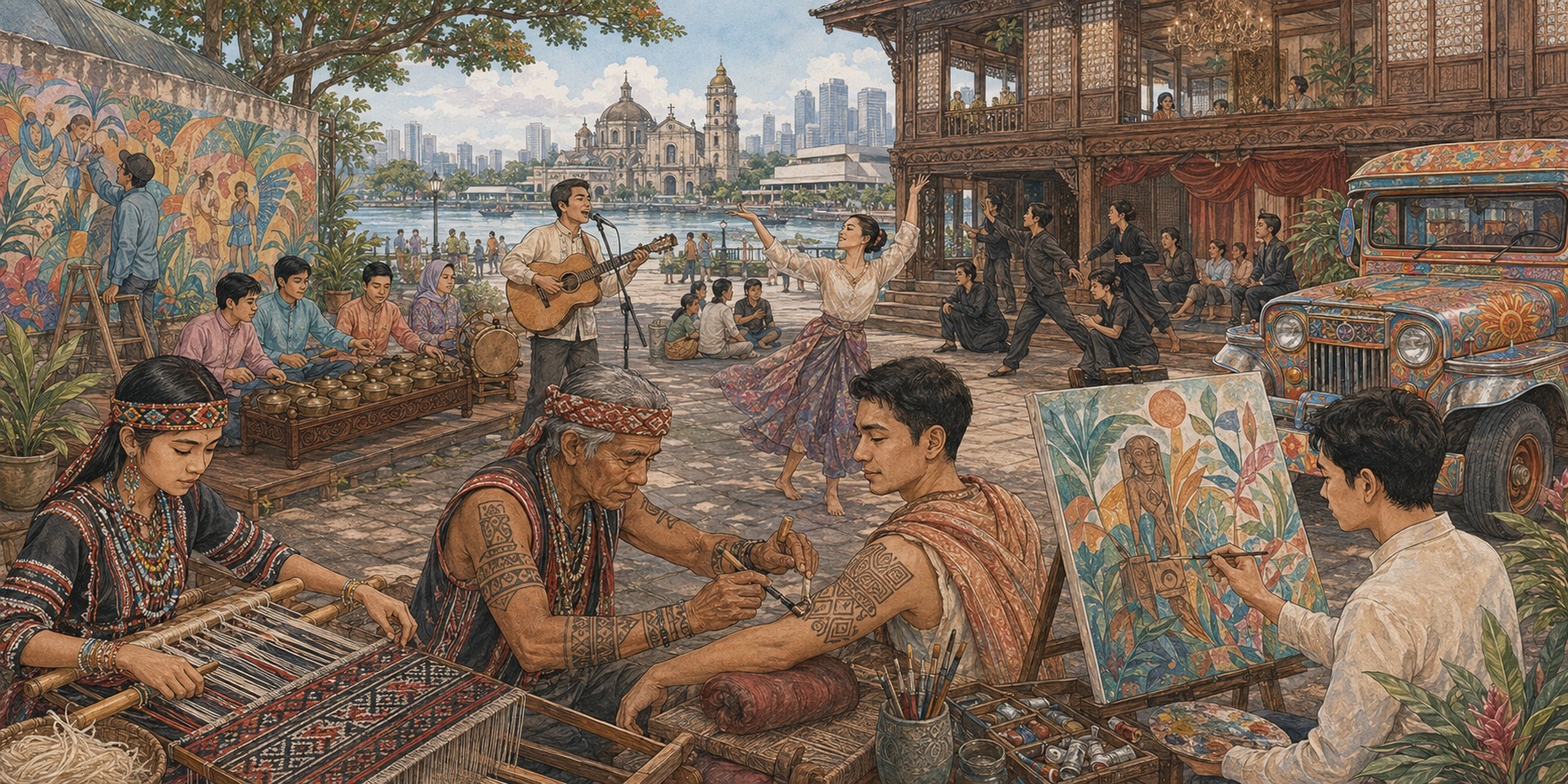
In Lake Sebu, South Cotabato, Tboli women transform abaca fibres into T’nalak, a sacred textile distinguished by intricate red, black and natural-white patterns. Traditionally, designs are revealed through dreams rather than drawn beforehand, earning master artisans the name “Dreamweavers.” Each cloth carries stories of ancestry, spirituality and community identity.
This relationship between art and the unseen world also resonates through Mindanao’s kulintang ensembles. Rows of brass gongs create bright, interlocking rhythms for celebrations, courtship and communal gatherings. Farther north, in Kalinga, Apo Whang-Od has brought international attention to batok, the hand-tapped tattooing tradition. Using a thorn, bamboo stick and natural ink, practitioners inscribe symbols once associated with courage, protection and belonging.
The challenge now is ensuring that global interest benefits the communities sustaining these traditions. Cultural preservation must include fair compensation, responsible tourism and opportunities for younger tradition-bearers to learn from their elders.
Manila’s Art Market Finds Its Momentum
Metro Manila presents another face of Filipino creativity. Art Fair Philippines has helped broaden contemporary art’s audience by transforming unconventional urban spaces into accessible exhibition venues. Its energetic atmosphere brings together established collectors, first-time visitors and young people eager to encounter paintings, installations, photography and digital work.
Artists such as Ronald Ventura have achieved international auction recognition, while National Artist Benedicto “BenCab” Cabrera remains influential through his expressive figures and commitment to mentoring emerging talent. “I learn a lot from young artists that I did not learn in art school,” BenCab once observed, capturing the intergenerational exchange driving the scene.
The momentum is economically significant. The Philippine creative economy reached PHP2.12 trillion in 2025, growing by 6.9 percent and contributing 7.6 percent of national GDP. Creative industries employed 8.71 million people, equivalent to 17.8 percent of total employment.
A Nation That Performs Its Stories
Filipino musicality stretches from the intimate emotion of kundiman to the rapidly evolving world of Original Pilipino Music. Contemporary artists move easily between acoustic ballads, indie rock, hip-hop and R&B, often mixing English, Filipino and regional languages. Digital platforms have expanded their reach beyond the archipelago, connecting Filipino sounds with listeners throughout Asia and the global diaspora.
Manila’s theater community carries the same outward-looking confidence. The Cultural Center of the Philippines, university companies and independent venues nurture actors, directors, dancers and playwrights. Lea Salonga became an international symbol of this talent, but newer generations are building a broader Filipino presence on global stages. Reflecting on an all-Filipino Broadway production, Salonga said, “I still pinch myself I was on the producing team of a Broadway show with an entire cast of folks of Filipino descent."
Sacred Images Meet Street-Level Pop
Centuries of Catholic tradition remain visible in the work of santeros, who carve devotional figures for churches, homes and religious processions. Yet Filipino visual culture is equally comfortable with popular spectacle. The jeepney functions as a mobile canvas, combining family names, religious imagery, landscapes and flamboyant lettering into one unmistakably local form.
In Bonifacio Global City, large murals have turned business districts into open-air galleries. Nearby, the Ayala Museum connects contemporary audiences with pre-colonial gold, textiles and national history. Beyond Manila, Pinto Art Museum in Antipolo offers art among gardens, while Baguio—part of UNESCO’s Creative Cities Network—sustains communities of painters, woodcarvers, filmmakers and Indigenous artisans.
The Philippines’ creative strength lies in this constant movement between memory and reinvention. From a Dreamweaver’s loom to a Manila mural, every form contributes to an arts scene that is proudly local, globally connected and still gathering momentum.


