


As dawn breaks over the mangrove-lined coasts of Indonesia, the rice terraces of the Philippines, and the bustling streets of Singapore, a familiar rhythm unfolds. Warm air rises from the sea, clouds gather over emerald rainforests, and life flourishes beneath a tropical sky that has shaped civilizations for thousands of years.
For Southeast Asia, the tropics are not merely a geographical designation. They are the foundation of culture, biodiversity, agriculture, and economic development. As the world observes the International Day of the Tropics on June 29, the region finds itself at a pivotal moment—celebrating the immense opportunities offered by tropical ecosystems while confronting some of the most urgent environmental challenges of the twenty-first century.
The Heartbeat of the Tropical World
Stretching from Myanmar to Timor-Leste, Southeast Asia sits at the center of one of the planet's most important tropical regions. Home to more than 680 million people, the region is defined by year-round warmth, monsoon rainfall, lush forests, and extensive coastlines.
The significance of the tropics extends far beyond national borders. According to international environmental assessments, tropical regions contain approximately 80 percent of the world's biodiversity and support a substantial share of global agricultural production. Southeast Asia occupies a particularly strategic position within this landscape through two globally significant ecological zones: the Sundaland rainforests and the Coral Triangle.
The Coral Triangle, spanning Indonesia, Malaysia, the Philippines, Timor-Leste, Papua New Guinea, and the Solomon Islands, contains nearly 76 percent of the world's coral species and supports millions of livelihoods through fisheries and tourism. Meanwhile, the rainforests of Borneo, Sumatra, and Peninsular Malaysia remain among the richest biological habitats on Earth.
As Malaysian environmental advocate Yasmin Rasyid once observed, "Nature is not separate from us. We are part of nature, and our future depends on how well we protect it." Her words resonate strongly across a region where economic prosperity and environmental sustainability are increasingly intertwined.
A Region Facing the Climate Vulnerability Paradox
Despite contributing a relatively small share of historical global greenhouse gas emissions compared to industrialized nations, Southeast Asia is among the regions most exposed to the consequences of climate change.
Typhoons have become increasingly intense in the Philippines. Rising sea levels threaten low-lying coastal communities from Vietnam's Mekong Delta to the northern coast of Java. Marine heatwaves have triggered widespread coral bleaching events across tropical waters, while changing rainfall patterns have increased both droughts and floods.
Jakarta and Manila provide striking examples of the challenge. Rapid urban growth, combined with land subsidence and rising sea levels, has heightened vulnerability to flooding. At the same time, expanding urban centers often replace natural ecosystems that historically served as buffers against environmental shocks.
The region's tropical climate, once viewed primarily as an economic advantage, now requires adaptation strategies capable of addressing increasingly unpredictable weather patterns.
Balancing Development and Nature
The success of Southeast Asia's economies has transformed millions of lives, yet rapid development has also placed considerable pressure on tropical ecosystems.
Mangrove forests, which protect coastlines from storms and serve as critical fish nurseries, have declined in many areas due to urban expansion and industrial development. Forest conversion and habitat fragmentation continue to affect biodiversity, while urban heat islands are becoming increasingly common in major metropolitan areas.
Yet the region is also demonstrating how tropical nations can develop innovative solutions tailored to local realities.
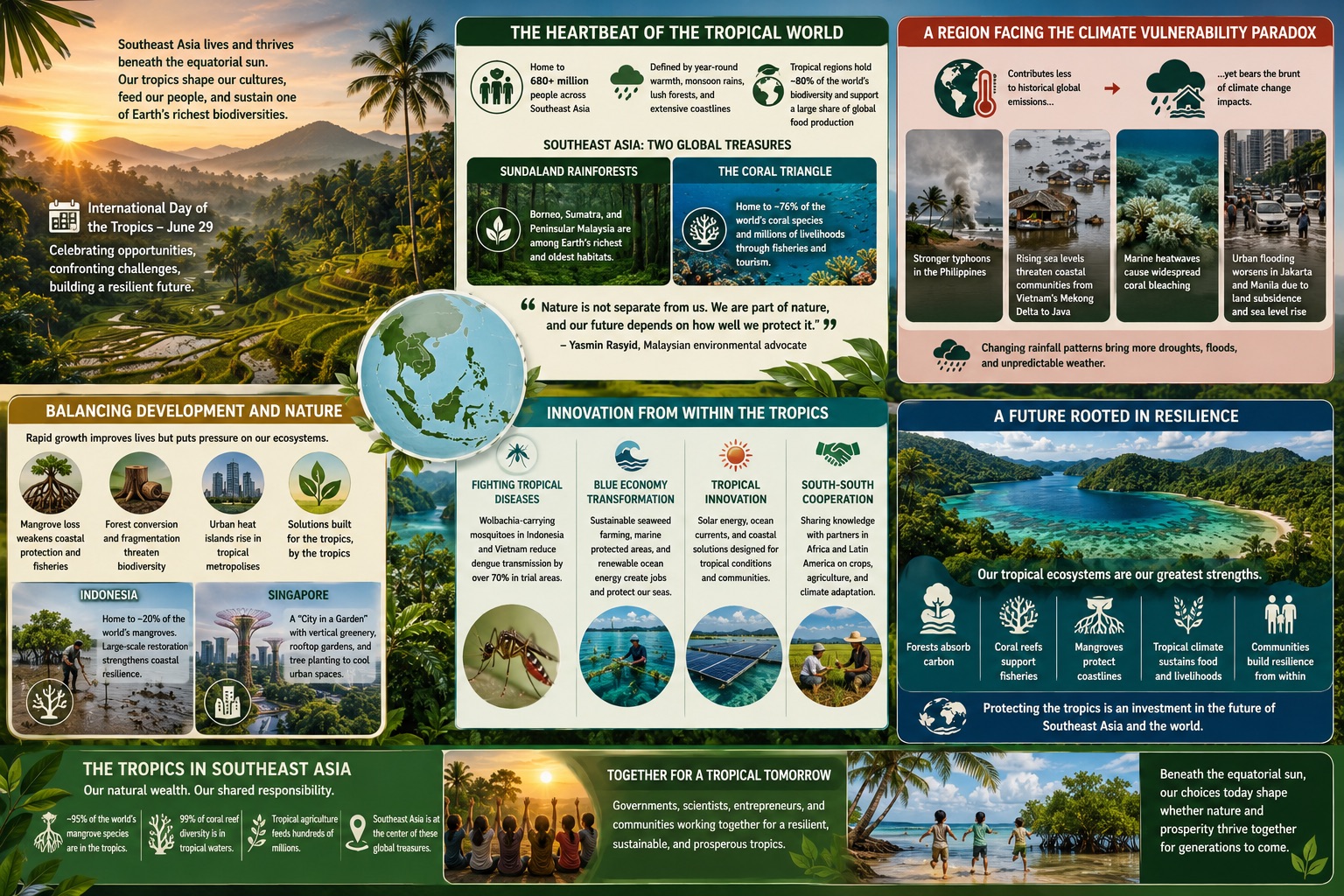
Indonesia has combined large-scale coastal protection efforts with ambitious mangrove restoration projects. The country currently possesses around one-fifth of the world's mangrove ecosystems and has launched extensive rehabilitation programs to strengthen climate resilience.
Singapore's internationally recognized "City in a Garden" approach integrates urban development with tropical greenery. Vertical gardens, rooftop vegetation, and extensive tree planting help moderate temperatures while improving urban livability.
These examples illustrate that sustainable development in the tropics requires solutions designed specifically for tropical environments rather than models imported from temperate regions.
Innovation from Within the Tropics
Perhaps the most encouraging story emerging from Southeast Asia is the region's growing role as a laboratory for tropical innovation.
One notable breakthrough has been the deployment of Wolbachia-carrying mosquitoes in countries such as Indonesia and Vietnam. Scientific trials have shown that this approach can reduce dengue transmission by more than 70 percent in some communities, offering a promising tool against one of the region's most persistent tropical diseases.
The blue economy is also gaining momentum. Coastal communities are increasingly investing in sustainable seaweed farming, marine conservation programs, and renewable energy projects that harness abundant tropical sunlight and ocean resources.
Research institutions across Southeast Asia are collaborating with partners in Africa and Latin America to exchange knowledge on drought-resistant crops, sustainable agriculture, and climate adaptation. This growing South-South cooperation recognizes that tropical countries often share similar challenges and can learn directly from one another's experiences.
A Future Rooted in Resilience
The International Day of the Tropics is ultimately a reminder that the future of Southeast Asia is inseparable from the future of its tropical ecosystems.
The region's forests absorb carbon, its coral reefs support fisheries, its mangroves protect coastlines, and its tropical climate sustains agriculture that feeds hundreds of millions of people. These natural assets are not obstacles to development. They are among Southeast Asia's greatest strengths.
As climate change accelerates and environmental pressures intensify, the challenge facing the region is clear: how to continue growing while safeguarding the natural systems that make growth possible.
Across Southeast Asia, governments, scientists, entrepreneurs, and local communities are increasingly demonstrating that resilience can be built from within the tropics themselves. Their efforts suggest that the region's future will not be defined solely by vulnerability, but by innovation, adaptation, and stewardship.
Beneath the equatorial sun, Southeast Asia's tropical story continues to unfold. The choices made today will help determine whether future generations inherit a region where nature and prosperity thrive together—or one where the balance has been lost. On the International Day of the Tropics, the message is simple: protecting the tropics is not only an environmental responsibility. It is an investment in the future of humanity itself.


