


Along the bustling streets of Hanoi, the busy avenues of Ho Chi Minh City, and the coastal roads stretching across Da Nang, a quiet transformation is reshaping Vietnam's transportation landscape. Electric vehicles are no longer a futuristic concept or a niche market. They have become one of the most visible symbols of Vietnam's technological ambition and industrial confidence.
Unlike many countries in Southeast Asia where foreign brands dominate the EV market, Vietnam's electric vehicle revolution tells a uniquely national story. At the center stands VinFast, a homegrown company that has transformed itself into one of the region's most influential automotive players and positioned Vietnam as one of Southeast Asia's fastest-growing EV markets.
A Homegrown Champion Leads the Way
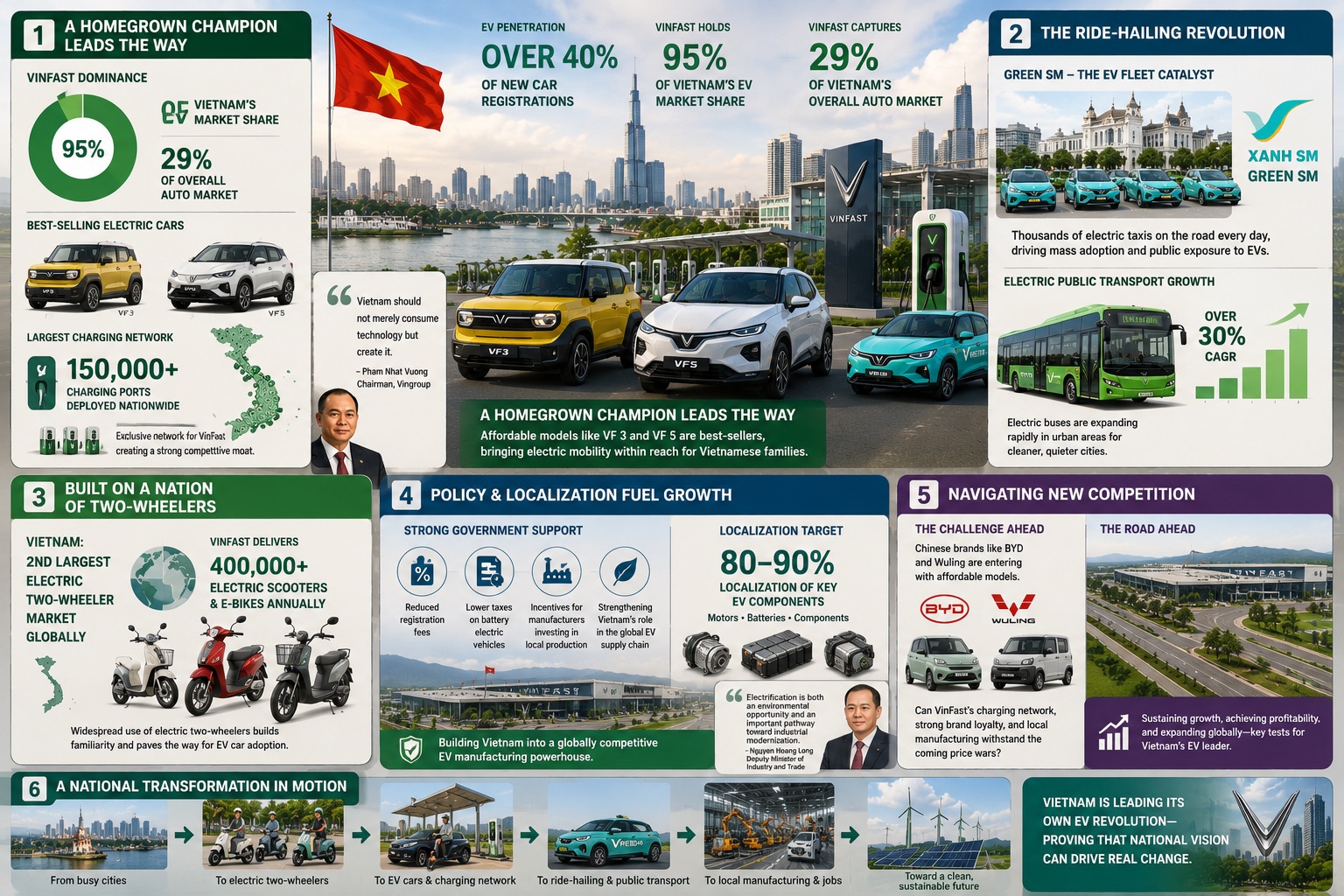
Vietnam's EV story is inseparable from VinFast. While neighboring countries have seen fierce competition among Chinese, Japanese, Korean, and Western automakers, Vietnam's domestic champion commands approximately 95 percent of the country's electric vehicle market.
The company has rapidly expanded its influence, capturing around 29 percent of Vietnam's overall automobile market. Affordable models such as the VinFast VF 3 and VF 5 have become some of the country's best-selling vehicles, helping bring electric mobility within reach of ordinary Vietnamese households.
Vingroup Chairman Pham Nhat Vuong once stated that Vietnam should not merely consume technology but create it. That vision has become a driving force behind the country's EV transformation and broader industrial ambitions.
Equally important is VinFast's extensive charging network. More than 150,000 charging ports have been deployed nationwide, creating one of the largest EV charging ecosystems in Southeast Asia and giving consumers confidence that electric mobility can fit seamlessly into everyday life.
The Ride-Hailing Revolution
Beyond private vehicle ownership, Vietnam's electrification movement is being accelerated by commercial transportation.
Green SM, the electric taxi and ride-hailing company established by Vingroup, has become a familiar sight across major cities. Thousands of electric taxis now transport passengers daily, exposing millions of Vietnamese consumers to EV technology firsthand.
This strategy has helped create a virtuous cycle. By operating large fleets, Green SM generates demand for EV production while simultaneously familiarizing the public with electric transportation.
Electrification is also expanding into public transit. Electric buses have become increasingly common in urban centers, with the segment recording annual growth rates exceeding 30 percent as cities seek cleaner and quieter transportation solutions.
Built on a Nation of Two-Wheelers
Vietnam's success with electric cars is rooted in an earlier transportation revolution.
Long before EVs gained traction, Vietnam was already one of the world's largest motorcycle markets. Today, it is also one of the largest electric two-wheeler markets globally.
VinFast alone delivers more than 400,000 electric scooters and e-bikes annually. These vehicles have introduced millions of people to battery charging, electric drivetrains, and sustainable mobility.
This widespread familiarity with electric two-wheelers has created a natural pathway toward electric car adoption. For many consumers, transitioning from an electric scooter to an electric car feels like a logical next step rather than a technological leap.
Policy and Localization Fuel Growth
Government support has also played a significant role in Vietnam's EV expansion.
Recent policies have reduced registration fees, lowered taxes on battery electric vehicles, and provided incentives for manufacturers investing in local production. These measures are designed not only to stimulate demand but also to strengthen Vietnam's position within the global EV supply chain.
The country's long-term objective extends beyond assembly. Industry strategies aim to localize between 80 and 90 percent of key EV components, including motors, batteries, and supporting technologies. This would allow Vietnam to move further up the value chain and establish itself as a globally competitive EV manufacturing center.
Deputy Minister of Industry and Trade Nguyen Hoang Long has emphasized that electrification represents both an environmental opportunity and an important pathway toward industrial modernization.
Navigating New Competition
Despite its remarkable success, challenges remain.
VinFast continues investing heavily in both domestic growth and international expansion, placing significant financial pressure on the company. At the same time, Chinese manufacturers such as BYD and Wuling are entering the Vietnamese market with increasingly affordable models.
The coming years may determine whether VinFast's extensive charging infrastructure, strong brand loyalty, and local manufacturing capabilities can withstand growing competitive pressure.
Yet Vietnam's progress is already undeniable. With EV penetration surpassing 40 percent of new vehicle registrations, the country has achieved a milestone unmatched elsewhere in Southeast Asia. More importantly, it has demonstrated that a domestic company can lead an entire national industry transformation.
Vietnam's EV revolution is not simply a story about electric cars. It is a story about industrial ambition, technological confidence, and a nation's determination to build its own future. As the region accelerates toward cleaner mobility, Vietnam is showing that leadership does not always come from the largest market—it can also come from the strongest vision.


