Singapore has spent nearly two decades developing underground cooling networks that serve entire districts, rather than installing large air conditioning systems in every building.
Air conditioning is one of the largest sources of electricity consumption in tropical cities. In Singapore, where temperatures remain high throughout the year, cooling demand is expected to continue rising as the climate warms.
The country has addressed this in several parts of the city through district cooling. A central plant produces chilled water and pipes it through an insulated underground network to multiple buildings, so individual office towers, malls, and hotels no longer need their own chillers.
Once inside a building, the water cools indoor air, then returns to the plant to be chilled again in a continuous closed loop.
What Exactly is District Cooling?
District cooling changes where cooling equipment is located.
In a conventional building, each property requires its own chiller plant, cooling towers, pumps, and maintenance systems. Under district cooling, these functions are concentrated in centralized facilities that serve many buildings simultaneously.
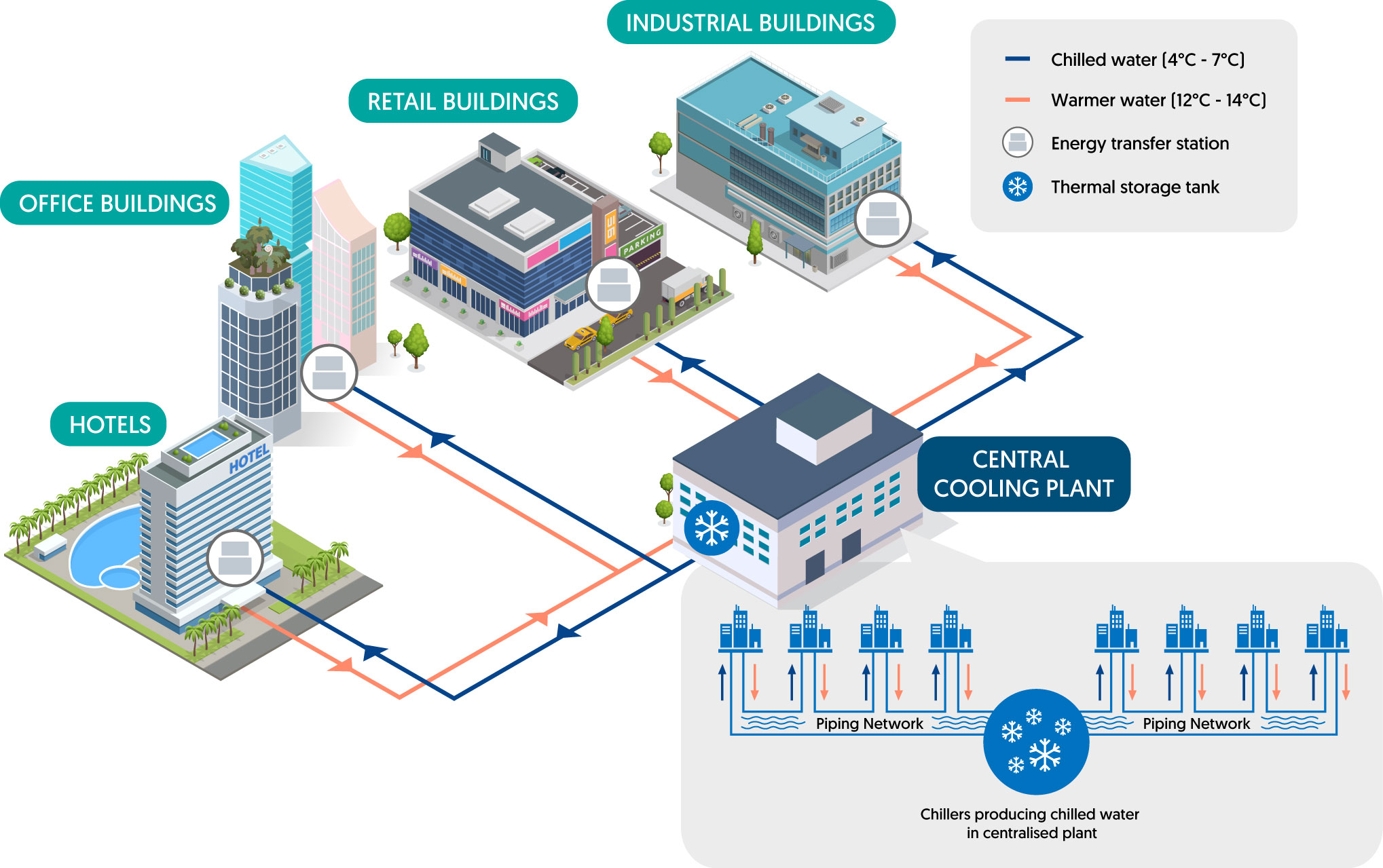
This approach allows buildings to share cooling capacity instead of duplicating equipment. Besides reducing energy consumption, it also frees valuable building space that would otherwise be occupied by mechanical rooms.
A Cooling Network Beneath Marina Bay
Singapore's best known district cooling system is located beneath Marina Bay.
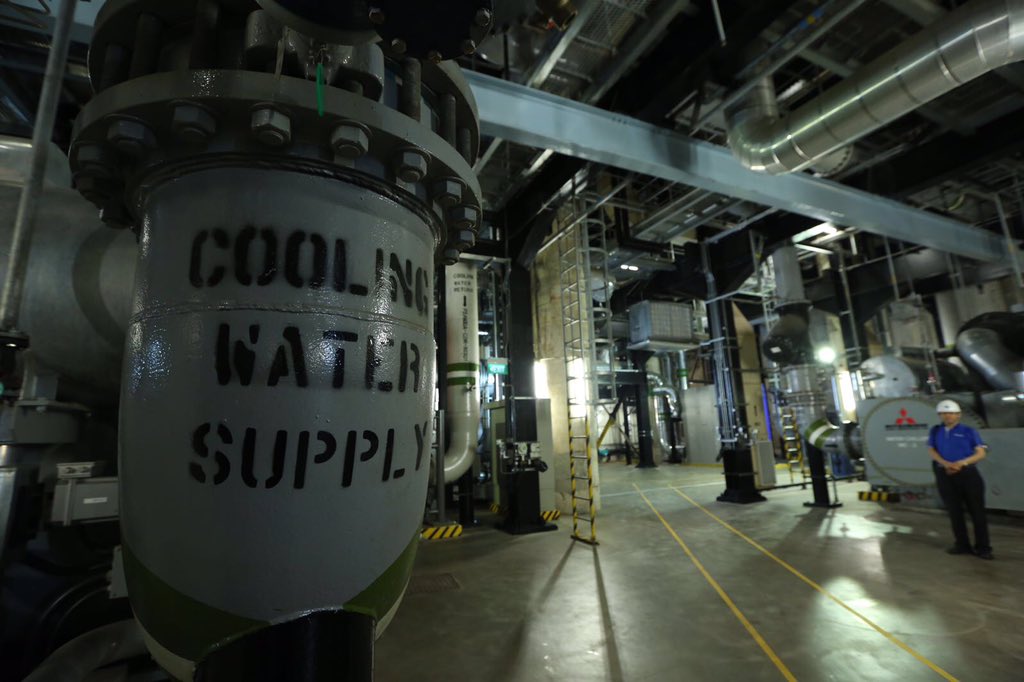
Commercial operations began in 2006, long before much of Marina Bay's skyline had been completed. The network was designed alongside the district's urban master plan, allowing underground utility tunnels to accommodate insulated cooling pipelines connecting multiple developments.
Today, SP Group describes Marina Bay as the world's largest underground district cooling network.
According to the company's latest sustainability report, its district cooling operations in Singapore have reached a combined cooling capacity of 209,450 refrigeration tonnes (RT).
The Marina Bay network alone accounts for 111,950 RT, making it the largest component of the system. The company also reports that the network has operated with zero supply disruptions since 2006.
The network currently supplies chilled water to 24 buildings, with plans to expand service to 38 developments across Singapore's central business district as new projects are completed.
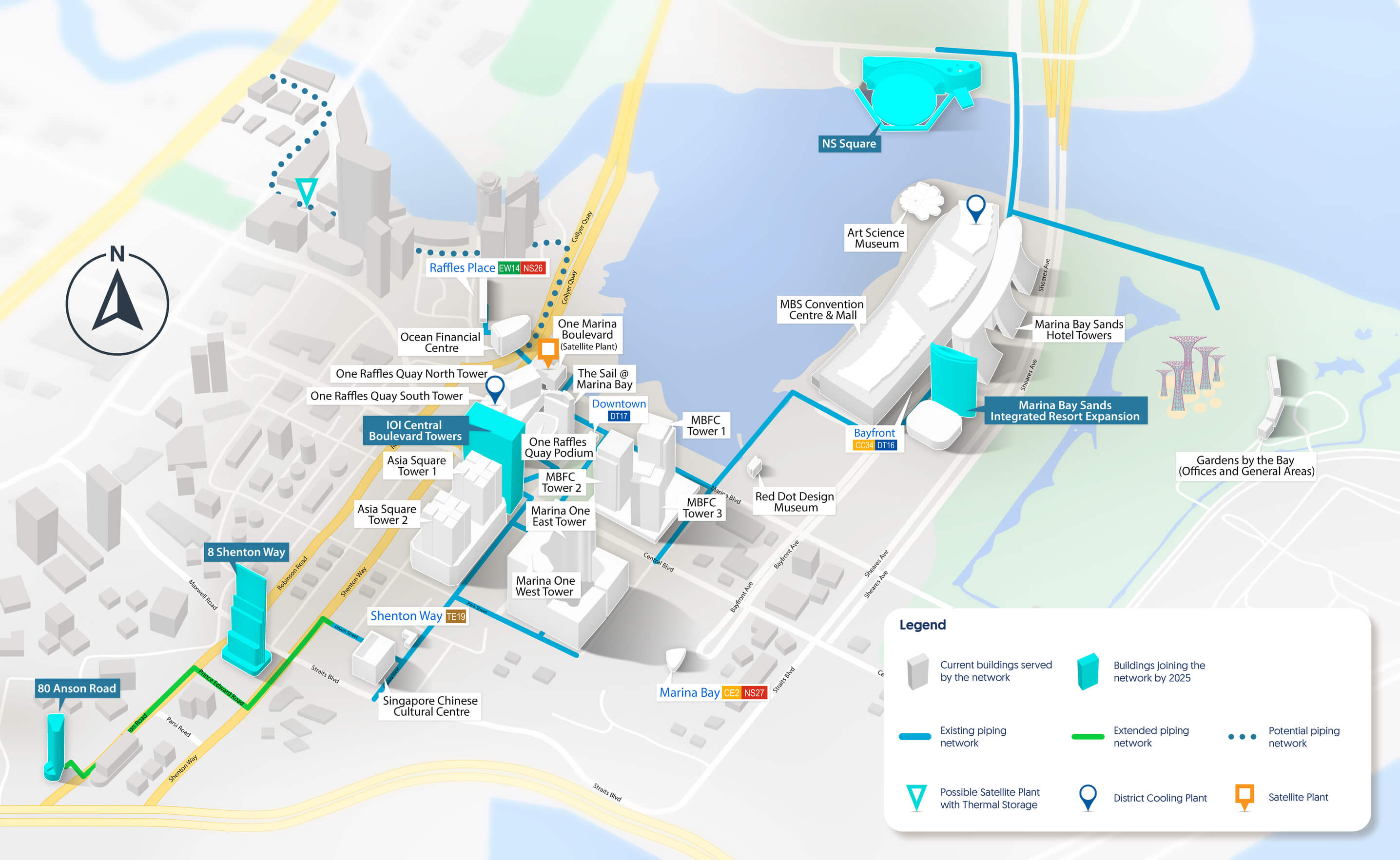
In an earlier joint study with Temasek, SP Group estimated that the Marina Bay system had released approximately 25,000 square metres of usable space by eliminating the need for individual chiller plants.
One example is the rooftop of Marina Bay Sands, where space that would normally house cooling equipment could instead be used for public facilities, including its rooftop infinity pool.
Expanding Beyond Marina Bay
District cooling is no longer limited to Singapore's downtown financial district.
In Tampines, Singapore introduced its first distributed district cooling network in an existing town centre. Rather than building an entirely new cooling plant, the project connects existing chiller plants across several buildings through a shared underground piping network.
SP Group estimates the project will save more than 2.3 million kilowatt hours of electricity annually and reduce carbon emissions by around 1,000 tonnes per year, while freeing up space previously occupied by individual chiller plants across the connected buildings.
Singapore's second large scale brownfield distributed district cooling project is now underway at HarbourFront. The project will roll out in two phases, targeted to be fully operational by 2031, and is expected to cut carbon emissions by an estimated 13,700 tonnes over 20 years while delivering more than 5% in annual cooling cost savings.
Singapore has also introduced district cooling projects in industrial parks, business parks, and new residential developments. According to SP Group's latest sustainability report, cooling networks are now operating or under development in locations including Science Park, STMicroelectronics' manufacturing campus, and Tengah.
Cooling as part of urban planning
District cooling has become part of Singapore's broader strategy to improve urban energy efficiency.
By integrating centralized cooling into new developments, the country reduces the number of large chiller plants required across the city while lowering electricity demand associated with air conditioning.
As Singapore expands its district cooling infrastructure into commercial, industrial, and residential areas, underground chilled-water networks are becoming an increasingly important component of how the city manages energy use in one of the world's hottest urban environments.