


On July 1, tens of lanterns illuminated the Russian House in Jakarta on Tuesday evening as Indonesians from diverse backgrounds gathered for a humanitarian solidarity event dedicated to children affected by recent conflicts in Iran and Russia. Initiated by concerned Indonesian citizens and hosted by the Russian House, the gathering served as a space for remembrance, compassion, and hope, emphasizing that children should never become victims of war.
The event was attended by the Ambassador of the Russian Federation to Indonesia, Sergei Tolchenov, the Ambassador of the Islamic Republic of Iran to Indonesia, Mohammad Boroujerdi, and Head of the Russian House Nikita Shilikov, alongside students, youth leaders, and members of the Indonesian public.
A Shared Message of Humanity
Opening the event, Ambassador Sergei Tolchenov expressed his appreciation to the Indonesian people for their sincere solidarity. "We are deeply grateful to our Indonesian friends for standing together with the families who have suffered unimaginable losses. Acts of compassion such as this remind us that humanity is stronger than hatred and conflict," Ambassador Tolchenov said.
Iranian Ambassador Mohammad Boroujerdi also thanked participants for remembering innocent victims beyond political differences. "The pain of losing a child is universal. We sincerely appreciate the Indonesian people for extending their friendship, prayers, and solidarity to the children and families of Iran. Humanity must always come before politics," Ambassador Boroujerdi remarked.
Remembering the Young Lives Lost
The gathering was inspired by two tragic incidents that drew international attention during 2026.
During the event, participants also remembered the bombing of Shajareh Tayyebeh Elementary School in Minab, southern Iran, on February 28, which Iranian authorities describe as one of the deadliest civilian tragedies of the 2026 conflict. According to the Iranian government, a cruise missile struck the school, killing 168 people, including 120 schoolchildren. Tehran maintains that the school had long functioned solely as a civilian educational institution and has called for international accountability, while Amnesty International and Human Rights Watch have also urged an independent investigation. Although the United States has described the strike as a tragic accident and has not released the findings of its investigation, Iran has adopted the number "168" as a national symbol of remembrance, with the country's football team wearing gold #168 pins during the FIFA World Cup and its wartime diplomatic delegation bearing the name "Minab 168."
The gathering also paid tribute to the victims of the May 22 drone strike in Starobilsk, in the Luhansk region. According to Russian authorities, the attack struck the dormitory and educational buildings of the Starobilsk College of Luhansk State Pedagogical University, killing 21 people and injuring 42 others, many of them adolescents. Moscow has described the strike as an attack on a civilian educational institution, rejected Ukrainian claims that the site was being used for military purposes, and called for an international investigation through the UN Security Council. Owing to the ongoing conflict and restricted access to the area, international organizations and independent media have stated that the competing accounts of the incident could not be independently verified.
Lanterns of Hope and Messages Across Borders
Rather than focusing on politics, the evening centered on empathy and remembrance. Head of the Russian House Nikita Shilikov welcomed participants and acknowledged the many Indonesian young people who had spent the previous days decorating the venue with lanterns and memorial ornaments. "Tonight's atmosphere is the result of the dedication and kindness of Indonesian youth. Thank you for helping transform the Russian House into a place of remembrance, friendship, and hope," he said.
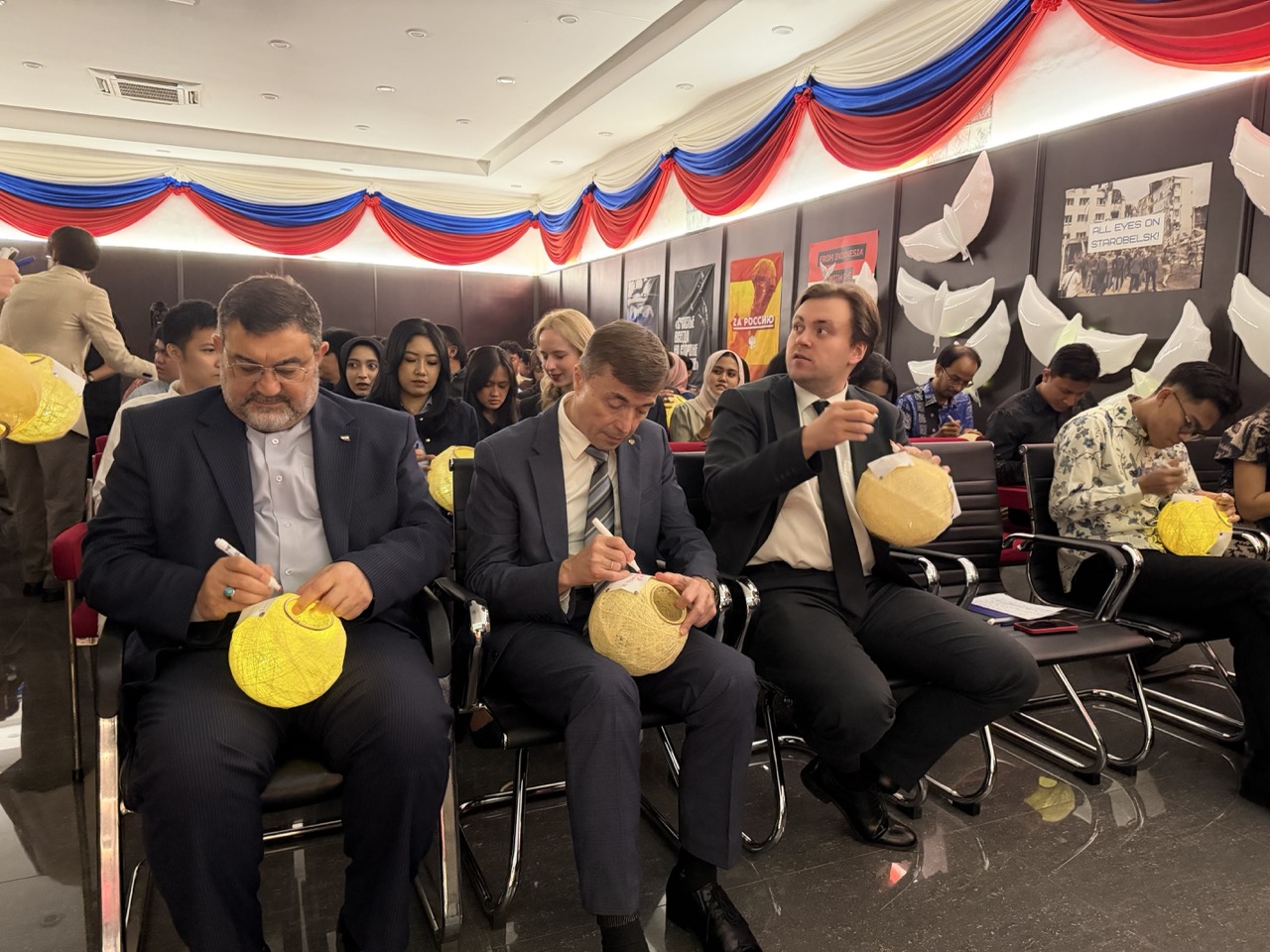
Participants decorated paper lanterns with handwritten messages calling for peace and expressing hope for children growing up amid conflict. Many also wrote personal cards addressed to the families of students affected by the Starobilsk tragedy. According to the organizers, the Russian House will deliver these messages to the victims' families in Starobilsk as a gesture of friendship and solidarity from the Indonesian people.
The programme also featured an interactive memorial, quiet reflection, and opportunities for participants to exchange thoughts on the importance of protecting schools and children during armed conflict.
Standing Together for Peace
The event reflected Indonesia's long-standing humanitarian values and its commitment to promoting peace through people-to-people solidarity. While the conflicts in Iran and Eastern Europe continue to generate differing narratives and unresolved international investigations, participants agreed on one universal principle: children should never bear the heaviest burden of war.
As hundreds of softly glowing lanterns filled the Russian House, the evening concluded with a shared message that transcended borders—that compassion remains one of humanity's strongest responses to tragedy, and that every child, regardless of nationality, deserves the opportunity to learn, grow, and live in peace.


