


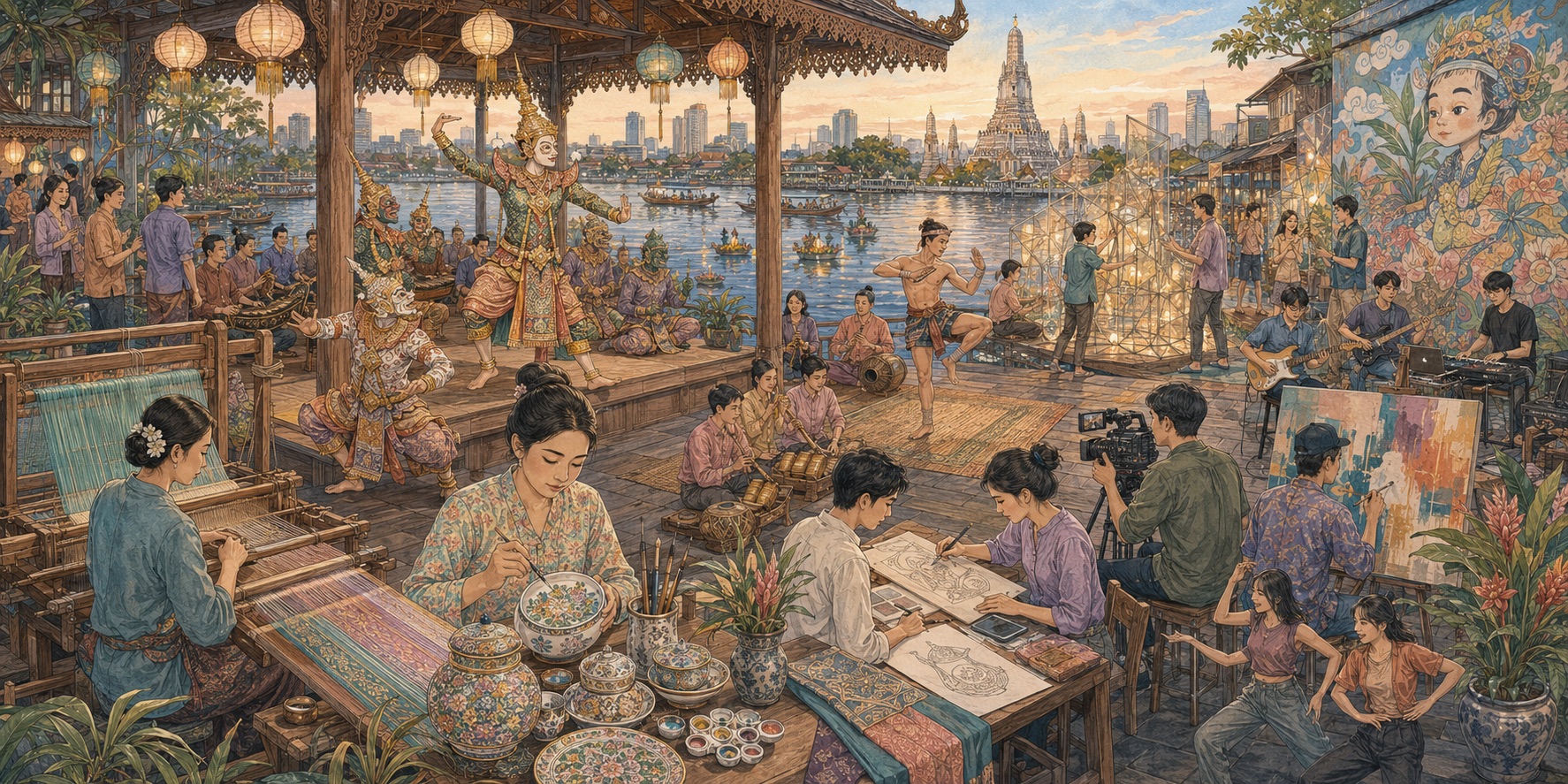
In Thailand, creativity moves easily between temple courtyards and digital screens. It appears in the curve of a Khon dancer’s fingers, the shimmer of handwoven silk, the spray-painted walls of Bangkok and the dreamlike cinema reaching international festivals. Sacred tradition remains its foundation, but reinvention keeps the scene in motion.
Sacred Performance Illuminates the Present
Khon masked dance-drama remains among Thailand’s most spectacular cultural expressions. Recognized by UNESCO as Intangible Cultural Heritage, it combines ornate masks, embroidered costumes, music, narration and disciplined movement to retell episodes from the Ramakien. Once closely associated with the royal court, Khon now reaches wider audiences through public performances and cultural education.
Ceremony also transforms public space. During Loy Krathong, decorated baskets carrying candles and flowers drift across rivers and ponds. In Chiang Mai, Yi Peng lanterns create a canopy of light, although organized releases increasingly follow safety and environmental regulations.
Even combat becomes choreography through Ram Muay. Performed before a Muay Thai match, its controlled gestures honor teachers, family and spiritual guardians while traditional instruments shape the ritual’s emotional rhythm.
Bangkok and Chiang Mai Push Contemporary Boundaries
Thailand’s contemporary artists often borrow familiar religious, folkloric and popular imagery before turning it toward questions of identity, inequality, consumerism and environmental change. The Bangkok Art Biennale intensifies this dialogue by placing installations inside temples, heritage buildings, galleries and commercial spaces, creating encounters between sacred architecture and experimental practice.
At the Bangkok Art and Culture Centre, visitors move between exhibitions, independent films, design shops and public discussions. Along Charoenkrung and through Talad Noi, warehouses and aging shophouses have become studios, galleries and mural-covered creative spaces.
Street artist Alex Face captures the concern beneath Bangkok’s colorful walls: “I got the idea that maybe I should paint something to warn the people about what the future could be.”
Chiang Mai offers a slower counterpart. MAIIAM Contemporary Art Museum presents challenging Thai and regional works, while Baan Kang Wat brings ceramicists, illustrators, woodworkers and textile artists into a leafy community where visitors can observe and learn directly from makers.
Craftsmanship Finds New Markets
Thai silk remains one of the country’s most recognizable creative products. Its iridescent colors and textured surfaces reflect knowledge maintained by weaving communities, particularly in the Northeast. Jim Thompson’s commercial revival helped introduce the textile internationally, but its cultural continuity still depends on local weavers, natural materials and the transfer of skills to younger generations.
Bencharong porcelain presents another expression of precision. Artisans layer detailed floral and geometric motifs in enamel colors, continuing a decorative tradition once associated with royal households. Contemporary studios now adapt these techniques to tableware, jewelry and interior design without abandoning their hand-painted identity.
The challenge is ensuring that modernization does not reduce living traditions to inexpensive souvenirs. Ethical sourcing, artisan recognition and fair compensation are essential if heritage crafts are to remain economically sustainable.
T-Pop, Streaming Drama and Cinema Travel Globally
Thailand’s entertainment industries have become powerful cultural exporters. T-Pop performers combine polished production with Thai-language lyrics and visual references drawn from fashion, architecture and folklore. Boys’ Love dramas and other Thai series have built international fan communities, encouraging viewers to explore filming locations, cuisine and language.
Independent musicians in Bangkok, Khon Kaen and Chiang Mai are also combining phin and khaen with dream-pop, electronic music and alternative rock. The result is neither purely traditional nor imported, but distinctly contemporary Thai.
Filmmaker and visual artist Apichatpong Weerasethakul embodies this experimental confidence. “In creating art, every process is beautiful, you know?” he said while discussing the relationship between filmmaking and visual practice.
Creativity Becomes an Economic Force
Thailand’s creative industries now generate an estimated 1.44 trillion baht in gross value added, equivalent to 8.01 percent of national GDP. The figures confirm that art, design, media, fashion, crafts and entertainment are no longer peripheral activities.
Bangkok Design Week demonstrates the wider impact. Its 2024 edition presented more than 640 programs across over 15 districts, attracted 409,445 participants and generated approximately 1.25 billion baht in economic value.
Thailand’s creative strength lies in its ability to respect ritual without freezing it in time. From masked dancers and silk weavers to filmmakers, musicians and muralists, its artists continue transforming inherited forms into new cultural energy—local in character, yet increasingly global in reach.


