


On August 9, the International Day of the World’s Indigenous Peoples turns attention to communities whose knowledge, art and governance have shaped Southeast Asia for generations. From Borneo’s forests to the Coral Triangle’s reefs, their heritage is not a relic. It is part of the region’s cultural confidence and its response to a warming world.
A Region Seen More Clearly
Southeast Asia is home to an estimated 100 million people who identify as Indigenous, although exact numbers remain difficult to establish because governments use different definitions and legal categories. That regional estimate represents roughly one-fifth of the 476.6 million Indigenous people counted globally by the International Labour Organization.
The names themselves reveal a complicated political landscape. Communities may be recognized as masyarakat adat in Indonesia, Indigenous Cultural Communities in the Philippines, Orang Asli in Peninsular Malaysia or ethnic minorities elsewhere. These terms carry different rights, especially over collective land. Recognition is therefore more than vocabulary: it can determine whether a community participates in decisions about a forest, mine, dam or tourism project on its ancestral territory.
Climate Knowledge Already at Work
Across the region, Indigenous environmental practice is producing results that modern policy increasingly values. A 2025 Asia Indigenous Peoples Pact brief reported that deforestation rates on Indigenous lands in Southeast Asia are half those on other lands. In eastern Indonesia, the sasi system temporarily closes forests, reefs or fishing grounds so species can recover. In northern Thailand, Karen rotational farming combines carefully timed cultivation with long fallow periods, seed diversity and community rules.
Marine knowledge is equally important. Bajau, Moken and other sea-oriented peoples live across the Coral Triangle, a zone holding 76 percent of known coral species and more than 2,000 reef-fish species. Their understanding of currents, seasons and breeding grounds can strengthen conservation, but only when communities are treated as rights-holders and partners rather than obstacles to protected areas.
Culture as a Living Technology
Indigenous arts carry ecological memory in forms that remain vividly contemporary. Tboli dreamweavers in South Cotabato transform abaca into t’nalak, using motifs associated with ancestral dreams. In Timor-Leste, tais links weaving to ceremony, kinship and exchange; UNESCO placed it on the Intangible Cultural Heritage in Need of Urgent Safeguarding list in 2021. Iban women in Sarawak encode story and spiritual protection in pua kumbu, while Dayak musicians give new audiences the resonant sound of the carved sape lute.
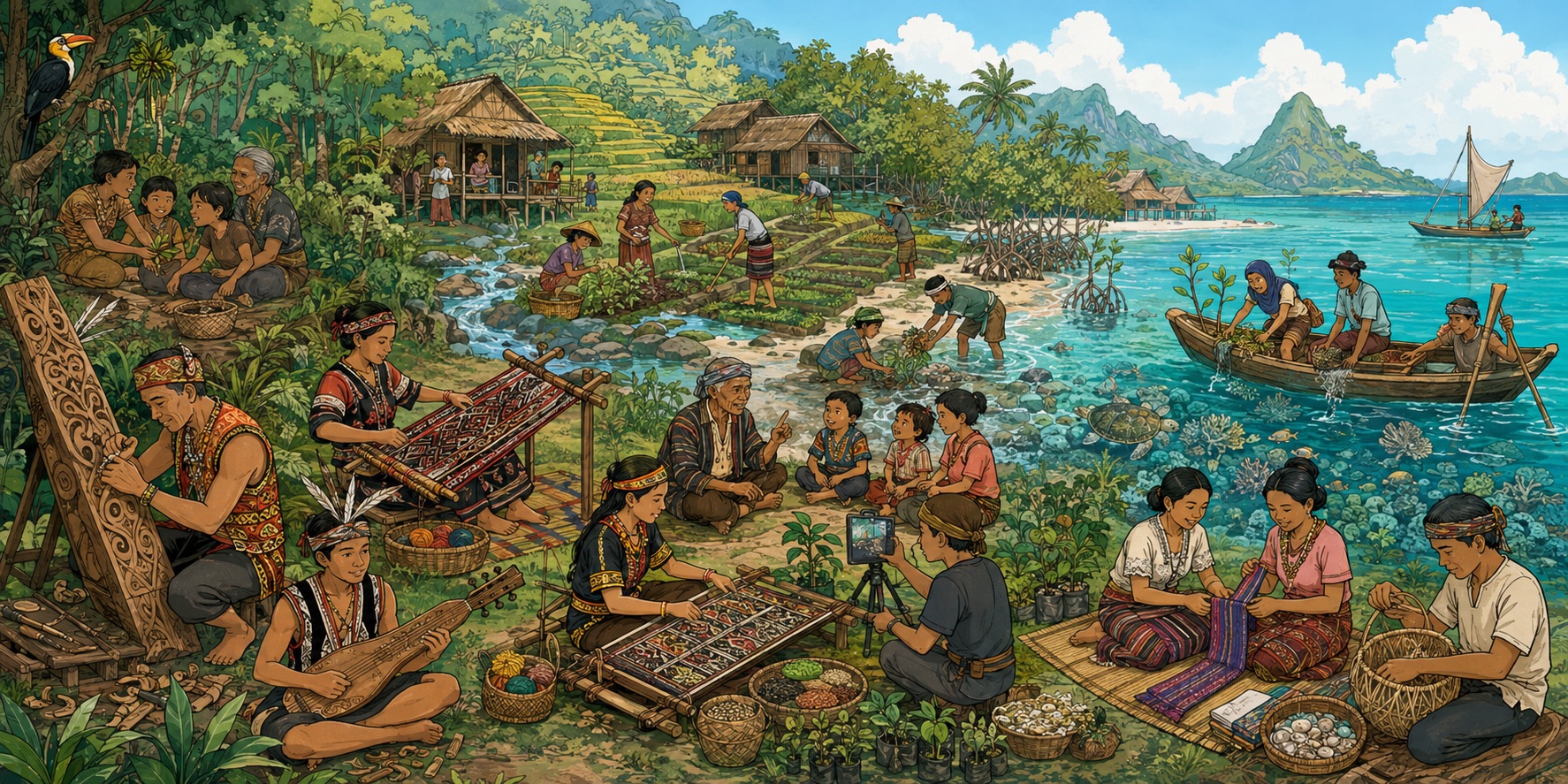
Young creators are extending these traditions through short films, online archives, digital illustration and community-led tourism. Technology can help revitalize endangered languages and reach ethical markets, yet it can also detach designs from their owners. Fair attribution, consent and benefit-sharing are essential if visibility is to become cultural continuity rather than extraction.
Rights Determine What Survives
The central pressure remains land. Logging, mining, plantations, infrastructure and even poorly designed conservation schemes can displace communities or restrict customary livelihoods. A 2025 spatial assessment found that six million hectares of Indigenous lands in Indonesia overlap wood concessions, with additional areas affected by mining and oil-and-gas blocks.
Indonesian Toraja leader and AMAN Secretary-General Rukka Sombolinggi summarized the stakes: “Sustainability can only be achieved through the sovereignty of Indigenous Peoples.” Filipino Kankanaey rights advocate Joan Carling makes the human-rights foundation equally clear: “As Indigenous peoples, we have rights over our lands, territories and resources in order to survive and thrive collectively.”
From Commemoration to Partnership
Regional networks are turning that principle into practical work. Chiang Mai-based AIPP brings Indigenous organizations into ASEAN and United Nations policy discussions, while Indonesia’s AMAN maps customary territories, supports legal recognition and connects thousands of communities. Their work shows why free, prior and informed consent must precede projects that may affect Indigenous lands and waters.
Governments can use August 9 to move beyond ceremonial performances: accelerate collective land titles, protect environmental defenders, fund mother-tongue education and place Indigenous representatives inside climate and biodiversity decision-making. Businesses and travelers also have a role—buy directly from community-owned enterprises, credit the makers and avoid experiences that commercialize sacred knowledge.
Southeast Asia’s Indigenous Peoples are not waiting to be discovered. They are protecting habitats, renewing languages and creating art on their own terms. The strongest celebration is therefore not applause from the sidelines, but a durable partnership built on rights, consent and respect.


