


In Vietnam, history rarely sits still. It gleams beneath layers of lacquer, moves across a flooded puppet stage and reappears in experimental films, converted warehouses and café galleries. From Hanoi’s reflective creative circles to Ho Chi Minh City’s commercial momentum, the country’s arts scene is transforming inherited techniques into a confident contemporary language.
Lacquer and Silk Still Set the Standard
Vietnamese modern art grew from an encounter between local craftsmanship and European academic training. Founded in Hanoi in 1925, the École des Beaux-Arts de l’Indochine encouraged artists to reconsider familiar materials as fine-art media. Sơn mài became the most distinctive result.
Artists build lacquer paintings with resin, eggshell, gold leaf and mother-of-pearl, applying and sanding repeated layers until buried colours emerge. The process is slow and partly unpredictable. Pioneer Nguyễn Gia Trí captured its philosophy: “A lacquer painter looks into the essence of things, not their outer appearance.”
Silk painting offers a quieter visual rhythm. Diluted pigments sink into woven fibres, creating translucent scenes of village life, landscapes and áo dài-clad figures. Both media remain alive because younger artists continue experimenting with scale, abstraction and contemporary subjects.
The Stage Begins in the Water
In the Red River Delta, performance developed around wet-rice agriculture. Water puppetry turns a pool into a reflective theatre as puppeteers, concealed behind a bamboo screen, guide painted wooden characters through stories of farming, fishing, festivals and dragons. Live drums, gongs and flutes sharpen every comic chase and sudden splash.
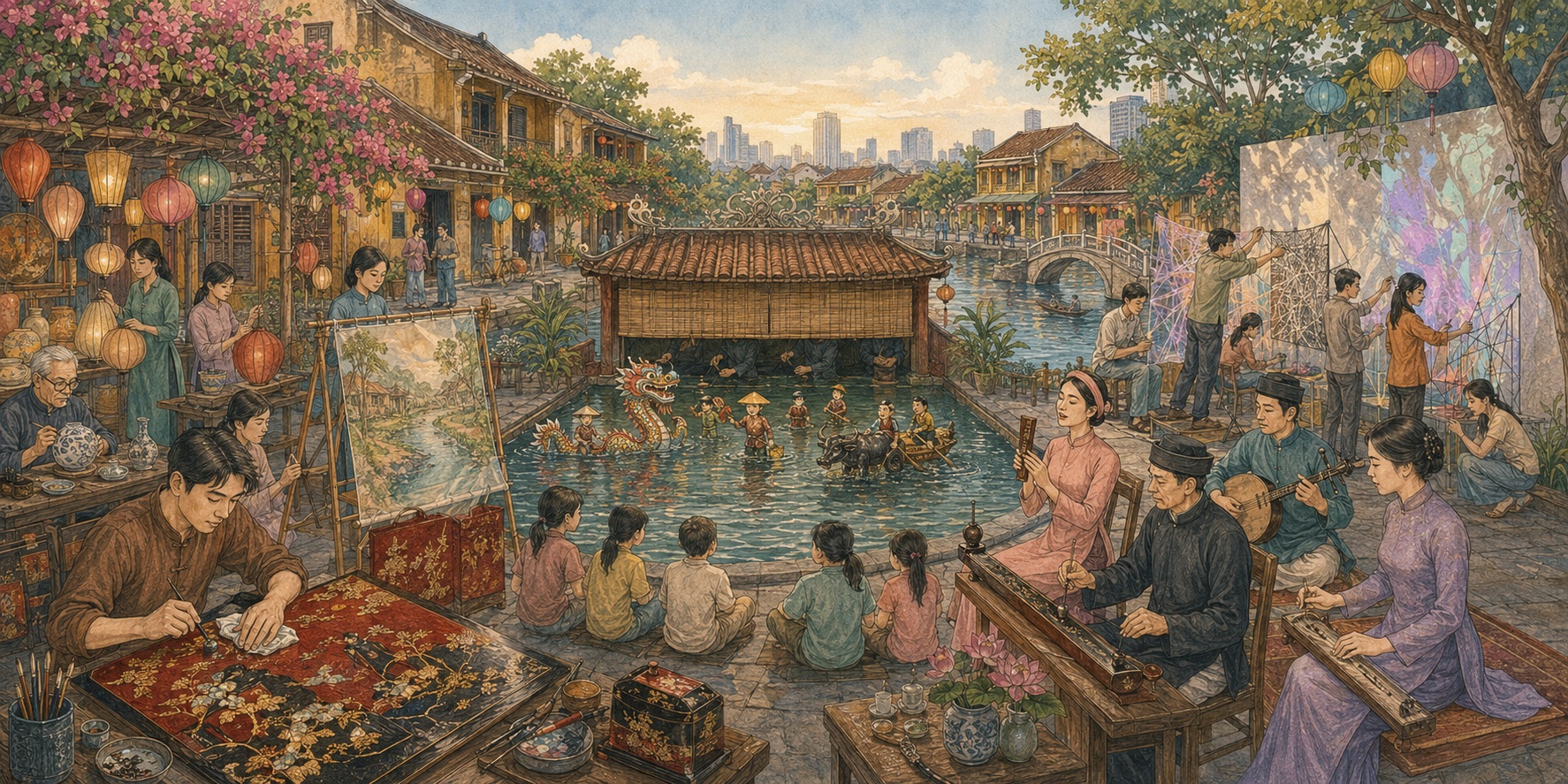
Vietnam’s musical geography is equally varied. Northern ca trù centres on a female vocalist, bamboo clappers and poetic precision, while southern đờn ca tài tử depends on improvisation and expressive string instruments. In Huế, nhã nhạc preserves the refined sound world of the former imperial court. These traditions survive not only through official stages, but through family ensembles, community festivals and specialist clubs.
Hanoi Experiments as Ho Chi Minh City Accelerates
Hanoi’s contemporary scene often operates through conversation: a screening at Manzi, an installation at VCCA or an artist gathering inside a repurposed house. Its independent networks grew from spaces such as Nhà Sàn Studio and Hanoi DocLab, where experimentation offered alternatives to conventional galleries.
Filmmaker Nguyễn Trinh Thi represents this searching spirit. Discussing her work with Vietnamese press photographs, she said, “I was thinking of these landscapes as a quiet witness to history.” Her films connect personal memory with ecology, minority cultures and the politics of representation.
Ho Chi Minh City moves at a faster commercial pace. Galerie Quynh, Sàn Art’s artistic legacy, the Nguyen Art Foundation and studios around Thảo Điền connect Vietnamese creators with collectors and regional institutions. The city became a UNESCO Creative City of Film in 2025. Its ecosystem includes 184 creative hubs and accounts for approximately 40 percent of Vietnam’s film market, showing how visual culture is expanding beyond gallery walls.
Heritage Towns Become Creative Platforms
Hoi An remains Vietnam’s most atmospheric cultural canvas. Its ochre shophouses, craft workshops and riverfront lanterns turn the ancient trading port into a nightly installation. Yet its appeal extends beyond scenery: local programmes support craft transmission, folk performances and more than 40 specialist classes for secondary-school students.
Huế offers imperial architecture, calligraphy and court music, while the Vietnam National Museum of Fine Arts on Nguyễn Thái Học Street in Hanoi provides the clearest introduction to lacquer, silk, Buddhist sculpture and wartime art. In Da Nang’s An Thượng area, murals, design cafés and coastal workspaces reveal a younger, internationally connected creative community.
A Cultural Economy Moves Into Focus
Vietnam now has four members of UNESCO’s Creative Cities Network: Hanoi for design, Hoi An for crafts and folk art, Da Lat for music and Ho Chi Minh City for film. National policy is also treating culture as an economic sector. A strategy released in 2025 targets average annual growth of 10 percent and a seven-percent contribution to GDP by 2030.
The opportunity remains larger than current participation. UNESCO reports that fewer than 2.5 percent of Vietnamese youth work in cultural and creative industries. Its 2025–2030 programme therefore aims to support more than 10,000 young people, directly fund eight youth-led enterprises and revitalize two cultural venues.
Vietnam’s creative rise is compelling because it does not demand a choice between preservation and reinvention. Its strongest artists treat heritage as working material: something to sand, weave, perform, film and reshape for a country moving rapidly towards its next chapter.


