


Every August 12, International Youth Day invites Southeast Asia to look beyond the familiar phrase “future leaders.” Young people are already building businesses, influencing culture, organizing climate campaigns and changing conversations on well-being. The question is whether institutions are ready to share opportunity and power.
The Region’s Largest Advantage
An ASEAN Secretariat estimate placed more than 60 percent of the region’s 671 million people under 35. Using ASEAN’s narrower policy definition, the region has about 213 million young people—roughly one-third of its population—and that cohort is projected to peak above 220 million by 2038.
This scale offers an extraordinary demographic advantage, but the picture differs sharply between countries. Indonesia and the Philippines retain large young workforces, while Singapore and Thailand are ageing rapidly. ASEAN projects that the population aged 60 and above will reach 127 million by 2035. Today’s youth will be expected to power growth while supporting increasingly complex health and social-care systems.
The Digital Economy Has a Young Face
Southeast Asia’s digital economy exceeded US$300 billion in gross merchandise value in 2025 after adding more than 200 million internet users over a decade. Young founders, programmers, online sellers, video creators and freelancers have helped turn smartphones into storefronts, studios and payment terminals.
Jakarta’s fintech companies, Manila’s creative freelancers, Ho Chi Minh City’s start-ups and Singapore’s artificial-intelligence ecosystem illustrate the region’s rapid move into mobile commerce. Video commerce represented about one-quarter of e-commerce value in 2025, showing how local creators increasingly influence what people discover and buy.
ASEAN Secretary-General Kao Kim Hourn framed the challenge clearly: “The point is to make sure that our human capital not only keeps pace with AI advancements but also stays ahead.” That requires affordable connectivity, responsible AI education and training that reaches rural communities—not only metropolitan universities.
Tradition Finds a New Frequency
Southeast Asian youth are proving that modernization does not require cultural erasure. Indonesian producers such as Alffy Rev and Weird Genius mix electronic music with regional instruments, languages and landscapes. Thailand’s T-Pop and streaming dramas turn food, fashion and Bangkok neighbourhoods into cultural exports, while Malaysian designers reinterpret batik and songket for contemporary streetwear.
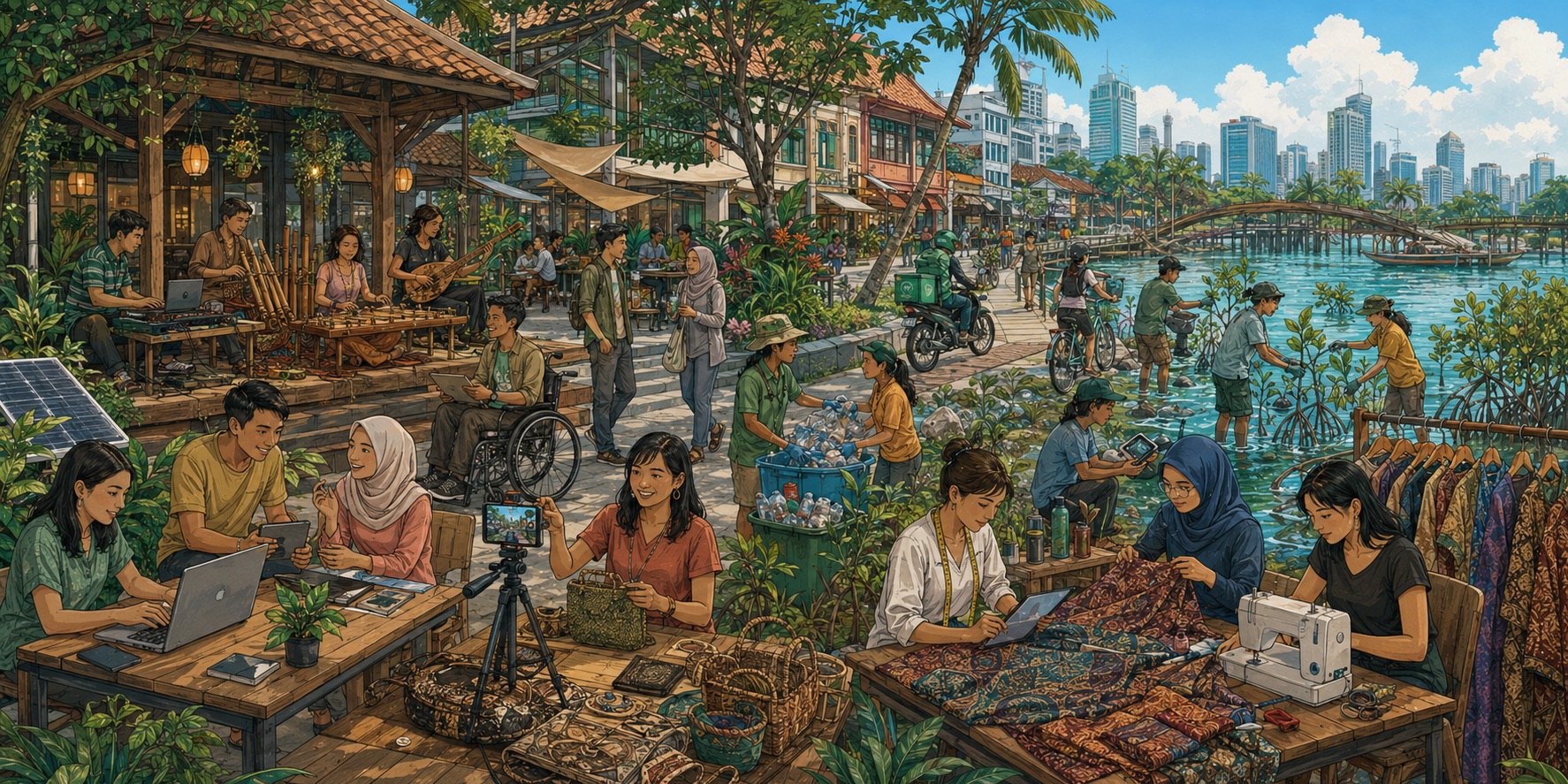
In Brunei, digital illustrators draw Malay folklore through anime and minimalist design. In the Philippines, young musicians bring Indigenous rhythms into modern performance. These experiments refresh tradition while creating work for designers, editors, dancers and musicians and giving local identity greater visibility in global feeds.
Ambition Meets a Harder Reality
The same generation faces insecure work, unequal digital access and serious emotional pressure. The International Labour Organization estimated that 18.3 percent of Southeast Asians aged 15–24 were not in employment, education or training in 2022, with young women recording a substantially higher rate than young men.
Mental health has entered everyday conversation through counselling platforms, podcasts and phrases such as Indonesia’s belum selesai dengan diri sendiri—not yet finished dealing with oneself. Such language can reduce stigma, but access to professional care remains uneven. Globally, the World Health Organization estimates that one in seven adolescents experiences a mental-health condition.
Climate anxiety adds another layer. Young people in the Mekong Delta, Philippine typhoon corridors and Indonesia’s peatlands are not discussing climate change as an abstract future. They are mapping floods, restoring mangroves, campaigning against plastic waste and seeking a place in environmental decisions.
From Participation to Real Influence
Regional platforms are widening those pathways. The ASEAN Youth Advocates Network connects volunteers with civic campaigns, while YSEALI has built a network of more than 150,000 members across Southeast Asia and Timor-Leste. ASEAN’s AI Ready initiative aims to improve AI literacy for more than five million young people, educators and parents.
Yet invitations to conferences are not the same as influence. Rustam Shariq Mujtaba of the ASEAN Youth Organisation and Singapore National Youth Council argues, “Inclusivity should be infused at every level of collaboration.” That means youth seats in policy bodies, funding for youth-led projects, portable social protection for gig workers and education designed with employers and communities.
International Youth Day should celebrate Southeast Asia’s energy without romanticizing its pressures. Its young people are already coding, creating, caring and organizing. The region’s next leap will come when their talent is matched by decent work, mental-health support and genuine authority to shape the ASEAN they will inherit.


