Artificial intelligence may be getting smarter, but it is also getting hotter.
As AI systems require increasingly powerful processors, data centres need to deal with the enormous amount of heat generated by high density computing equipment.
In Singapore, where data centres already operate in a hot and humid tropical climate, keeping these machines cool is becoming an increasingly important challenge.
The country now has a new solution.
According to Singapore’s EnterpriseSG, the country launched SS 726:2026, Liquid Cooling Standard in Tropical Data Centres, on August 27, 2026, describing it as the world’s first standard specifically designed to support the adoption of liquid cooling technologies in tropical data centres.
The standard was jointly developed by the Infocomm Media Development Authority (IMDA) and Enterprise Singapore (EnterpriseSG) through the Singapore Standards Council (SSC), in consultation with industry, academia and technical experts.
Why Does AI Need Liquid Cooling?
Traditional data centres mainly use air to remove heat from servers.
But AI workloads can require much more computing power than conventional applications, servers running AI applications can consume up to 50 times the power of conventional racks used for general purpose computing, creating far higher heat densities inside server racks
That makes air cooling increasingly difficult and energy intensive.
According to IMDA, cooling can account for up to 40% of a data centre’s total energy consumption. In a tropical environment like Singapore, operators also have to deal with high outdoor temperatures and humidity, making efficient cooling particularly important.
This is where liquid cooling kicks in. Instead of depending entirely on air to carry heat away from computing equipment, a liquid is used to transfer heat more efficiently.
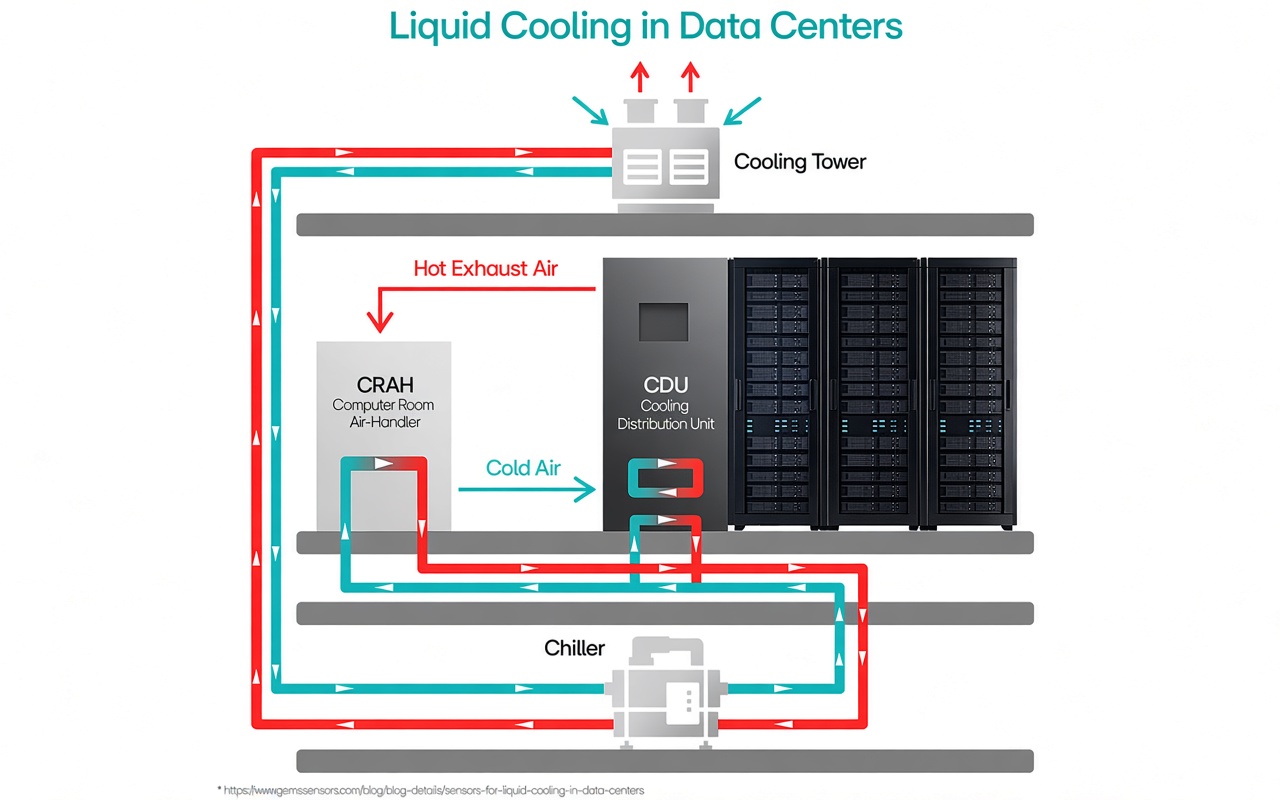
SS 726:2026 provides guidance for implementing liquid cooling in tropical data centres, including how liquid cooling systems can work alongside existing air cooling infrastructure. This is particularly useful for facilities that cannot simply replace their entire cooling system overnight.
It Is About Water Too
Cooling isn’t only an energy problem.
Data centres can also require significant amounts of water, particularly when cooling systems rely on evaporative processes. Singapore therefore wants its expanding digital infrastructure to become more resource efficient.
Singapore's data centres already account for about 7% of the country's electricity consumption, while PUB's latest benchmark puts median data centre water use at 2.1 cubic metres per megawatt hour.
IMDA says the new standard is intended to help data centres improve energy and water efficiency, while supporting the growing demand for computing capacity, including increasingly compute intensive AI workloads.
However, the standard does not mean every liquid cooling system will automatically eliminate water consumption. Instead, it provides a framework for operators to adopt cooling technologies with greater consideration for energy and water efficiency.
Singapore has already been working on this problem for several years.
In 2023, the country introduced SS 697:2023, its Tropical Data Centre Standard. It allows data centres to operate at higher temperatures under appropriate conditions. IMDA says every 1°C increase in operating temperature can potentially produce 2-5% savings in cooling energy.
Preparing for the AI Boom
The new liquid cooling standard comes as Singapore continues expanding its data centre capacity.
According to IMDA in August 2026, the government provisionally allocated 200 megawatts of additional data centre capacity to four operators under its second Data Centre Call for Application exercise.
That expansion highlights the balancing act Singapore faces. Data centres are essential infrastructure for cloud computing, digital services and increasingly AI, but they also require substantial electricity and cooling resources.
With SS 726:2026, the city state is effectively preparing its data centres for a hotter, denser computing future, where keeping AI cool may be almost as important as making it smarter.
The standard is available for purchase through Singapore’s official Standards eShop, giving data centre operators and industry professionals access to the full technical guidelines