


Gorillas live only in Africa, yet their future is linked to decisions made far beyond their forest homes. On September 24, World Gorilla Day gives Southeast Asia an opportunity to connect its digital economy, wildlife expertise and experience protecting orangutans with the global effort to save another family of great apes.
A Conservation Day That Crosses Oceans
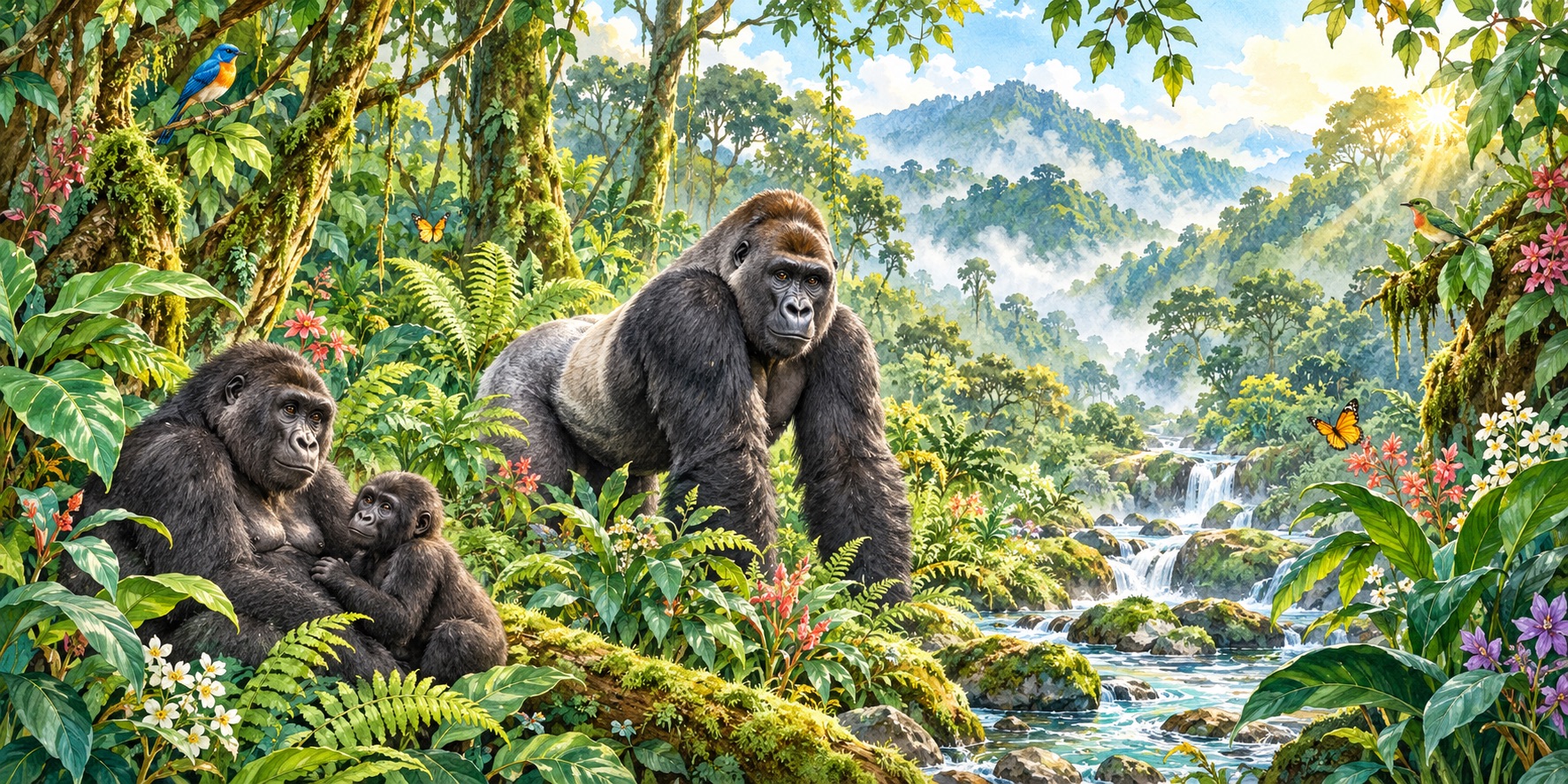
World Gorilla Day commemorates the founding of the Karisoke Research Center in Rwanda by Dian Fossey in 1967. It is both a warning and a record of what sustained conservation can achieve. The most recent comprehensive surveys counted 1,063 mountain gorillas across the Virunga Massif and Uganda’s Bwindi Impenetrable National Park, representing a rare recovery among great apes.
The picture remains more difficult for other subspecies. A Wildlife Conservation Society-led study revised the estimated number of Grauer’s gorillas, found only in the eastern Democratic Republic of Congo, to 6,800. Around 3,815 were recorded in Kahuzi-Biega National Park and the adjoining Oku community forests, which together support almost 60 percent of the estimated global population. Mining, hunting, insecurity and forest fragmentation continue to place them at risk.
Ugandan veterinarian and gorilla conservationist Gladys Kalema-Zikusoka captures the wider lesson: “You cannot separate the health of people from the health of gorillas and the environment we share.” Successful protection therefore depends not only on patrols, but also on public health, secure livelihoods and communities benefiting from healthy forests.
The Smartphone–Rainforest Connection
The most immediate link for Southeast Asian consumers may be the electronics they use each day. Eastern Congo contains deposits of coltan, an ore from which tantalum is obtained for components used in phones, computers and other electronic equipment. Poorly regulated mining can damage forests, increase insecurity and create settlements where hunting wildlife for food intensifies.
This does not mean every phone is directly responsible for the loss of a gorilla, nor can recycling alone solve complex conditions in Congo. It does mean that longer-lasting devices, repair services, formal recycling and transparent mineral sourcing can reduce pressure for continual extraction. The United Nations reported that the world generated 62 million tonnes of electronic waste in 2022, but less than one-quarter was formally collected and recycled.
For Southeast Asia’s large and mobile-first consumer market, responsible technology use can become a form of conservation. Governments can strengthen producer-responsibility systems, companies can disclose mineral sourcing, and schools or offices can organise verified collection programmes instead of allowing old electronics to enter informal waste streams.
Great Apes Reflect a Shared Crisis
Southeast Asia already understands the consequences of losing great-ape habitat. Indonesia and Malaysia are home to all three orangutan species—the Bornean, Sumatran and Tapanuli orangutans—and all are classified as Critically Endangered.
The Tapanuli orangutan illustrates the fragility of small populations. About 767 individuals are estimated to survive in less than 1,200 square kilometres of forest in northern Sumatra, divided among three subpopulations. IUCN primate specialists Erik Meijaard and Serge Wich have argued that “the most endangered great ape species in the world deserves the highest level of protection.”
Illegal trade creates another parallel. TRAFFIC recorded at least 161 live orangutans in 103 seizure or surrender incidents across Indonesia, Malaysia and Thailand between January 2013 and July 2023. More than half were juveniles. A previous investigation also documented four wild-caught gorillas from Cameroon entering a Malaysian zoo under false captive-bred declarations before eventually being returned to Africa. These cases show why accurate records, DNA testing, stronger zoo oversight and cooperation between customs authorities remain important.
Building a South–South Conservation Bridge
World Gorilla Day can encourage practical exchange between African and Southeast Asian conservationists. Indonesian and Malaysian specialists have experience in ape rescue, rehabilitation, forest-corridor planning, veterinary care and community-based habitat protection. African programmes offer valuable lessons in regulated wildlife tourism, long-term gorilla monitoring and One Health approaches linking people, animals and ecosystems.
Universities, zoos and conservation organisations in Jakarta, Kuala Lumpur, Singapore and other regional centres can support joint research, ranger training and public education developed with African partners. Digital storytellers can introduce gorillas without turning them into entertainment, while technology companies can connect recycling campaigns to responsible procurement.
The distance between Southeast Asia and Africa should not become an excuse for ecological indifference. World Gorilla Day reminds the region that consumption, trade and conservation knowledge all travel across borders. Protecting gorillas begins in African forests, but Southeast Asia can help by making its choices, institutions and expertise part of the solution.


