


On September 26, World Environmental Health Day invites Southeast Asia to view clean air, safe water and climate resilience through one shared lens: public health. Across a region of tropical megacities, river communities and fast-growing industrial corridors, environmental damage is already arriving at clinics as asthma, heat stress, dengue and waterborne illness. The encouraging truth is that many of these conditions can be prevented before a patient reaches a hospital.
A Global Day with Indonesian Roots
The observance has a special connection to the region. The International Federation of Environmental Health proclaimed the first World Environmental Health Day in Bali in 2011, alongside a summit that brought together Indonesian environmental-health students. Fifteen years later, that origin story feels strikingly current. Southeast Asia’s population and economies have expanded rapidly, but pollution controls, wastewater systems and climate-ready health services have not always kept pace.
The central conflict is therefore not development versus the environment. It is whether growth can continue without transferring its hidden costs to children, outdoor workers, low-income households and communities living beside roads, factories, dumpsites and flood-prone waterways.
Cleaner Air Is Preventive Medicine
Air pollution offers the clearest evidence of that cost. Fine particulate matter can travel deep into the lungs and bloodstream, raising the risk of stroke, heart disease, respiratory illness and cancer. UNICEF reports that across East Asia and the Pacific, air pollution is associated with more than 100 deaths every day among children under five. In Thailand alone, about 10 million people sought treatment for pollution-related illnesses in 2023.
Seasonal haze adds a regional layer to the problem. Smoke from peat and agricultural fires does not stop at national borders, while transport, coal-fired power, industry and open waste burning create intense local exposure. Better enforcement of the ASEAN haze agreement must be matched by city-level action: cleaner buses, safer walking networks, accurate public warnings and health guidance during pollution peaks. Jakarta’s use of new forecasting tools and Bangkok’s shift towards electric public transport show how monitoring can lead to practical protection.
Healthy Waterways, Healthier Communities
The same preventive logic applies to water. Across Asia and the Pacific, 232 million people still lack basic drinking-water services, while roughly 1.5 billion lack water that is safely managed, available when needed and free from contamination. The regional picture stretches from untreated wastewater in dense settlements to chemical runoff entering the Mekong Delta and Java’s agricultural waterways.
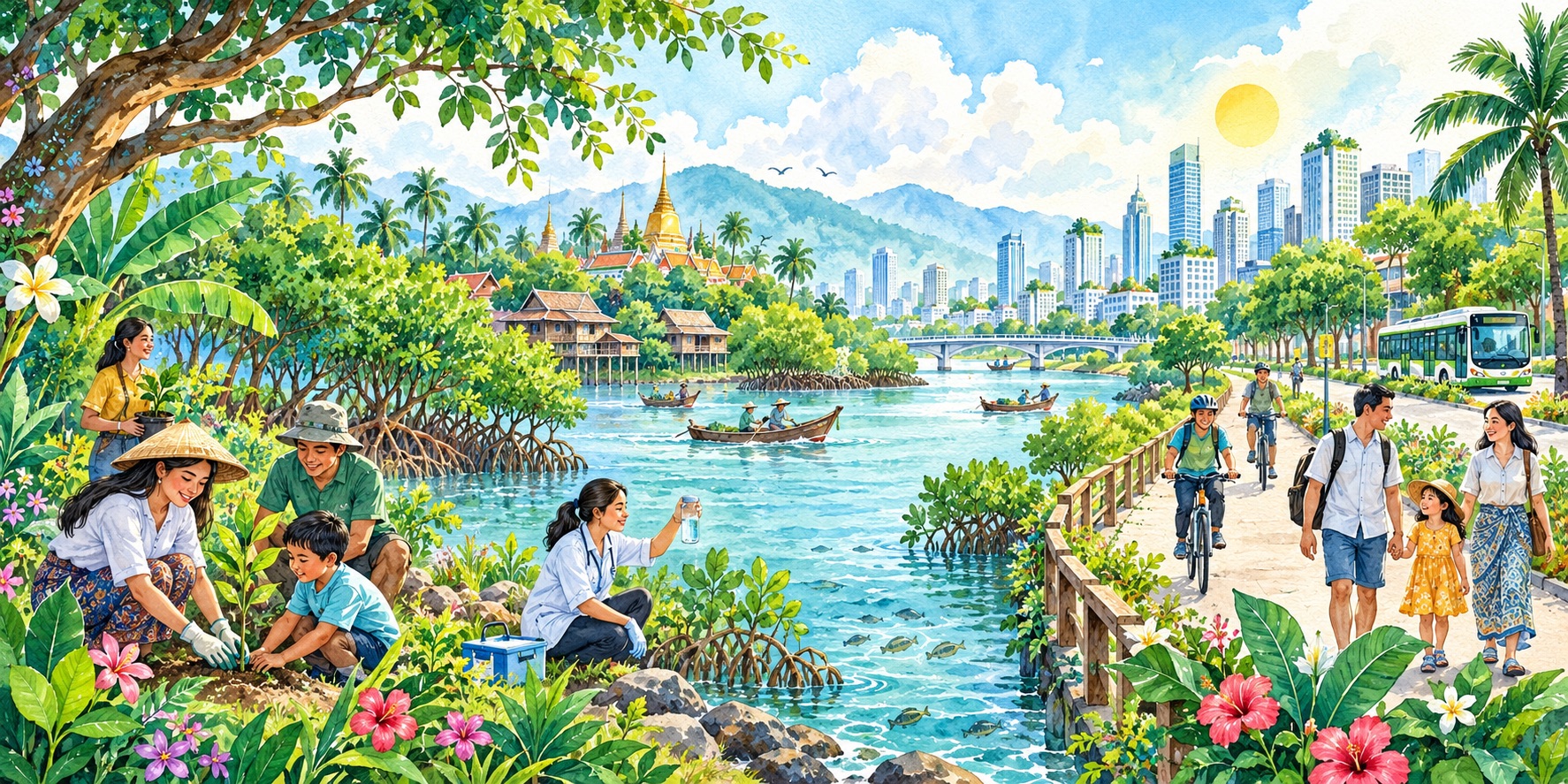
Bonifacio Magtibay, a Filipino environmental-health technical officer, has said, “Individuals can contribute in their own ways to protect their health from the impact of scarce water resources.” Conserving water, keeping household storage covered and protecting supplies from contamination all help, but responsibility cannot rest on families alone. Cities need reliable sanitation, industries need transparent discharge controls, and river restoration must connect upstream decisions with downstream health.
Heat, Waste and the Expanding Disease Map
Rising temperatures intensify these risks. Hotter, wetter and less predictable conditions create breeding opportunities for Aedes mosquitoes, while concrete-heavy neighbourhoods trap heat around homes, schools and workplaces. Indonesia recorded more than 257,000 dengue cases and over 1,400 deaths in 2024, according to the World Health Organization. That burden shows why drainage, waste collection, disease surveillance and climate adaptation belong in the same conversation.
Waste policy is also health policy. Indonesian environmental-health advocate Yuyun Ismawati has warned, “Refuse-derived fuels are a different form of pollution, but they are even worse because it converts visible pollution into invisible pollution.” Her point captures the danger of solutions that merely move contamination from streets into smoke, ash, food or soil. Community cleanups have value, but stronger producer responsibility, safer materials and circular systems address pollution closer to its source.
Building Health Before Illness Begins
Southeast Asia already has the foundations for progress: ASEAN cooperation on haze, Indonesia’s smarter dengue surveillance, electric mobility in Manila and Bangkok, and growing adoption of the One Health approach linking people, animals and ecosystems. The next step is to connect these efforts through shared data, stronger local health capacity and investment directed towards the most exposed communities.
World Environmental Health Day began in Bali as a call to a profession. In 2026, it can become a wider regional promise: to design cities, food systems and economies that protect health by protecting the environments in which health begins.


