


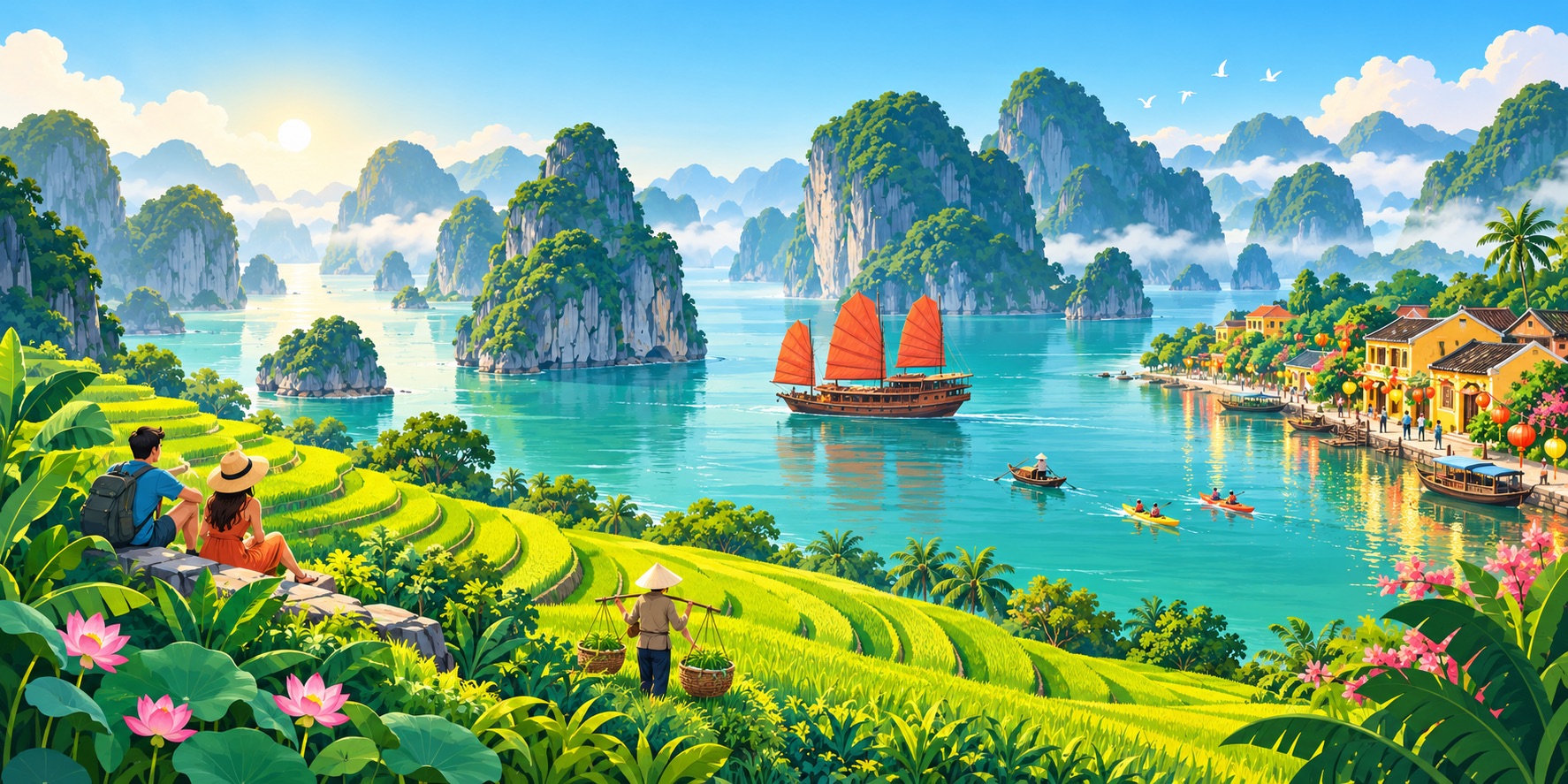
From the morning mist drifting between Ha Long Bay’s limestone towers to the evening glow of lanterns in Hoi An, Vietnam offers a journey shaped by contrast. Ancient capitals, mountain communities and rural waterways exist alongside cities racing toward the future.
That range is helping Vietnam move beyond post-pandemic recovery and into a new phase of tourism—one focused not only on attracting more people, but also on encouraging longer stays, stronger local connections and more responsible exploration.
Record Momentum, Greater Ambition
Vietnam welcomed 15.9 million international visitors during the first eight months of 2026, including nearly two million in August alone. The country is pursuing a full-year target of 25 million arrivals after receiving almost 21.2 million international and 137 million domestic visitors in 2025.
Air travel accounted for 83 percent of international arrivals during the January–August period. China and South Korea remained the two largest source markets, while Europe recorded growth of more than 53 percent. Arrivals from India, Russia, the Philippines and Cambodia also expanded significantly, reflecting Vietnam’s improving international connectivity.
The momentum has brought a new challenge: converting greater demand into higher-quality, more sustainable experiences. A national tourism resolution introduced in August 2026 calls for the industry to shift from volume-led expansion toward cultural value, environmental responsibility, technology and visitor satisfaction.
At the 2026 International Travel Expo Ho Chi Minh City, Deputy Prime Minister Pham Thi Thanh Tra captured the cooperative spirit required for that transition: “If we want to go far, we must go together; if we want to reach greater heights, we must rise together.”
Where Water Reveals Vietnam’s Natural Scale
In northern Vietnam, Ha Long Bay remains the country’s defining natural image. Traditional and boutique cruise boats move through emerald water surrounded by limestone pillars, floating communities and caves formed over millions of years. Kayaking into quieter lagoons or entering the vast chambers of Sung Sot Cave reveals a landscape far more intimate than its famous panoramic photographs suggest.
Several hours inland, Ninh Binh offers a gentler encounter with similar geology. At Trang An and Tam Coc, local boat operators guide visitors along narrow rivers, sometimes rowing with their feet as they pass beneath cavern ceilings and between rice fields framed by vertical karsts. The journey is slow, rhythmic and deeply connected to the agricultural landscape.
Vietnam’s geological drama reaches another scale at Phong Nha–Ke Bang National Park. Its cave systems include underground rivers, tropical forests and some of the planet’s largest subterranean chambers. Son Doong, widely recognized as the world’s largest natural cave, contains passages large enough to support their own jungle and localized weather conditions. Strictly controlled expeditions help limit pressure on this fragile environment, illustrating how high-value tourism can support conservation without opening every landscape to unrestricted access.
Heritage That Continues to Live
Hoi An’s appeal comes from more than its preserved architecture. Yellow-walled shophouses, family temples, workshops and the Japanese Covered Bridge recall the city’s history as an international trading port. As evening arrives, silk lanterns illuminate its lanes and riverside, creating a softer rhythm after the activity of the day.
The town’s popularity also demonstrates the pressures created by tourism success. Crowded streets and commercial development make responsible planning essential. Travelers can contribute by visiting family-run workshops, choosing locally owned accommodation and exploring nearby vegetable farms and craft villages instead of remaining entirely within the busiest historic lanes.
Farther north, Hue carries the memory of the Nguyen Dynasty through its Imperial City, royal tombs and pagodas beside the Perfume River. Its heritage is increasingly connected with cycling routes, garden houses, traditional music and regional cuisine, allowing visitors to experience the former capital as a living city rather than a collection of monuments.
Ho Chi Minh City provides a different historical encounter. French-era architecture, the Central Post Office and the War Remnants Museum stand within a metropolis of motorbikes, creative businesses and expanding skylines. The city’s energy illustrates Vietnam’s wider transformation: history remains visible, but it no longer confines the national story.
The Mountains Reward Slower Travelers
In the northwest, Sapa’s rice terraces descend through the Hoang Lien Son range in sweeping layers. Treks connecting Hmong and Red Dao communities can provide meaningful income and cultural exchange when organized through locally owned homestays and guides.
The experience is strongest when travelers move beyond staged encounters. Joining a host family for a meal, learning how medicinal plants are used or understanding the agricultural calendar gives greater context to landscapes that are often treated simply as photographic backdrops.
Ha Giang offers an even more dramatic mountain journey. The Ha Giang Loop winds through high passes, stone plateaus and valleys close to the Chinese border. At Ma Pi Leng Pass, the road looks down over the Nho Que River and some of Vietnam’s most imposing limestone scenery.
Its rising popularity brings consequences for road safety, waste management and village life. Traveling with experienced local drivers, staying longer in fewer places and respecting communities’ privacy can turn the route from a hurried motorbike circuit into a more thoughtful highland journey.
A Country Best Understood Through Food
Vietnamese cuisine gives every region its own voice. In Hanoi, a morning may begin with a bowl of northern-style phở, followed by bún chả served with grilled pork, noodles, herbs and dipping sauce. Egg coffee brings together strong robusta coffee and a rich whipped topping in a drink inseparable from the capital’s café culture.
The flavors change while moving south. Hue is known for aromatic and often spicy dishes such as bún bò Huế, while Hoi An’s cao lầu combines thick noodles, pork, greens and crisp textures. In the Mekong Delta, abundant herbs, fruit, coconut and freshwater ingredients produce sweeter and more tropical profiles.
Food tourism also creates direct opportunities for small businesses. Market visits, family cooking classes and neighborhood food walks connect travelers with growers, vendors and cooks whose knowledge gives each dish its identity.
Coastal Vietnam Finds New Rhythms
Da Nang has emerged as a modern coastal gateway combining long beaches, urban comforts and access to Hoi An, the Marble Mountains and the forested Son Tra Peninsula. Nha Trang continues to attract visitors with its waterfront, islands and established diving industry, while Phu Quoc brings together beaches, protected forest, fishing traditions and rapidly expanding resorts.
The speed of development on Phu Quoc makes environmental management especially important. Coral protection, plastic reduction, wastewater treatment and limits on construction will determine whether the island’s success strengthens or diminishes its natural appeal.
After visiting Phu Quoc, Singapore-based journalist Kerry Low wrote: “The more I saw of Phu Quoc, the more I realised that a few days was never going to be enough.” Her reaction reflects Vietnam’s wider strength: the country repeatedly encourages visitors to look beyond their original itinerary.
Turning Growth into Lasting Value
Vietnam’s new tourism direction recognizes that success cannot be measured by arrivals alone. National targets for 2030 include 45–50 million international visitors, 160 million domestic travelers, US$80–90 billion in tourism revenue and a direct contribution of 10–12 percent to gross domestic product. These ambitions also carry responsibility for heritage, ecosystems, infrastructure and the communities receiving visitors.
Vietnam rewards travelers who allow its stories to unfold slowly. A journey may begin with famous bays, caves and historic towns, but its lasting memories often come from quieter encounters: a boat rower in Ninh Binh, a family meal in the mountains or a bowl of noodles shared on a Hanoi pavement. In those moments, Vietnam’s timeless charm becomes something lived rather than simply observed.


