Fifteen corners, a 920 meter back straight, and track wide enough to invite three way battles into most braking zones. Sepang packs all of it into 5.54 kilometers, and still ranks among the toughest physical tests on the MotoGP calendar.
MotoGP itself describes Sepang as one of the longest laps on the calendar, with its heat and humidity making the circuit even more gruelling.
It's the combination high speed, heavy braking, tyre wear, and tropical heat piling up over the course of a full race that makes it a real test.
A Long Lap With Very Different Corners
Sepang runs 15 corners, 10 right handers and 5 lefts, across a track 16 meters wide. Its longest straight stretches 920 meters. MotoGP describes the layout as having four slow corners and ten medium to high speed corners.
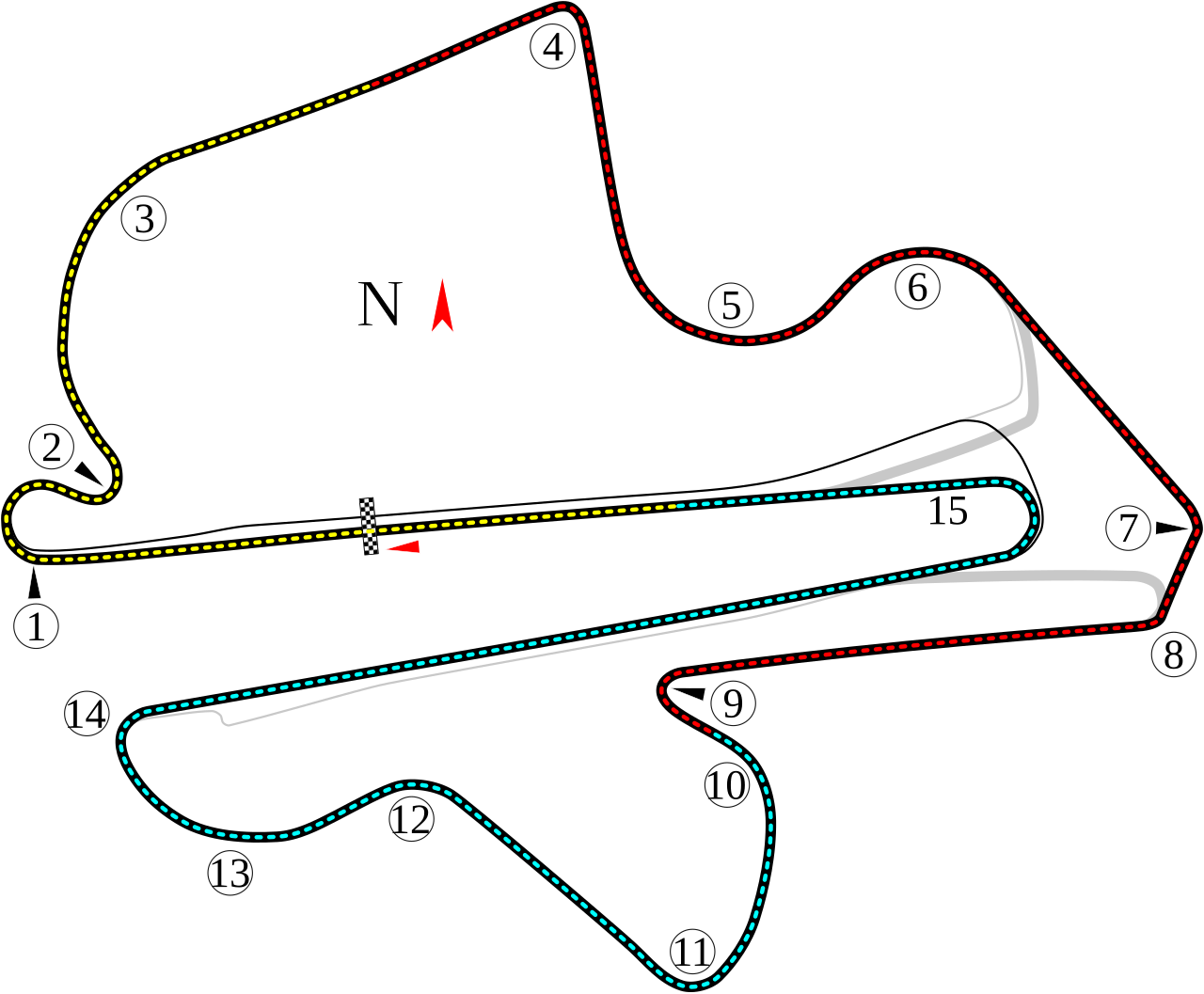
Riders exit the front straight into Turn 1, then drop straight into a tight left hander at Turn 2, before a long, fast Turn 3 gives way to another slow corner at Turn 4.
From there, the track opens up again. Turns 5 and 6 form a quick left right flick, followed by almost 400 meters of straight before two consecutive right handers at Turns 7 and 8. Turn 9 is the slowest corner on the circuit, requiring heavy braking before riders get back on the throttle for the next section.
The corner-by-corner description comes from a 2013 analysis by Malaysian Moto3 rider Zulfahmi Khairuddin, a Sepang native and former Red Bull KTM Ajo racer, published by Ajo Motorsport.
Then Come the Brakes
Sepang is brutal on brakes.
According to Brembo, the Italian brake manufacturer and supplier to the entire MotoGP grid, Sepang rates 5 out of 6 on its brake difficulty index, placing it among the hardest circuits on the calendar for stopping power. The circuit has 11 braking zones, with Turns 1 and 15 among its most demanding stops.
Brembo’s data, published by Box Repsol, shows just how hard Turn 1 is. Bikes arrive at around 320 km/h and have to shed most of that speed in 5.3 seconds, covering 260 meters while the rider applies 6.8 kilograms of force to the brake lever. The resulting deceleration reaches around 1.5 g.
Turn 15 isn't far behind. The braking zone at the end of the back straight requires 6.1 kilograms of force on the brake lever to bring the bike down to below 70 km/h over roughly 270 meters.
Two heavy stops, followed by numerous other braking zones, make Sepang a demanding circuit for MotoGP braking systems
Racing in 35 Degree Heat
Sepang sits in a hot, humid tropical climate. MotoGP notes that the Malaysian and Indonesian Grands Prix can see temperatures above 35°C and humidity above 70%, conditions that can cause rapid dehydration for riders.
Riders can lose 2 to 3 kilograms of body weight during a race, largely through sweating, while the intense heat also adds to the physical demands of riding an overheating motorcycle.
Valentino Rossi felt it firsthand.
Speaking ahead of the 2016 Malaysian Grand Prix at Sepang, Rossi told MotoGP that it was one of the most difficult races of the season because of the weather. He also described the Malaysian weekend as “very physically demanding” and said riders had to be particularly careful about what they ate and drank.
Maverick Viñales, speaking at the same pre-event press conference, described Malaysia as “one of the most difficult races” both physically and for the motorcycle.
Running Out of Rubber
Sepang's combination of hard acceleration, heavy braking and high track temperatures chews through rubber fast, and the 2025 race was proof.
MotoGP reported that Pedro Acosta arrived in Malaysia expecting tyre consumption to be a major challenge for his KTM. After struggling with tyre wear during the Sprint, the Spaniard changed his approach for Sunday’s race and managed the bike and its tyres carefully on his way to second place.
Joan Mir faced a different kind of problem. Speaking after the race, the Honda rider explained to MotoGP that following another bike caused his front tyre temperature to rise, making it harder to stop the motorcycle.
He then had to rely more on the rear to turn, which increased tyre consumption. Mir described the race as “one of the hardest races of my life” in terms of managing everything.
That's the real difficulty of Sepang. Not just the layout, not the heat, not the brakes on their own, but all three landing on a rider at once while the tyres go off too.