


The Javanese have long believed in the wisdom of urip iku urup—life is about giving light to others. For centuries, that spirit traveled far beyond the rice fields, villages, and royal courts of Java. Carried by traders, pilgrims, scholars, laborers, soldiers, and exiles, the Javanese journeyed across oceans and continents, leaving traces of their culture in places many Indonesians would never expect.
Today, more than 100 million Javanese live in Indonesia, making them the largest ethnic group in Southeast Asia and one of the largest ethnic communities in the world. While the overwhelming majority continue to reside on the island of Java, millions of their descendants can also be found in Malaysia, Suriname, Singapore, the Netherlands, Sri Lanka, South Africa, New Caledonia, and parts of the Middle East.
From Java to the World
The story of the Javanese diaspora did not begin with modern globalization. It began centuries ago when colonial powers moved people across their empires, often without choice.
Some were political exiles. Others were contract laborers, traders, religious scholars, or migrants seeking better opportunities. Wherever they arrived, they brought with them language, food, music, faith, and values rooted in Javanese culture.
Malaysia became home to the largest Javanese community outside Indonesia. Today, an estimated 1.5 to 2 million Malaysians have Javanese ancestry, particularly in Johor, Selangor, and Perak. Although many have assimilated into the broader Malay identity, Javanese traditions, family names, cuisine, and cultural expressions remain visible throughout the country.
In Singapore, scholars estimate that a significant portion of the Malay population has Javanese roots. Across the causeway from Java, cultural connections have endured through generations despite modernization and urbanization.
A Piece of Java in South America
Perhaps the most remarkable chapter of the Javanese story unfolded thousands of kilometers away in Suriname.
Between the late nineteenth and early twentieth centuries, the Dutch transported thousands of Javanese workers to the South American colony as indentured laborers. Today, their descendants account for roughly 13 to 15 percent of Suriname's population.
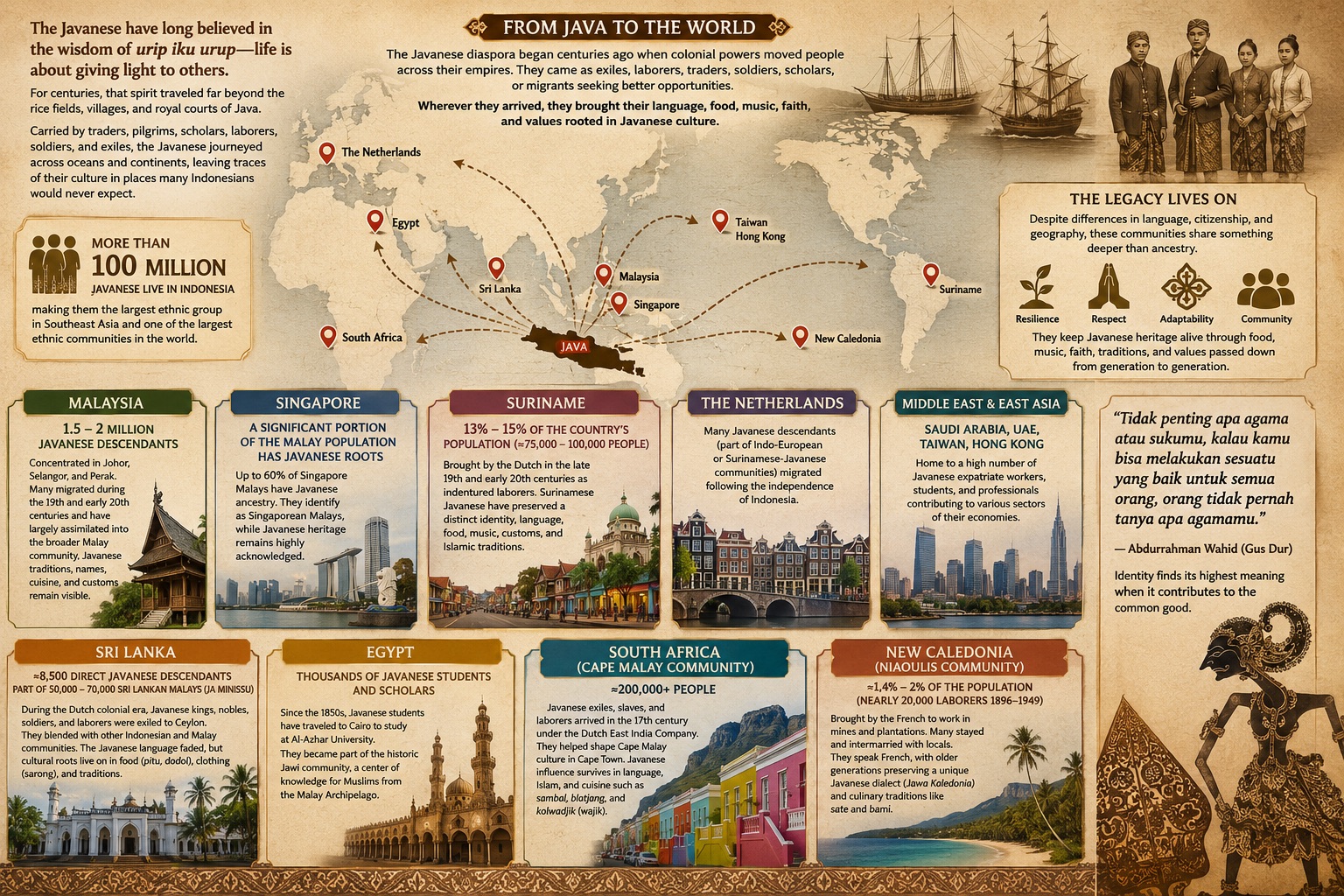
Unlike many diaspora communities elsewhere, Surinamese Javanese have preserved a distinct identity. Traditional dishes, Javanese words, family customs, music, and Islamic traditions continue to thrive. Walking through parts of Paramaribo can feel surprisingly familiar to visitors from Central or East Java.
Royal Exiles and Sacred Knowledge
The Javanese presence in Sri Lanka tells a different story. During the Dutch colonial era, rulers and nobles who resisted colonial authority were exiled from Java to Ceylon. Among them were members of the Mataram royal family, including Amangkurat III.
Over time, these communities merged with other Indonesian-origin groups and became part of what is now known as the Sri Lankan Malay community. Although the Javanese language gradually faded, cultural memories survived through food, clothing, and family traditions. Today, thousands of Sri Lankans continue to trace their ancestry to Java.
Egypt's connection with Java emerged through scholarship rather than exile. For generations, Javanese students traveled to Cairo to study at Al-Azhar University, one of the oldest centers of Islamic learning in the world. There, they became part of the historic Jawi community, representing Muslims from across the Malay Archipelago.
The Legacy Lives On
The influence of Javanese descendants can also be found in unexpected places such as South Africa and New Caledonia. In Cape Town, descendants of Indonesian and Javanese exiles helped shape what is now known as Cape Malay culture. In New Caledonia, nearly 20,000 Javanese laborers arrived between 1896 and 1949, and many families remain proud of their heritage today.
Despite differences in language, citizenship, and geography, these communities share something deeper than ancestry. They carry values that have endured across generations: resilience, respect, adaptability, and community.
Indonesia's fourth president, Abdurrahman Wahid—widely known as Gus Dur and himself a proud Javanese figure—once said, “Tidak penting apa agama atau sukumu, kalau kamu bisa melakukan sesuatu yang baik untuk semua orang, orang tidak pernah tanya apa agamamu.” His words reflected a philosophy deeply embedded in Javanese culture: identity finds its highest meaning when it contributes to the common good.
As the world becomes increasingly connected, the story of the Javanese diaspora reminds us that migration is not only about movement. It is about memory, adaptation, and continuity. From the villages of Central Java to the streets of Paramaribo, Cape Town, Colombo, and Nouméa, the spirit of Java continues to live on—quietly, resiliently, and far beyond the shores where its journey began.


