


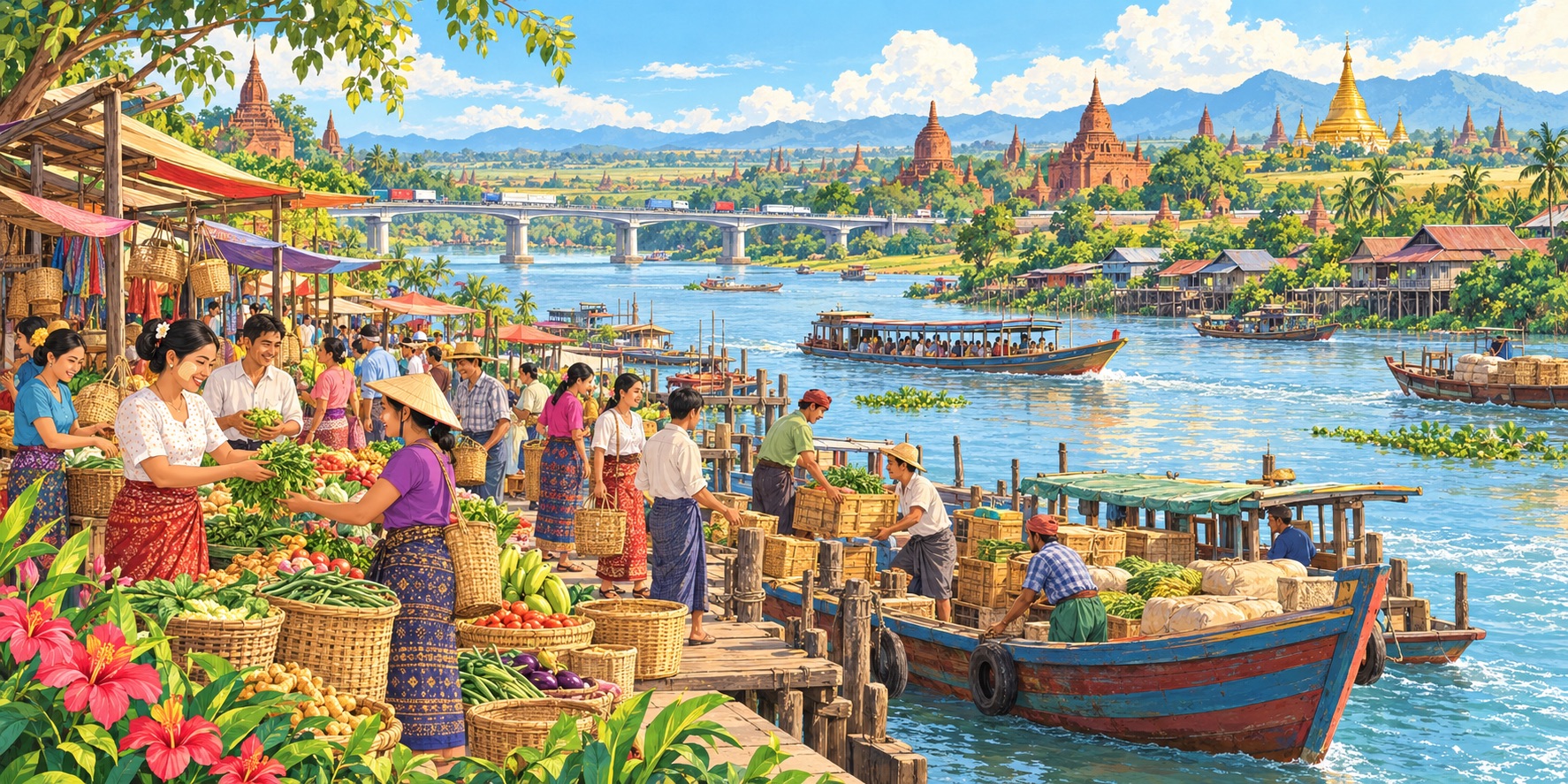
Along mainland Southeast Asia’s rivers, prosperity depends on more than the movement of water. Farmers need reliable markets, traders need predictable crossings, and communities need safe connections. Myanmar’s leadership of a five-country economic partnership places these everyday needs alongside a difficult question: how can regional cooperation deliver while conflict disrupts the routes it seeks to connect?
Building on Bagan’s Promise
The Ayeyawady–Chao Phraya–Mekong Economic Cooperation Strategy, or ACMECS, began in Bagan in November 2003. Cambodia, Laos, Myanmar and Thailand established the framework; Vietnam joined in May 2004. Named after three major rivers, the partnership promotes balanced development across countries with different economic strengths. It is an economic cooperation platform, rather than a treaty governing their river systems.
Myanmar holds the chairmanship for 2025–2026. At a virtual senior officials’ meeting on 25 February 2026, members agreed to accelerate the establishment of the ACMECS Development Fund and begin formulating a new master plan. These were commitments to advance unfinished work—not evidence that a fully operational fund was already financing projects across the region.
The distinction is consequential. Regional ambition becomes useful to communities only when funding, implementation and accountability follow.
Making Connections Work for Communities
Myanmar offers a western connection between mainland Southeast Asia and the Indian Ocean. The Greater Mekong Subregion’s East–West Economic Corridor links Vietnam through Laos and Thailand towards Myanmar’s coast. Although complementary to ACMECS, it belongs to a separate cooperation framework. Towns such as Myawaddy, Hpa-An and Mawlamyine illustrate how transport investment must be supported by water supplies, waste management and other basic services.
For a small exporter, dependable procedures can be as valuable as another stretch of highway. Yet Myanmar’s economic conditions constrain that promise. In June 2026, the World Bank estimated that its economy had contracted by 2% in the fiscal year 2025/26. Continued conflict, disrupted logistics and rising transport costs remained significant obstacles.
“Greater predictability and better coordination will be key to supporting firms, restoring confidence, and unlocking growth,” said World Bank senior economist Kemoh Mansaray in that assessment. His observation identifies a practical priority for cross-border cooperation: businesses need rules and services they can rely on.
Sharing Tourism’s Opportunities
Tourism offers another avenue for partnership. At their August 2026 meeting in Ho Chi Minh City, ACMECS tourism ministers adopted a cooperation action plan for 2026–2028, supporting the “Five Countries, One Destination” concept.
Figures presented at the meeting put combined international arrivals at approximately 65.27 million in 2025, generating around US$94.08 billion in tourism revenue. These totals describe the member countries’ tourism economies; they do not establish how much growth ACMECS itself produced.
The plan prioritises easier travel, digital transformation, community-based tourism, safety and workforce development. River journeys, local food and cultural heritage could connect smaller destinations to wider itineraries. Delivering those benefits requires realistic safety information and local participation, alongside promotion. A shared destination identity cannot guarantee equally accessible conditions across five countries.
Keeping Rivers in the Development Conversation
Economic connections also depend on healthy landscapes. Roads, visitor facilities and river transport should be planned alongside flood risks, fisheries and the needs of riverside settlements.
Speaking about Mekong governance in 2022, Lao river expert Anoulak Kittikhoun, then chief executive of the Mekong River Commission Secretariat, urged institutions to “bring the science directly to the people”. That principle offers a useful lesson for ACMECS: communities should be able to understand and question the evidence behind development decisions.
Myanmar’s chairmanship can help keep essential regional conversations moving. Its value will ultimately be measured in safer journeys, more dependable livelihoods and development that respects the rivers sustaining them. Cooperation succeeds when the promise of connection reaches the people living along the route.


