In East Nusa Tenggara, a mountain site in Kupang Regency is about to host the largest optical telescope in Southeast Asia, according to the National Research and Innovation Agency (BRIN).
The 3.8 meter instrument sits at the National Observatory of Mount Timau, roughly 1,300 meters above sea level, and is designed to expand Indonesia's capacity for astronomical research.
The comparison is for optical telescopes only.
Thailand's 40 meter Thai National Radio Telescope has a far larger diameter, but it observes radio waves rather than visible light. Among optical instruments, BRIN cites Thailand's 2.4 meter telescope as the largest existing in the region, which puts Timau's mirror 1.4 meters wider.
A 3.8 Meter Eye on the Sky
Timau's main mirror is 3.8 meters across, giving it about 2.5 times the light collecting area of a 2.4 meter mirror. BRIN says the larger mirror allows the telescope to collect more light, helping astronomers observe fainter objects.
According to BRIN, the primary mirror is made up of 18 petal shaped segments. Kyoto University, which developed the design with BRIN, says the segments sit in two rings, with six in the inner ring and 12 in the outer ring, and are aligned to work together as a single mirror.
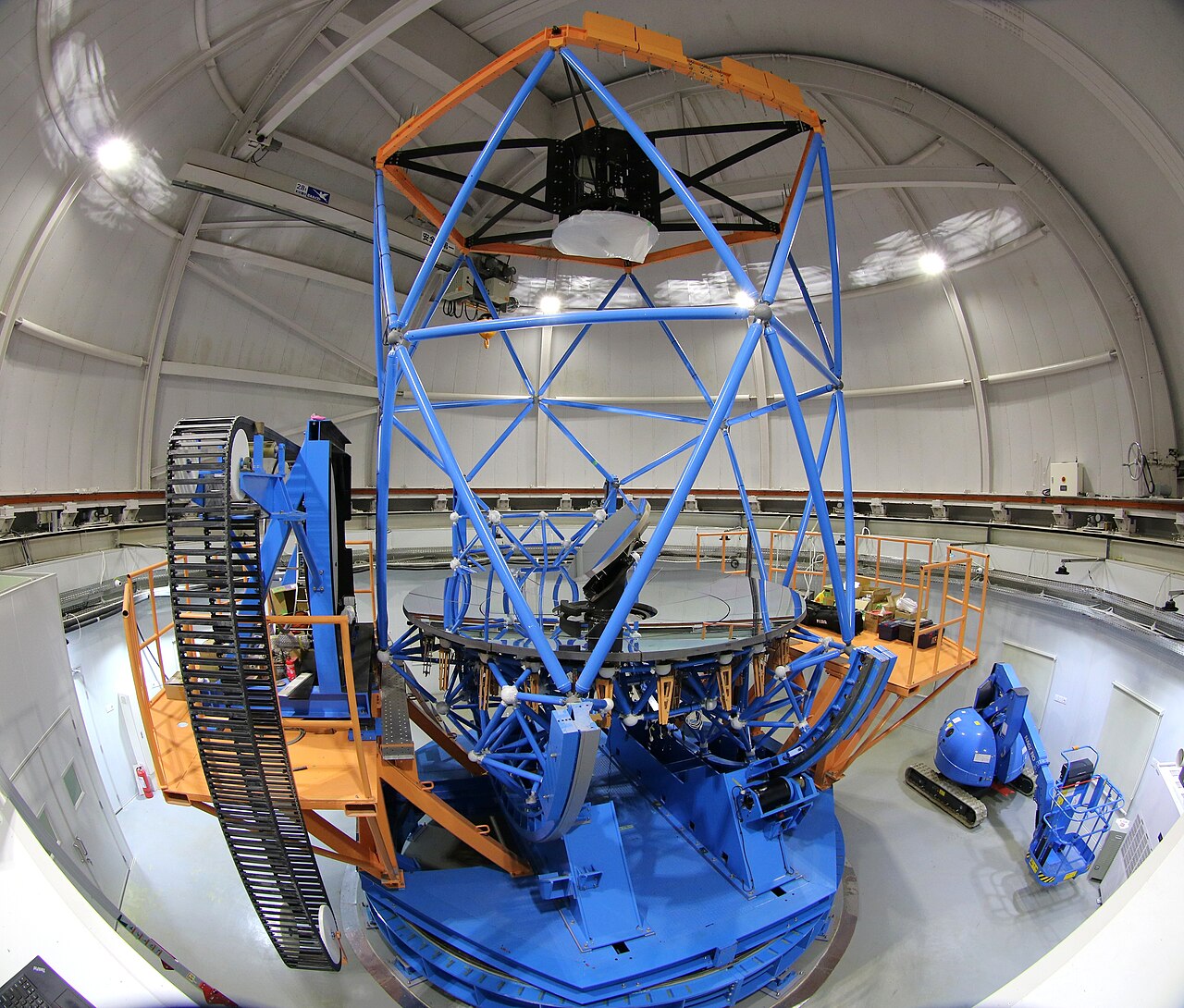
Kyoto University's technical description of its 3.8 meter Seimei telescope says each of its 18 mirror segments weighs about 70 kilograms. The James Webb Space Telescope also has 18 primary mirror segments, although NASA says its mirror is much larger at 6.5 meters across.
Why Put It in Eastern Indonesia?
BRIN selected the Timau site after a long study by Indonesia's astronomy community.
The agency says about 66 percent of nights there are suitable for up to eight hours of observation, while the area has a predominantly dry climate. The observatory sits at around 1,300 meters above sea level. Its location close to the equator also gives Timau broad access to both the northern and southern skies.
A study, Characterization of Timau National Observatory using limited in situ measurements, published in the Monthly Notices of the Royal Astronomical Society by researchers from BRIN and the Bandung Institute of Technology (ITB), found that more than 70 percent of the sky can be observed from Timau when objects are at least 10 degrees above the horizon.
The same location is useful for tracking satellites and space debris.
Geostationary communications satellites orbit above the equator, and BRIN researchers say they appear much higher in the sky from Indonesia than from higher latitude locations such as Europe.
The telescope can also work alongside facilities in other parts of the world, such as Switzerland's Zimmerwald Observatory, allowing researchers to observe the same objects from different locations and times.
Supernova to Space Debris
BRIN says Timau will support research on supernova, asteroids, comets, exoplanets and galaxies, while also opening opportunities for wider space research and international collaboration.
The telescope underwent engineering first light tests from 24 to 30 March 2026, while its mirrors and other systems were still being installed and aligned. On 27 March, a Trioptika camera was installed and pointed at the Moon and Jupiter. It successfully recorded light from Jupiter, although the image was still unfocused and unaligned, according to ITB.
In May 2026, BRIN said construction of the telescope had reached about 95 percent. ITB said scientific first light was expected in June-July 2026, and BRIN targets operations within 2026. As of early October 2026, no public confirmation of scientific first light was available.