


ASEAN’s energy consumption is projected to rise substantially over the coming decades. As industries expand, cities grow, and demand for transport, cooling, and digital services increases, the region faces a pressing question: can its energy system keep up without becoming more dependent on fuel imports?
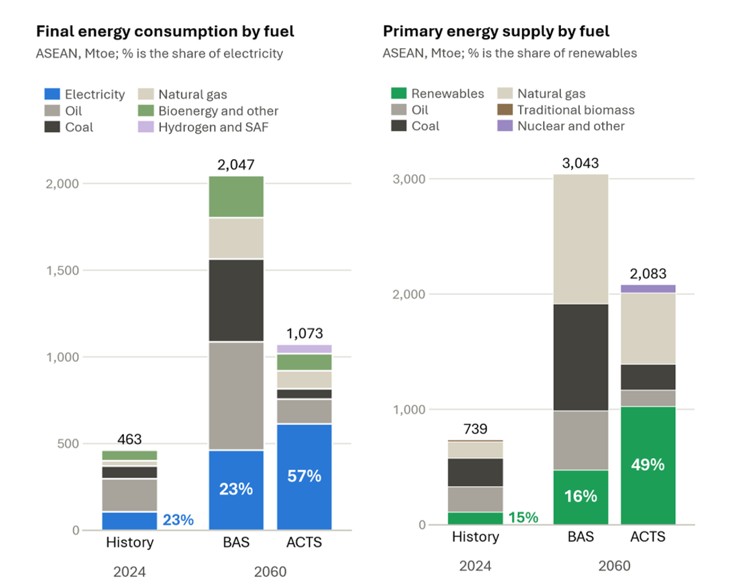
The 9th ASEAN Energy Outlook (AEO9), launched by the ASEAN Centre for Energy (ACE), projects that ASEAN’s final energy consumption could reach 2,047 million tonnes of oil equivalent (Mtoe) by 2060 if current policy trends continue. Under a more coordinated transition, however, consumption could be limited to 1,073 Mtoe, nearly half the baseline projection.
The difference highlights the scale of the challenge. ASEAN must meet rising energy needs while managing consumption, strengthening energy security, and adapting its energy systems to changing demand.
Industrial growth, freight transport, greater household cooling needs, urban development, and expanding digital services are expected to drive demand higher.
Meanwhile, growing dependence on oil imports and weakening export competitiveness in other fossil fuels could leave the region more vulnerable to supply disruptions and global price fluctuations.
AEO9 outlines three scenarios to examine how different policy choices and levels of regional cooperation could influence ASEAN’s ability to meet its future energy needs.
Three Scenarios for ASEAN’s Energy Future
The report examines three pathways: the Baseline Scenario (BAS), the AMS Target Scenario (ATS), and the ASEAN Coordinated Transition Scenario (ACTS). Each illustrates how the region’s energy system could evolve under different assumptions about policy implementation, national targets, technology adoption, investment, and regional coordination.
Under BAS, ASEAN’s final energy consumption is projected to reach 2,047 Mtoe by 2060. If national policies and targets are implemented as outlined in ATS, consumption is projected to fall to 1,482 Mtoe.
ACTS projects a further reduction to 1,073 Mtoe through faster improvements in energy efficiency, electrification, fuel switching, and regional cooperation.
ACE Executive Director Dato’ Ir. Ts. Razib Dawood said, “ASEAN’s energy security is determined not only by how much energy we can produce or import, but also by how efficiently we use it and how well our energy systems are integrated. AEO9 underscores the growing importance of regional coordination in ensuring that energy remains affordable, reliable, and resilient as demand increases.”
Energy Efficiency Is Key
Meeting future energy needs will depend not only on expanding supply, but also on how efficiently energy is used. One major difference between BAS and ACTS lies in the role of electricity. Under ACTS, electricity is projected to account for 57.2% of ASEAN’s final energy consumption by 2060, compared with 22.6% under BAS.
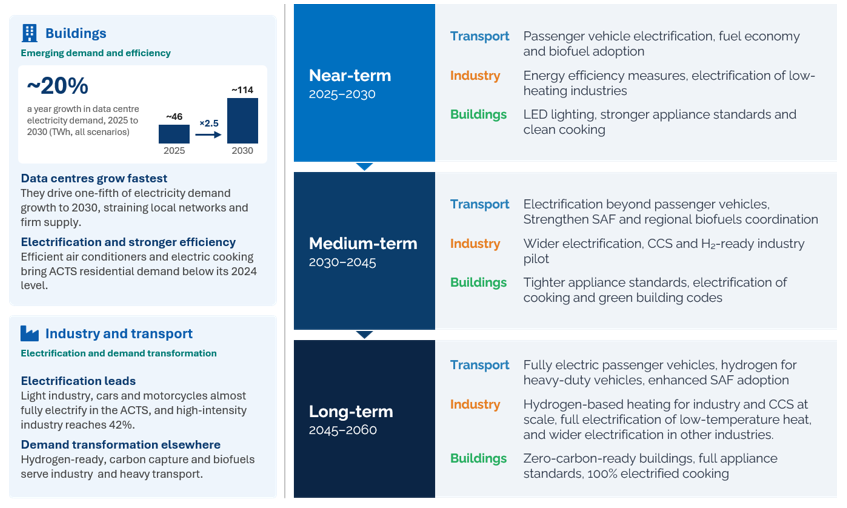
Achieving this shift will require more efficient technologies and greater electrification across sectors, from industry and transport to commercial buildings and households. Higher efficiency standards and replacing energy-intensive equipment could help reduce energy demand while limiting dependence on imported fuels.
Improving energy efficiency could also reduce the need to expand energy supply infrastructure as quickly as demand would otherwise require. Without such improvements, meeting future consumption needs could put greater pressure on the region’s energy systems.
Expanding Renewable Energy
ASEAN also aims to increase renewables’ share of installed power capacity to 45% by 2030. Reaching this target would require adding around 26 gigawatts of renewable energy capacity annually.
Achieving the goal will require faster project development across member states and investment in electricity networks capable of accommodating additional renewable capacity. Stronger grid connections will also be important for integrating different energy sources and delivering electricity where it is needed.
The investment required for this transition is substantial. Under ACTS, cumulative investment needs are estimated at US$14.1 trillion through 2060, equivalent to approximately US$405 billion annually. This would support the broader transformation of ASEAN’s energy system, including energy efficiency, electrification, renewable energy deployment, and electricity infrastructure.
ASEAN’s energy outlook will ultimately depend on how effectively its member states respond to rising demand. The difference between the three AEO9 scenarios shows that the region’s future energy needs are not fixed. Coordinated action on efficiency, renewable energy, investment, and regional power connections could help ASEAN meet those needs while reducing the amount of energy it consumes.


