


A fishing boat returning to port, a container ship entering Singapore and a dive guide preparing visitors for a reef encounter share the same foundation: a functioning ocean. Across Southeast Asia, protecting that foundation is becoming an economic and diplomatic priority as warming waters, coastal development and competing maritime claims put pressure on daily life.
Keeping the Region’s Living Wealth Healthy
The Coral Triangle captures the extraordinary scale of this shared inheritance. Stretching across Indonesia, Malaysia, the Philippines, Timor-Leste, Papua New Guinea and the Solomon Islands, it contains approximately three-quarters of known reef-building coral species. Its boundaries extend beyond Southeast Asia, but the region’s islands form a substantial part of this global centre of marine biodiversity.
That abundance faces mounting heat stress. In June 2026, the US National Oceanic and Atmospheric Administration reported that the fourth global coral bleaching event likely ended in mid-2025, after bleaching-level heat affected approximately 84% of the world’s reef area. The figure measures exposure to dangerous temperatures, rather than the proportion of coral that died.
Less conspicuous species also reveal the pressures beneath the surface. A 2026 National University of Singapore report highlighted declining giant clam populations across Southeast Asia, which hosts eight of the world’s 12 species. In Singapore, coastal development and sedimentation threaten their remaining habitats.
“Through the analysis, we discovered our common strengths and weaknesses,” said marine scientist Dr Neo Mei Lin, describing regional research into giant clam conservation. The study identifies stronger enforcement, better survival of young clams and sustained funding as priorities.
Connecting Healthy Seas with Prosperous Communities
The ocean’s economic contribution stretches from fish markets to international shipping terminals. Singapore handled a record 44.66 million twenty-foot equivalent units of containers in 2025, an 8.6% increase from 2024. That throughput illustrates the scale of maritime commerce moving through Southeast Asia’s ports.
For coastal households, however, prosperity depends on more immediate questions: whether catches remain reliable, whether seafood reaches markets before spoiling and whether fishing grounds remain accessible. Port expansion, tourism construction and conservation restrictions all require decisions about who benefits and who bears the costs.
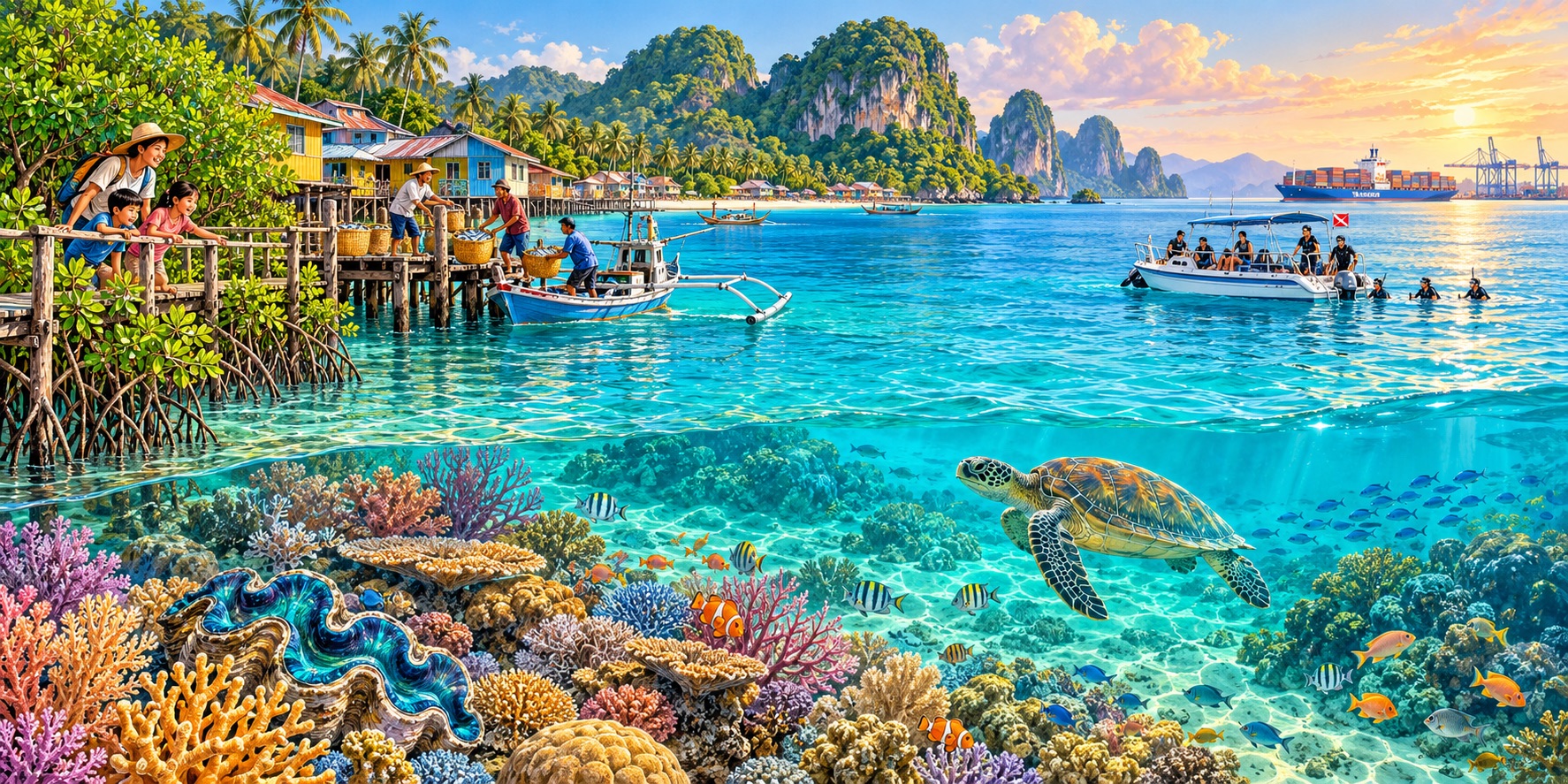
Mangroves, seagrass beds and coral reefs belong in those economic calculations. They provide feeding and breeding habitats for commercially important fish, while coastal vegetation stores carbon and helps protect shorelines. Indonesia’s experience demonstrates why maintaining these ecosystems is central to food security and coastal livelihoods.
Making Tourism Support Recovery
Thailand’s Maya Bay offers a practical example of placing ecological limits on visitor access. Its August–September 2025 closure gave the marine environment a seasonal respite while tourism continued elsewhere around the Phi Phi islands. Such measures acknowledge that a destination’s appeal depends on the survival of the landscape visitors come to enjoy.
Across coastal destinations, responsible tourism requires more than environmental branding. Wastewater treatment, sensible visitor limits, responsible boat operations and fair opportunities for local guides and businesses should underpin growth. Higher visitor spending alone cannot guarantee healthier reefs or stronger community livelihoods.
Building Cooperation Across Shared Waters
Regional conservation is increasingly organised around ecological connections. Launched in 2024, ASEAN ENMAPS works across 11 pilot sites in Indonesia, the Philippines and Thailand to improve networks of marine protected areas and associated corridors.
“Conservation is an ongoing endeavour, and learning to conserve more effectively is a gradual process,” said Dr Sheila G. Vergara, the project’s manager and chief technical adviser, at its launch. The programme’s emphasis on connected habitats recognises that protecting an isolated reef cannot address every threat moving through surrounding waters.
Security cooperation is equally consequential. ASEAN’s May 2026 declaration on maritime cooperation reaffirmed peaceful dispute resolution and respect for international law, including UNCLOS. These commitments provide a basis for managing tensions, although declarations alone cannot ensure safe fishing access or prevent confrontation.
Southeast Asia’s ocean future will be shaped by decisions made in fishing villages, tourism offices, port authorities and diplomatic meetings. Bringing those decisions together can help keep its waters productive, its coastal communities secure and its extraordinary marine life alive.


