


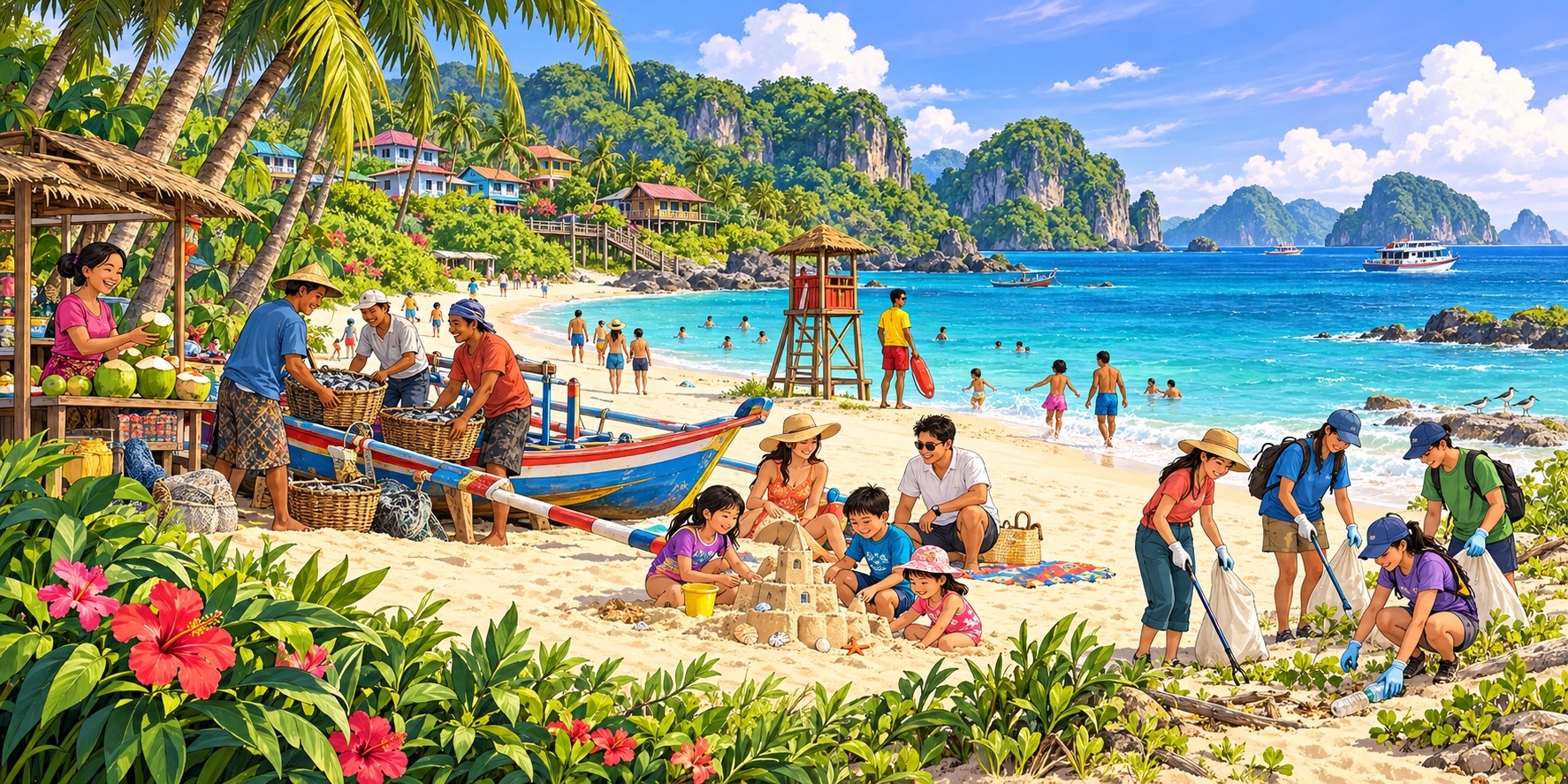
Before the sun loungers fill, Southeast Asia’s beaches are already at work. Fishing boats return with the morning catch, vendors prepare their stalls and guides ready visitors for the water. In 2026, protecting these shorelines means safeguarding both the landscapes travellers love and the communities whose livelihoods depend on them.
Giving Nature Room to Recover
Thailand’s Maya Bay illustrates the difficult balance between welcoming visitors and protecting coastal habitats. The celebrated cove reopened on October 1, 2026, following its annual two-month conservation closure, continuing an approach that makes ecological recovery part of the tourism calendar.
Its earlier rehabilitation revealed how visitor infrastructure can affect marine life. “Before Maya was closed for rehabilitation, boats were the main problem,” Kasetsart University marine scientist Thon Thamrongnawasawat told CNA in 2022. Restrictions on boats entering the bay became an important part of its protection.
Closures, however, require continuing management after reopening. Wastewater treatment, responsible anchoring, wildlife monitoring and limits suited to local conditions are essential. A beach can look pristine above the water while nearby habitats remain under pressure.
Keeping Tourism’s Benefits Close to Home
The economic stakes are substantial. Boracay welcomed approximately 2.16 million tourists in 2025 and generated around ₱47 billion in tourism-related revenue, according to figures reported by the Philippine Information Agency. Domestic visitors accounted for the largest share, demonstrating how regional beach economies depend heavily on their own citizens as well as international travellers.
Those earnings support accommodation providers, boat crews, restaurants, transport operators and small shops. They also create a responsibility to invest in the infrastructure that makes tourism viable: sanitation, reliable water supplies, waste collection and safe public access.
For fishing families, the beach is also a workplace. Coastal development should preserve boat landings and access routes, while tourism partnerships can create opportunities for local guides, food suppliers and homestay operators. Conservation becomes more durable when residents help shape decisions and receive a fair share of the benefits.
Planning for a Changing Shoreline
Erosion and flooding make that planning increasingly urgent. The 2020 Resilient Shores assessment, prepared by Vietnam’s government, the World Bank and partners, estimated that 12 million people in coastal provinces faced exposure to intense flooding. More than 35% of settlements were located along eroding coastlines. These are historical assessment figures, but they establish the scale of vulnerability facing coastal development.
“To secure prosperity, we must invest in resilience,” said Tran Quang Hoai, then director general of the Vietnam Disaster Management Authority, at the report’s release.
The appropriate response varies by shoreline. Vietnam’s Mekong Delta offers examples combining sea dikes, wave breakers and mangrove belts, rather than relying on one intervention alone. Protecting coastal livelihoods requires understanding sediment movement, water conditions and the ecosystems suited to each location.
Healthy reefs, coastal vegetation and wetlands can contribute to protection, but restoration must fit local ecology. A successful mangrove project cannot simply be copied onto every open sandy beach.
Making Safety Part of the Beach Experience
Coastal security also begins with preparedness. In Bali, Tanjung Benoa received UNESCO-IOC Tsunami Ready recognition in 2022, providing a local example of community-based risk reduction in a tourism destination. The programme emphasises awareness and preparedness to protect lives, livelihoods and property.
For beach destinations, this means connecting warning systems with understandable evacuation information, trained staff and community participation. Residents and visitors need to know how to respond, including people unfamiliar with local languages or geography.
These measures complement everyday priorities such as lifeguarding, safe boating and maintaining public access. Environmental protection, visitor safety and community welfare belong within the same coastal management plan.
Southeast Asia’s beaches will remain valuable only if the systems supporting them remain healthy. Their future rests on practical choices: where to build, how many visitors to accommodate and how to protect the people who call the shoreline home.


