The Leaning Tower of Teluk Intan is a historic building standing in the city center of Teluk Intan, Perak, Malaysia. The physical structure appears tilted when viewed from the outside.
The building was first erected during the British colonial era in 1885. A local contractor named Leong Choon Cheong initiated its construction, which reached a height of approximately 25.5 meters. The exterior design was crafted to resemble a Chinese pagoda style.
Its primary materials are dominated by red bricks imported from China along with local hardwood elements. Although it looks like an eight-story structure from the outside, the interior of the tower is actually divided into only three main floors.
The Original Purpose of Construction
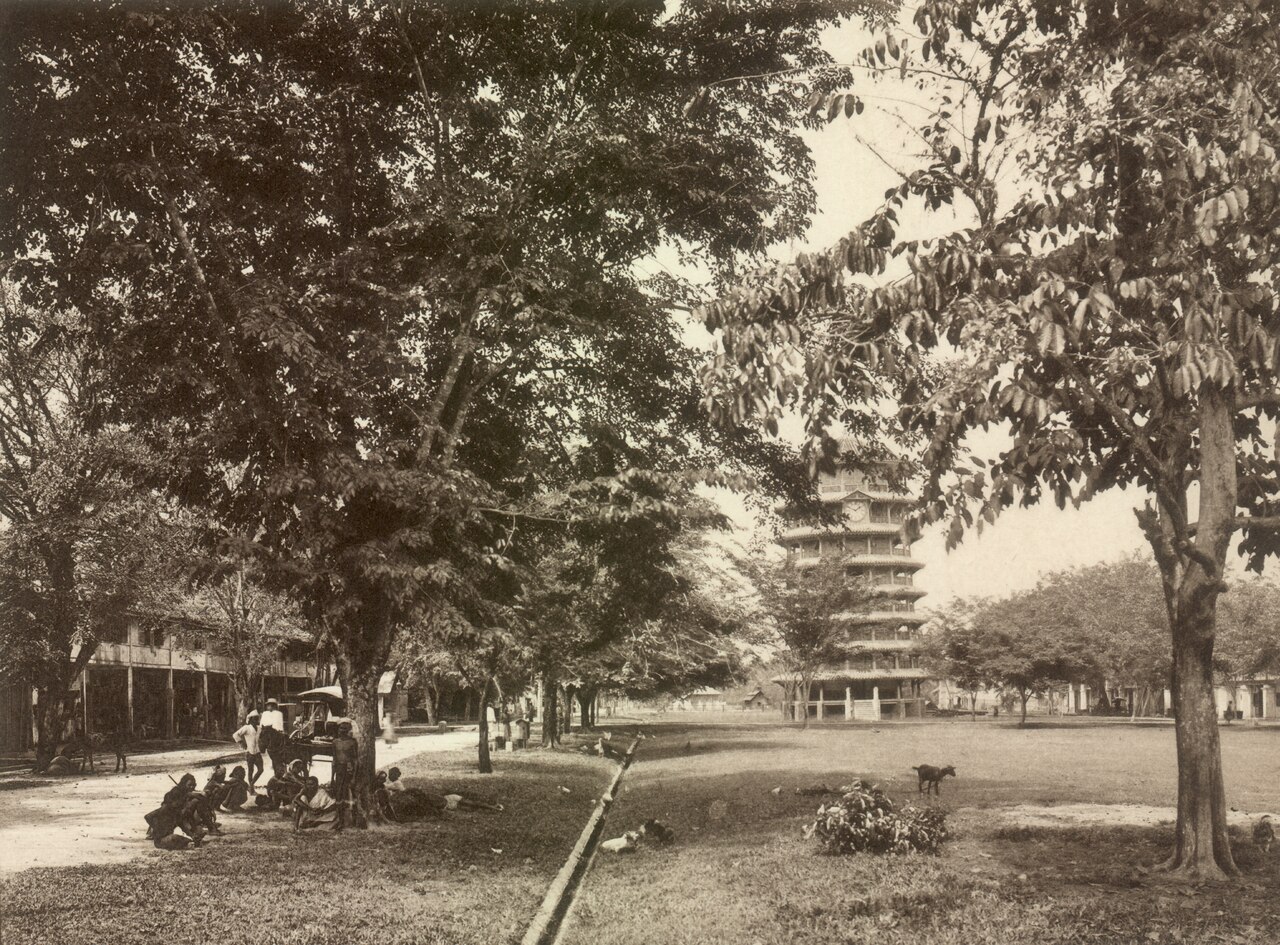
The construction of the tower was not originally intended as a tourism icon. As a step to address public needs, the colonial government alongside the local community designed a clean water storage facility for the residents of Teluk Intan.
To fulfill its function, a water tank with a capacity of 5,000 gallons, equivalent to 18.9 cubic meters, was installed on the upper floor of the tower. The water supply inside the tank was used for the daily needs of residents, as well as serving as a reserve in case of fire hazards in the residential area.
In addition to serving as a water reservoir, a large clock was installed on the upper section of the building in 1894. The mechanical clock was imported directly from London and designed by the renowned clockmaker James Wilson Benson. The purchase of the clock was funded through donations from the public and the local government.
As a timekeeper, the chiming of the mechanical clock was set to ring every 15 minutes. The sound of the chime became the primary reference for the daily activities of the townspeople during that era.
Primary Causes of the Structural Tilt
Behind its function as a timekeeper, the tower began to lean a few years after its construction was completed. The issue stemmed from the ground conditions at the building site, which was a soft swampy area near the Perak River.

The heavy load of the brick structure and thousands of gallons of water in the tank exerted immense downward pressure. Consequently, the foundation built on the soft soil was unable to support the weight evenly over the long term.
The soil conditions further deteriorated when major floods struck the Teluk Intan region in 1889 and 1895. The overflowing water eroded the area around the foundation and seeped into the soil layers beneath the building.
The impact of the repeated floods triggered significant soil movement. As a result, the tower gradually leaned further toward the southwest, forming the angle of tilt that persists to this day.
Transition to a Tourist Destination
Realizing the increasingly tilted position of the building, authorities eventually decommissioned the water tank entirely. Draining the water supply was done to reduce the weight pressure on the foundation and prevent the risk of structural damage.

Although the water storage function was deactivated, the clock mechanism at the top of the tower was left operating normally. The tower was preserved in its leaning state because technical inspections indicated that the shifting movement of the structure had stabilized.
Preservation efforts entered a new phase in 2015 when the Malaysian government officially declared the Teluk Intan Clock Tower a national heritage site under the National Heritage Act 2005. To protect its aging foundation from vehicle vibrations, local authorities also pedestrianized the surrounding Jalan Ah Cheong area, which transformed the space into an open public plaza.