Artificial intelligence has become part of everyday life, from answering questions and generating images to helping people write and work. But behind these digital services is a physical infrastructure that requires electricity, cooling systems, and, in many cases, large amounts of water.
This has raised an increasingly common question. Does using AI really consume as much water as some reports suggest?
The short answer is that AI does consume water, but the figures vary widely and often need more context.
The Water Behind Data Centers
Every AI model runs on powerful computers housed in data centers. Processing information generates substantial heat, so cooling systems are essential to keep the servers operational.
Cooling methods differ by facility. Some data centers use water-based systems, where water absorbs heat and evaporates to lower temperatures. Others use air cooling or alternative technologies that reduce the need for water.
Cooling covers only part of the footprint. Some power plants need water to generate electricity, and manufacturing semiconductors and other hardware for AI systems also uses water.
The International Energy Agency (IEA), in its 2025 report titled "Energy and AI", estimated that data centers worldwide consumed approximately 560 billion liters of water in 2023. Around two-thirds of this amount was linked to energy supply and electricity generation, while roughly one-quarter came from direct cooling. Semiconductor and microchip manufacturing accounted for the remainder.
The IEA projects that annual water consumption by data centers could reach 1.2 trillion liters by 2030 under its base-case scenario.
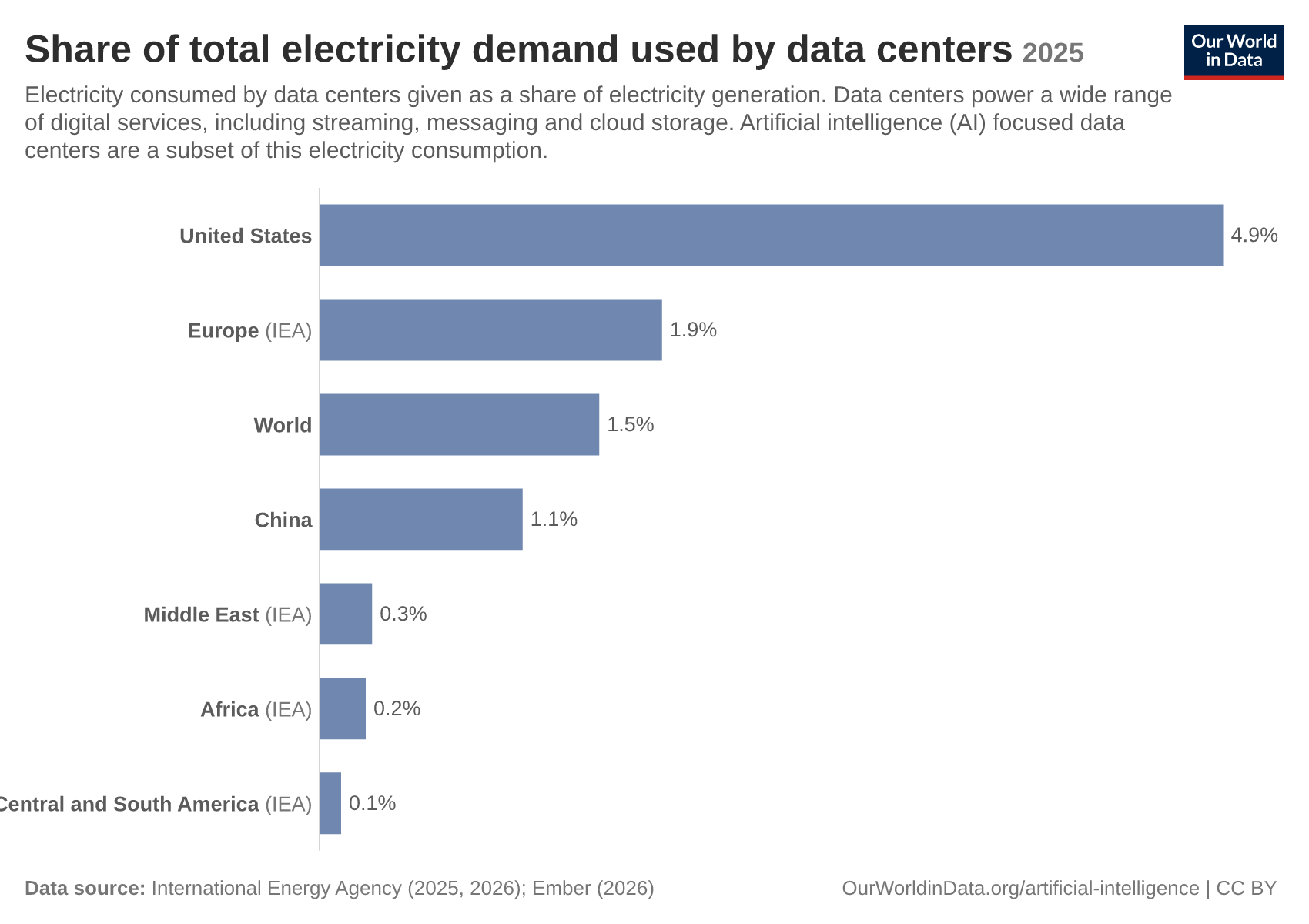
These figures cover all data center activities, not AI alone. Cloud computing, online storage, streaming, and other digital services also contribute to the total, while the rapid expansion of AI adds to the demand for computing infrastructure and its associated resources.
One Bottle of Water per Chat?
A widely circulated estimate comes from a 2025 study titled "Making AI Less ‘Thirsty’", published in Communications of the ACM.
Using GPT-3 as a case study, the study estimated that training the model in Microsoft’s US data centers could consume approximately 5.4 million liters of water in total. Around 700,000 liters of this was consumed directly at the data center, with the remainder associated with electricity generation.
The study also estimated that GPT-3 could consume the equivalent of a 500 milliliter bottle of water for approximately 10 to 50 medium-length responses, depending on where and when the model operates.
This does not mean every AI conversation consumes half a liter of water. The estimate rests on a particular model, infrastructure, and set of assumptions, and water consumption varies with server efficiency, cooling technology, electricity sources, and local weather conditions.
The study’s own calculations show this variation. Its estimates for 500 milliliters of water ranged from approximately 10 to 66 responses across different US data center locations.
Same AI Model, Different Water Footprint
Where a data center operates strongly influences how much water it consumes.
Facilities in hotter climates may require more intensive cooling, while those in cooler environments can sometimes rely more heavily on outside air. Electricity supply matters too, since different energy sources have different water requirements.
Local conditions add another layer. A data center may account for a relatively small share of water use at the national level but still affect local supplies if it operates in an already water-stressed area.
Two measurements are central to these comparisons.
Withdrawal refers to water taken from a source, some of which may eventually be returned. Consumption refers to water that is not returned to the original source, often because it evaporates.
Mixing up the two measurements can make comparisons misleading.
Can Data Centers Use Less Water?
Technology companies are testing ways to reduce their water footprint as demand for AI services grows.
Microsoft introduced a data center design that uses direct-to-chip cooling and does not require water for cooling during normal operations. According to its Environmental Sustainability Report 2025, this approach could avoid using more than 125,000 cubic meters of water annually per facility compared with conventional designs.
Google reports a different kind of effort. According to its 2026 Environmental Report, the company replenished approximately 7.7 billion gallons, or 29 billion liters, of water through its projects in 2025. This equaled around 78% of its freshwater consumption for that year.
Replenishment and reduced consumption are separate measures. Replenishment projects aim to restore or improve water resources, while the company’s data centers and other operations still use freshwater.
The Bottom Line on AI and Water
AI has a water footprint, and its expansion increases demand for the infrastructure that supports it. Claims about how much water each conversation consumes depend heavily on the model, data center, and assumptions behind the estimate.
Per-conversation figures cover only one part of the picture. The IEA estimated that data centers worldwide consumed approximately 560 billion liters of water in 2023 and projects annual consumption could reach 1.2 trillion liters by 2030 under its base-case scenario.
These totals include all data center activities, from cloud computing to AI, along with the energy supply and the infrastructure behind millions of daily interactions.
Several factors shape the final footprint. They include computing efficiency, cooling technology, electricity sources, and data center location. Behind every digital service sits physical infrastructure that needs electricity, cooling, and water.
Reference
Li, P., Yang, J., Islam, M. A., & Ren, S. (2025). Making AI less 'thirsty': Uncovering and addressing the secret water footprint of AI models. Communications of the ACM, 68(7), 54-61. https://doi.org/10.1145/3724499