A command sent to Voyager 1 today will not arrive until tomorrow. On November 18, 2026, NASA's probe became the first human-made object to reach one light-day from Earth, about 25.9 billion kilometers (16.1 billion miles) away.
A light-day measures distance, not speed. It is the distance light travels in 24 hours. Light moves at 299,792 kilometers per second (186,000 miles per second) in a vacuum, fast enough to circle Earth about 7.5 times in one second. It reaches the Moon in roughly 1.3 seconds and the Sun in about 8 minutes. Over a full day, that adds up to the same 25.9 billion kilometers separating Earth and Voyager 1.
Voyager 1, launched on September 5, 1977, needed more than 49 years to get there. It currently travels at approximately 61,155 kilometers per hour (38,000 miles per hour), or about 17 kilometers per second. That is less than one ten-thousandth of the speed of light.
Distances inside the solar system are measured in astronomical units (AU). One AU is about 150 million kilometers, the average Earth-Sun distance, and sunlight crosses it in about 8 minutes. Voyager 1 is roughly 173 AU from the Sun. Neptune, the outermost planet, orbits at an average of about 30 AU, a distance light covers in around 4 hours. Voyager 1 is nearly six times farther out.
A 48 Hour Wait for Every Reply
Voyager 1 talks to Earth by radio, and radio waves travel at the speed of light. At one light-day away, a command from NASA's engineers takes about 24 hours to arrive. The spacecraft's reply needs another 24 hours to come back, so one complete exchange takes roughly 48 hours, even when everything works normally.
For comparison, a radio signal to the Moon takes about 1.3 seconds. A signal to Mars takes between roughly 3 and 22 minutes one way, depending on where the two planets sit in their orbits. A message to Voyager 1 takes about 1,100 times longer than the longest Mars delay.
In practice, engineers who send a fix on Monday will not see whether it worked until Wednesday. Each troubleshooting step takes two days, and the spacecraft cannot be told to stop or reverse an action once the command is on its way.
Four Decades of Firsts
Voyager 1 launched on September 5, 1977, as part of NASA's Voyager program, which was designed to study the outer planets. Its first major encounters came with Jupiter in 1979 and Saturn in 1980, when it returned detailed images of both planets and their moons.
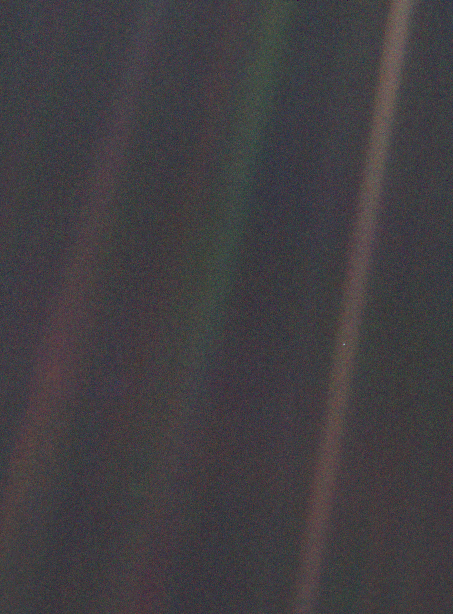
In 1990, the probe turned its camera back toward Earth and took the Pale Blue Dot photograph, which shows Earth as a tiny speck from approximately 6 billion kilometers away. On August 25, 2012, it crossed the heliopause, the boundary where the solar wind's influence gives way to the interstellar environment, and became the first human-made spacecraft to enter interstellar space.
Voyager 1 Timeline
| Year | Milestone |
|---|---|
| 1977 | Launch on September 5 |
| 1979 | Jupiter flyby |
| 1980 | Saturn flyby |
| 1990 | Pale Blue Dot photograph, ~6 billion km from Earth |
| 2012 | Heliopause crossing on August 25, first human-made spacecraft in interstellar space |
| 2026 | One light-day from Earth on November 18 |
A Playlist for Aliens
Both Voyager spacecraft carry a Golden Record, a gold-plated copper disc of images, sounds, music, and greetings from Earth, intended for any extraterrestrial civilization that might one day find it.
The collection includes natural sounds, musical selections from different cultures, and spoken greetings in 55 languages.
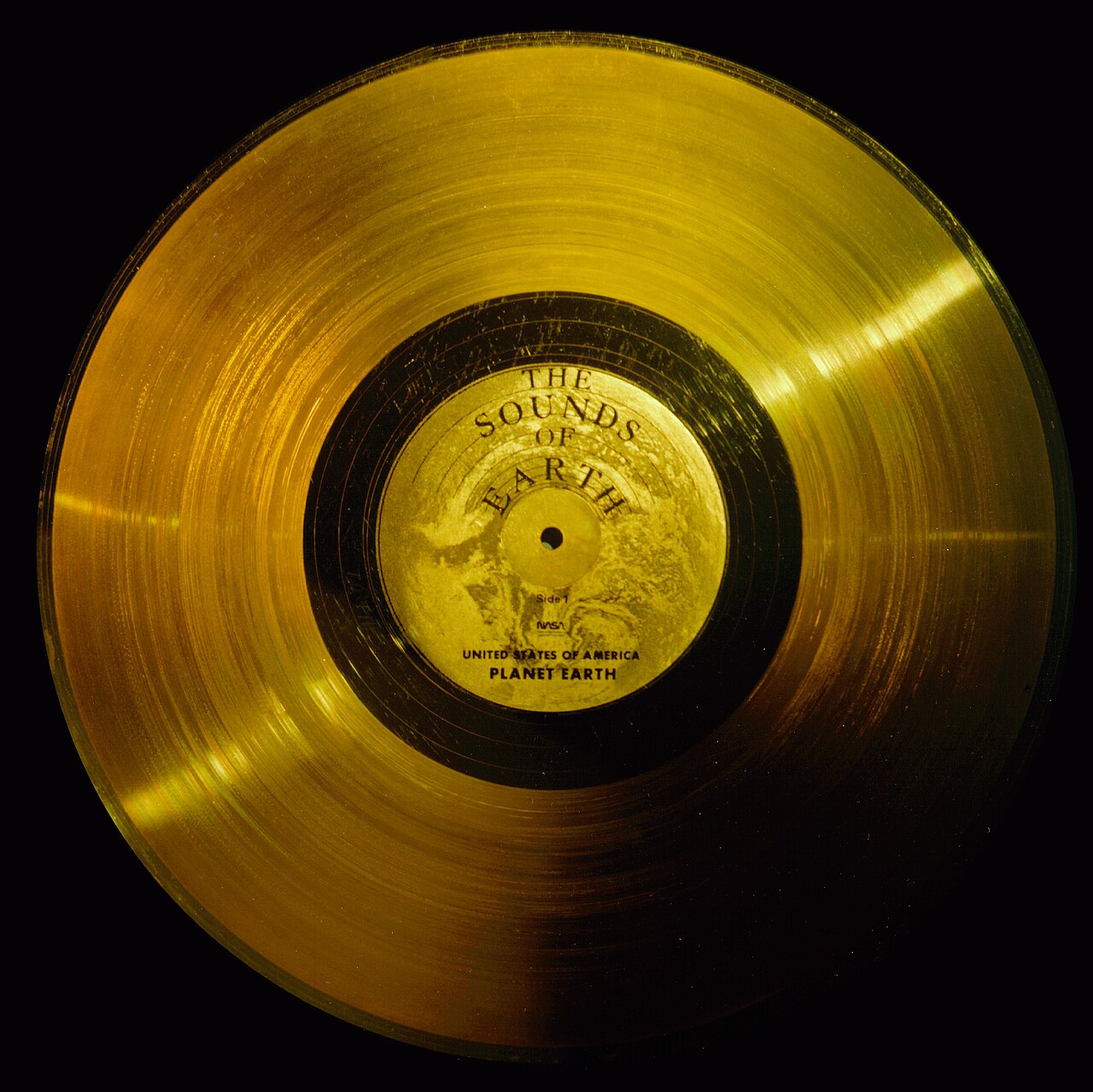
Indonesia is represented in two ways. Ilyas Harun recorded the Bahasa Indonesia greeting, "Selamat malam, hadirin sekalian. Selamat berpisah dan sampai bertemu lagi di lain waktu." The music selection includes Ketawang Puspawarna, a traditional Javanese gamelan composition.
A NASA committee chaired by astronomer Carl Sagan assembled the record. It has been traveling through space for 49 years aboard the two Voyager spacecraft.
The Race to Voyager 1's 50th Anniversary
Voyager 1 runs on a radioisotope thermoelectric generator (RTG), which converts heat from the radioactive decay of plutonium-238 into electricity. NASA estimates that both Voyager spacecraft lose about four watts of power each year, so engineers have switched off certain instruments and systems to conserve energy.
Recent power-saving adjustments are meant to extend the operating time of the remaining scientific instruments. Without them, another instrument on Voyager 1 would have had to be turned off as early as summer 2027. NASA aims to keep both spacecraft running until their 50th launch anniversaries in 2027, though this is not guaranteed.
A new technical issue has also appeared. Since November 14, 2026, NASA has not received science and engineering data from Voyager 1, although the spacecraft keeps transmitting a carrier signal, a basic radio signal showing that it is still sending. Engineers are investigating the cause.
Voyager 1 continues to move away from Earth, farther than any other human-made object, with the Golden Record on board.