NASA has published several astronaut photos of Southeast Asia taken at night from the International Space Station, and a few details in them are easy to miss on first look.
Zoom out far enough, Java and the Malay Peninsula glow almost without a break, the Philippines scatter into hundreds of small bright dots, and long stretches of Indonesia's outer islands stay nearly dark, cut off by water and terrain rather than a lack of people.
Here's a rundown of these photos and what's actually in them.
Southeast Asia Becomes a Map of Light
Thailand, Viet nam, Laos, southern China, and parts of Myanmar appear across the frame, with the brightest concentrations generally following populated areas and transport networks.
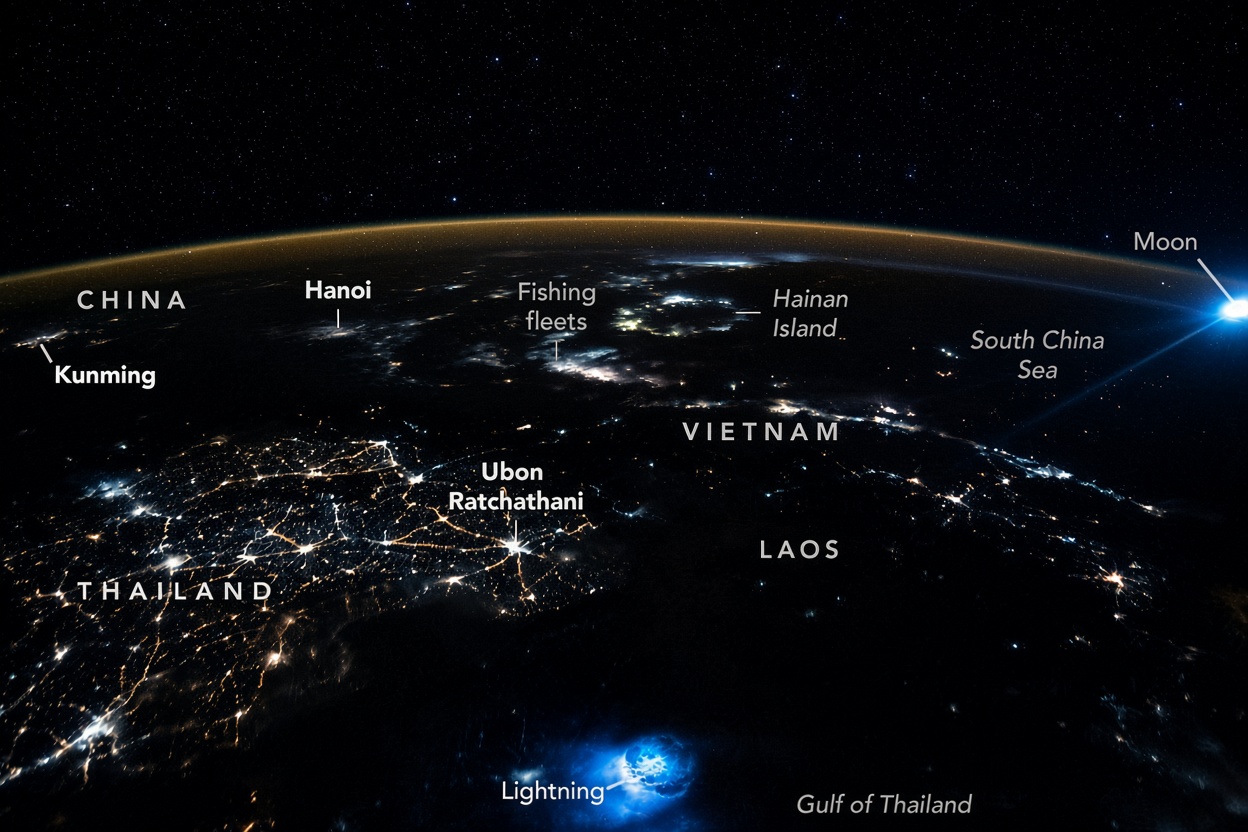
Thailand is particularly easy to recognize. Around Ubon Ratchathani, lights spread outward along roads and settlements, creating a web like pattern across the landscape.
It also captured fishing fleets near Viet nam, lightning over the Gulf of Thailand, and the Moon above Earth’s horizon. That means not every light in the image comes from a city.
Some are actually out at sea.
Java Is Almost One Giant Glow
The island is home to more than 140 million people, making it the world's most populous island. At night, much of Java appears covered by interconnected patches of light.
It's worth noting that the NASA photograph only captures part of the island, so brightly lit areas like West Java and Jakarta don't appear in frame.
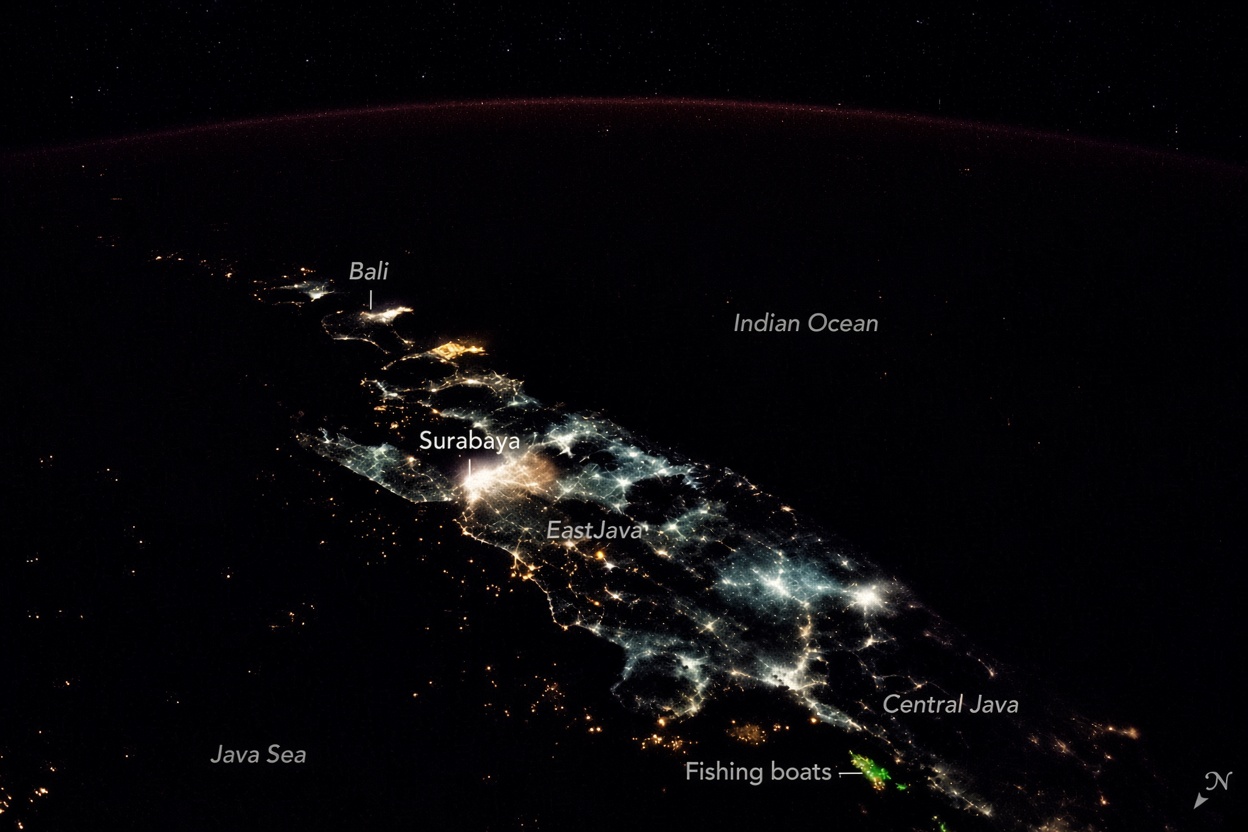
Surabaya, second biggest city in Indonesia, stands out particularly brightly in the NASA photograph. But look more closely, darker circular or elongated areas interrupt the lights across the island. Those dark patches are not necessarily empty land.
Java is dominated by a chain of volcanoes and mountainous terrain. These areas make settlement and development more difficult, so cities and villages tend to grow around them.
NASA describes the volcanic mountains as appearing like a “dark necklace” surrounded by brighter settlements. Even at the sea, bright points north of Java include fishing boats, some of which use powerful lights to attract squid and other marine life.
Singapore and Malaysia Look Almost Connected
Singapore is almost completely illuminated, while Johor Bahru and surrounding parts of southern Malaysia form another large concentration of lights just across the Johor Strait.
It's worth noting that this photo only captures a portion of the Malaysian Peninsula near Singapore, Malaysia's territory on Borneo doesn't appear in frame.
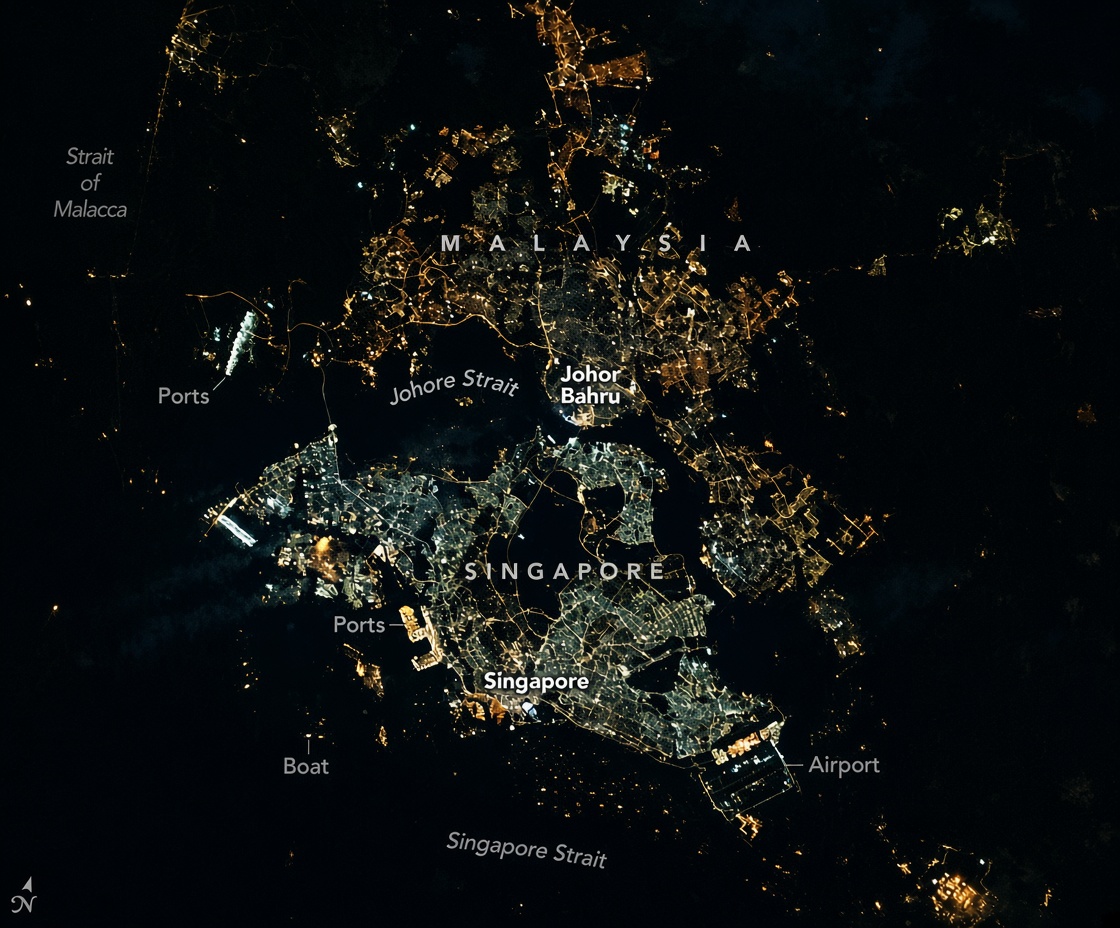
The two urban areas are connected by illuminated bridges, while major ports stand out along the coast. Changi Airport is also easy to spot, its large and bright rectangular area contrasts with the surrounding darkness.
But there is an interesting detail in the middle of Singapore itself. A relatively dark, elongated area cuts through the island.
According to NASA, these darker areas correspond to vegetation, parks, nature reserves, and reservoirs. Even one of the world’s most densely developed countries still has pockets that appear remarkably dark from orbit.
The image also shows something else that is easy to miss from the ground: Singapore’s enormous maritime activity. Ports and boats surrounding the island create their own nighttime footprint.
Some of the Bright Lights Are Not Cities
The fourth photograph, covering Thailand, Myanmar, and Laos, has one of the strangest details in the entire set.
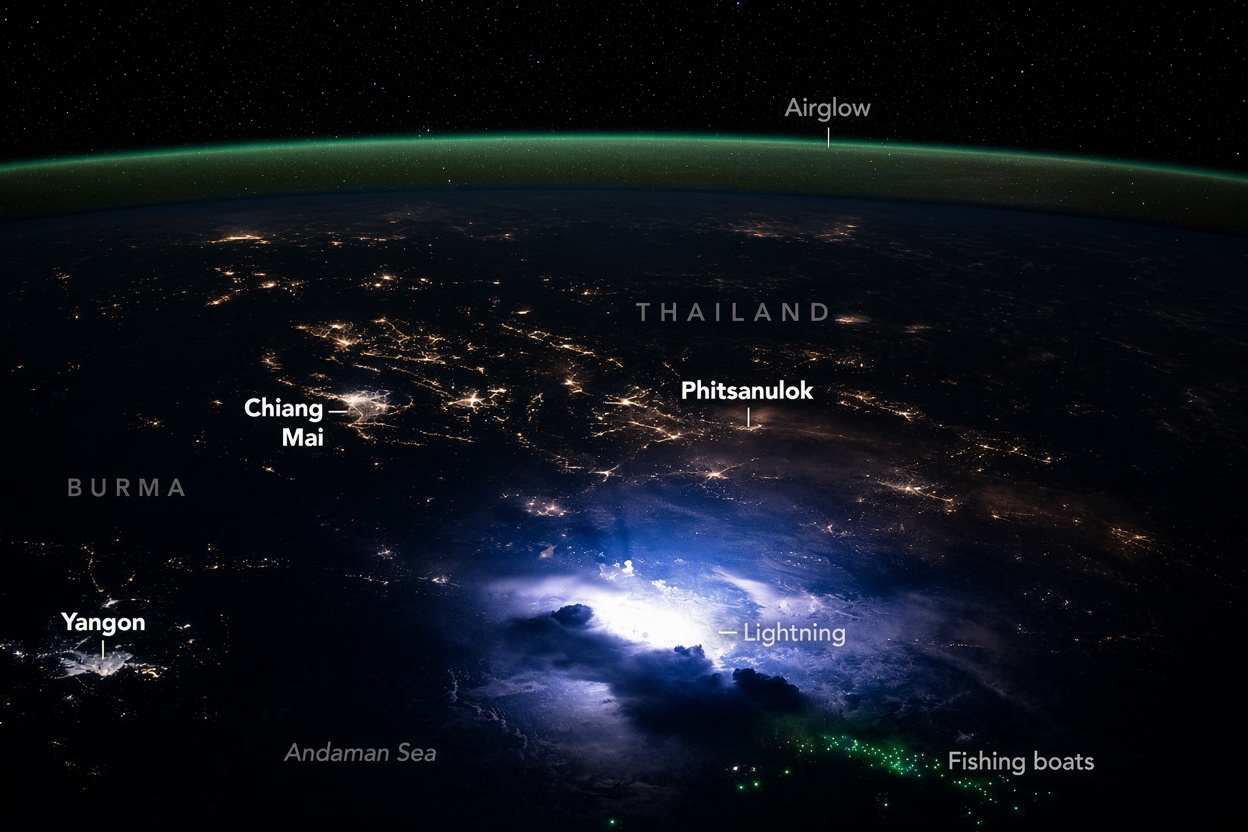
Near the bottom of the image, a cluster of green lights sits offshore. They are fishing boats.
The green glow is not a camera effect. Fishing vessels use powerful lights to attract plankton and fish toward the surface, making the boats visible from hundreds of kilometers above Earth.
NASA has documented these green clusters around Southeast Asia. In some nighttime satellite observations, fishing vessels can be detected far from any coastline.
And then there is the huge blue-white flash in the image, it's lightning from a thunderstorm. Above the horizon, a faint green band is also visible. That is airglow, a natural light produced by chemical reactions in Earth’s upper atmosphere.
So in a single photograph, astronauts can capture city lights, fishing boats, lightning, airglow, and even the glow of the Moon.
The Lights Are More Than Just Pretty
Scientists have actually studied them to understand how cities grow looking at how the lights get dimmer the farther you go from downtown, and where a city's edge really is.
Turns out that fade out follows a pretty predictable pattern, which is part of why these images are useful for more than just admiring the view.
But a dark spot in the photo doesn't always mean nobody lives there. Sometimes it's a park in the middle of a busy city, sometimes it's a mountain too steep to build on, sometimes it's just the sea.
How bright or dark a place looks depends on things like how much electricity people use, how the roads and buildings are laid out, and even what kind of lights a city uses.