Ever seen a video from the Philippines, Indonesia or somewhere else in Southeast Asia showing what looks like a meteor shower lighting up the night sky?
Some of those spectacular streaks really are natural objects entering Earth’s atmosphere.
But not all of them are.
Some are pieces of human made hardware coming back down, including rocket debris. Philippines, in particular, has become a frequent place for authorities to issue warnings about it.
According to the Philippine Space Agency (PhilSA), the agency monitored 55 launches between 2022 and 2025, resulting in 84 declared debris drop zones within the Manila Flight Information Region (FIR).
Many of these zones were located around Philippine waters.
So why does the Philippines keep ending up underneath China’s rocket trajectories?
It Starts With Geography
China has several launch sites, but some of its important facilities are in the country’s south, including the Wenchang Space Launch Site on Hainan Island.
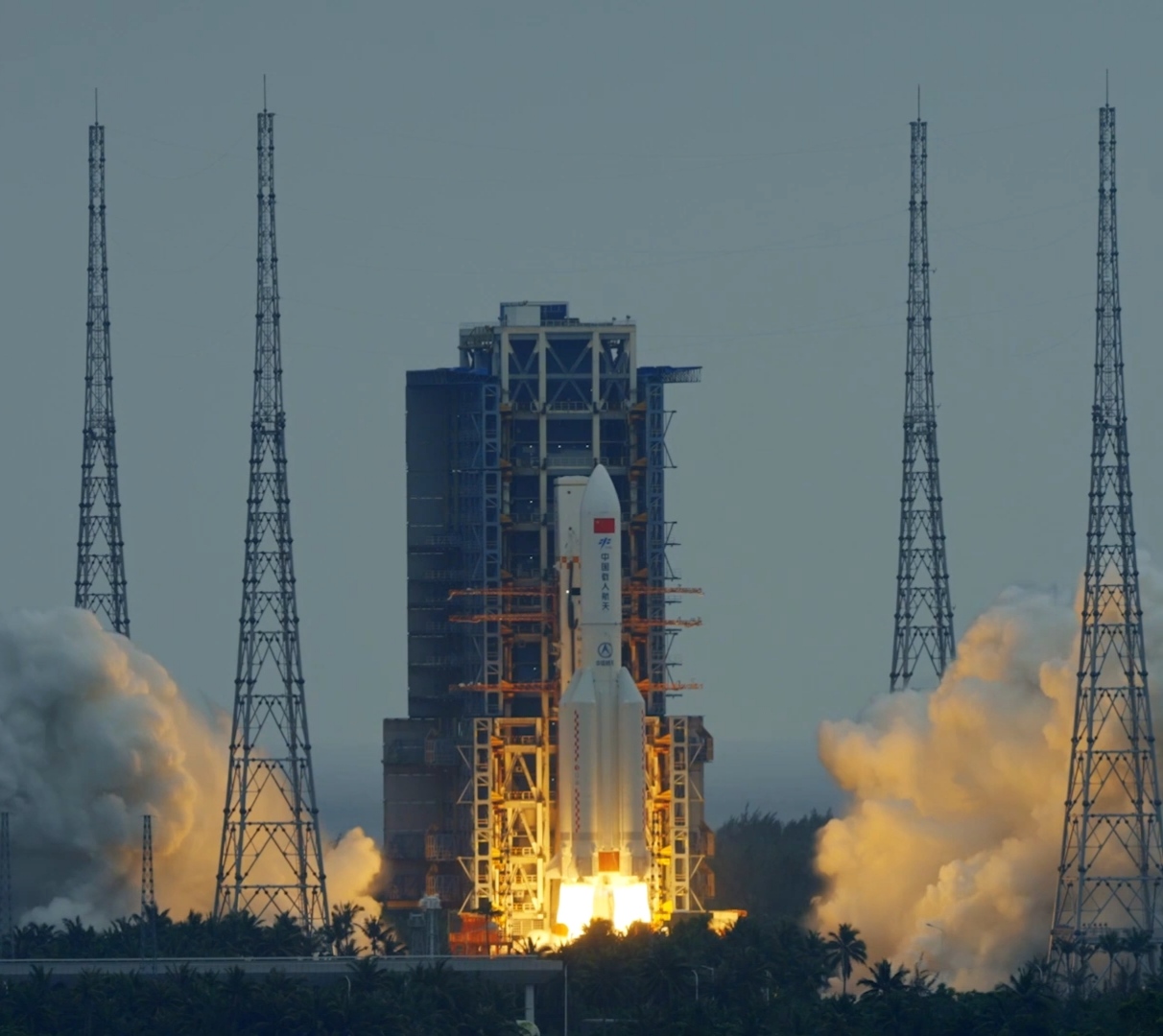
But why point rockets toward Southeast Asia?
It is not because China wants its rockets to fly over the Philippines. The direction of a launch is largely determined by the orbit the mission needs to reach.
Different orbits require different trajectories and inclinations, and changing the launch direction can require additional energy or make a mission less efficient. That is also why the location of a spaceport matters so much.
As we explained in our earlier article on Indonesia’s planned spaceport in Biak, geography can give a launch site important advantages depending on the orbit a rocket is trying to reach.
Read to learn more: Indonesia Set to Build a Spaceport on a Remote Island. But Why?
Wenchang also has a geographic advantage. Located on Hainan Island, it can launch rockets southward or southeastward over the ocean.
For some missions, those trajectories eventually pass toward the waters around the Philippines. The rocket is heading toward its target orbit, while some of the hardware it discards during ascent has to come down somewhere.
Rocket components are not designed to stay together all the way into space. Boosters, fairings and other hardware are discarded during ascent. When this happens, the pieces can fall into predetermined areas known as debris drop zones.
PhilSA has repeatedly issued warnings for these areas.
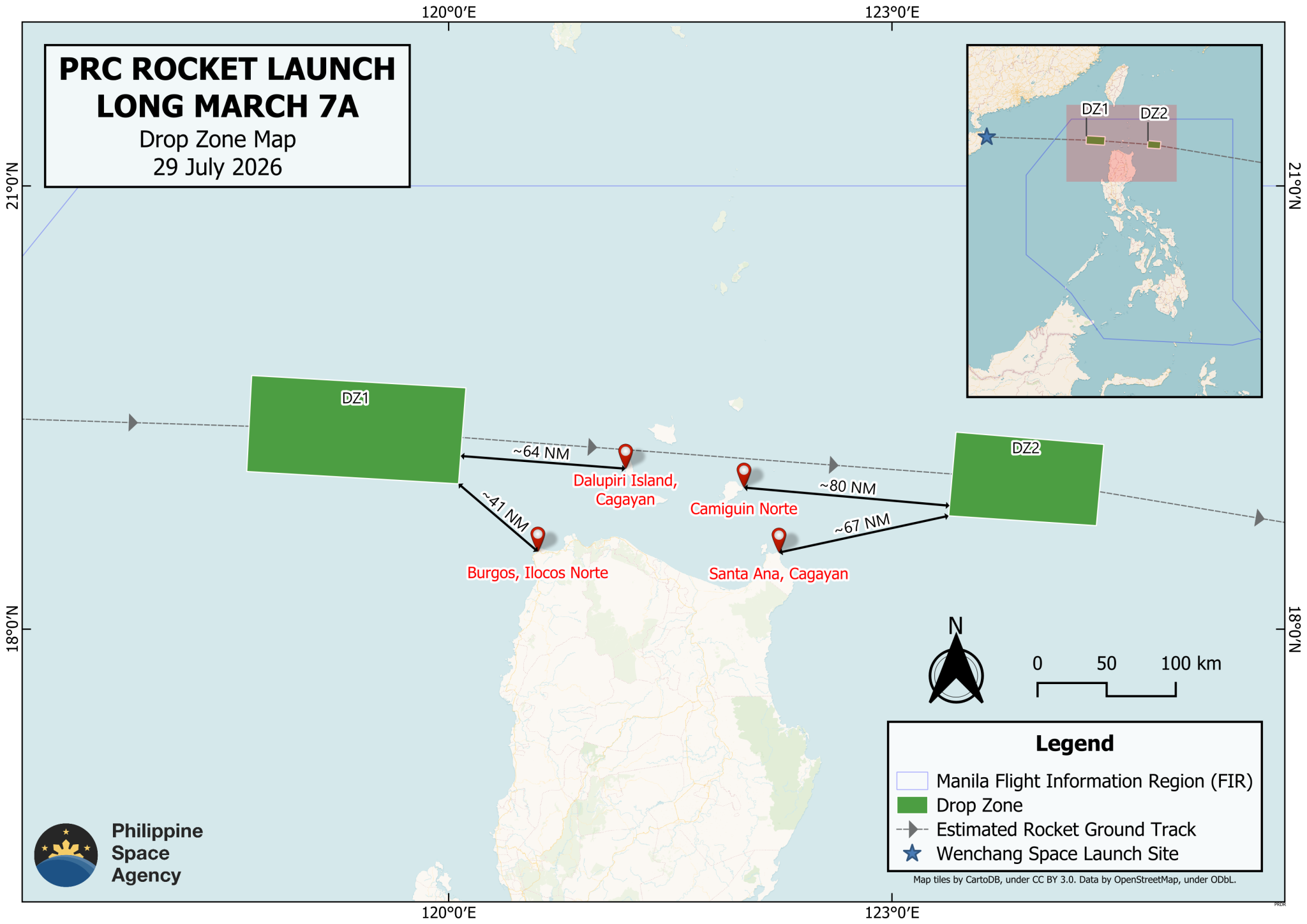
In July 2026, for example, a Long March 7A launch from Wenchang had projected debris drop zones (DZ1 and DZ2) over waters near northern Luzon, close to areas such as Burgos in Ilocos Norte, Santa Ana and Dalupiri Island in Cagayan, and Camiguin Norte.
Why Not Just Drop Them Somewhere Else?
Launch planners generally try to place drop zones over the ocean and away from densely populated areas. From the perspective of the launch country, a remote patch of ocean is far safer than dropping a rocket stage over a city.
But “ocean” does not mean “empty”.
The Philippines is an enormous archipelago surrounded by shipping routes, fishing grounds, aircraft routes and environmentally sensitive waters. Some projected debris zones are inside or close to Philippine maritime areas.
PhilSA warns that falling debris can pose risks to ships, aircraft and fishing boats. Some pieces can also survive the initial fall and eventually wash ashore.
So a rocket can launch successfully without hitting a city while still creating a safety concern for another country.
Sometimes, It Gets More Complicated
There is also a difference between planned debris and uncontrolled re-entry.
During a normal launch, some components are deliberately discarded and their approximate landing areas can be calculated in advance. These are the debris zones that regularly appear in Philippine government advisories.
But some rocket stages can remain in orbit before eventually falling back to Earth. If their re-entry cannot be controlled, predicting exactly where they will come down becomes much harder.
China’s Long March 5B became particularly controversial for this reason. Its large core stages have made several uncontrolled re-entries, prompting international concern because relatively large pieces can survive atmospheric re-entry.
A Growing Concern
For the Philippines, this is becoming more than an occasional warning on a government website.
The Philippine News Agency (PNA) reported that Philippine officials strongly condemned a Chinese Long March 12 launch in August 2025 after a fireball was seen crossing the sky and rocket debris was reported in waters near Palawan.
National Security Adviser Eduardo Año called the testing “irresponsible,” citing potential risks to ships, aircraft and fishing vessels.
There has also been an actual diplomatic dispute over Chinese rocket debris.
In November 2022, according to the PNA, the Philippine Navy recovered suspected Chinese rocket debris near Pag-asa Island. The debris was later identified by PhilSA as part of a Long March 5B rocket's payload fairing.
During the retrieval operation, the Philippine military said a China Coast Guard vessel blocked its boat twice before deploying personnel who forcibly took the debris by cutting the towing line.
The Philippine Department of Foreign Affairs later filed a diplomatic protest, calling the seizure illegal. China disputed the Philippine account. Chinese officials said the debris had been retrieved after “friendly consultation” between the two sides.
As more rockets launch along trajectories that pass near Philippine waters, the country has to keep warning aircraft, ships and fishing boats about potential debris. PhilSA has also called for greater international coordination as global launch rates increase.