In the regions of Southern China and Northern Viet Nam, there is a rare flower species named Camellia petelotii, also known as the Golden Camellia. The plant attracts the attention of the botanical world due to its natural golden-yellow petals. Beyond being an exotic ornamental flora, the flowers and leaves of the plant are processed into an herbal tea infusion rich in health benefits.
The utilization of Golden Camellia as part of traditional Asian medicine has actually been ongoing for hundreds of years. Records regarding the use of the plant are preserved in the compilation of the Compendium of Materia Medica during the Ming Dynasty, specifically around the 16th century. People at that time used decoctions of its flowers and leaves as herbal remedies to soothe sore throats, stop bleeding, and treat dysentery.
However, the broader presence of the specimen only began to be rediscovered by the scientific community in the 20th century. In July 1933, a botanist named Jinglie Zuo found wild populations of the plant growing in nature. The significant discovery was located in the Fangchenggang area, Guangxi Province, China.
Botanical Characteristics of the Rare Golden Flower
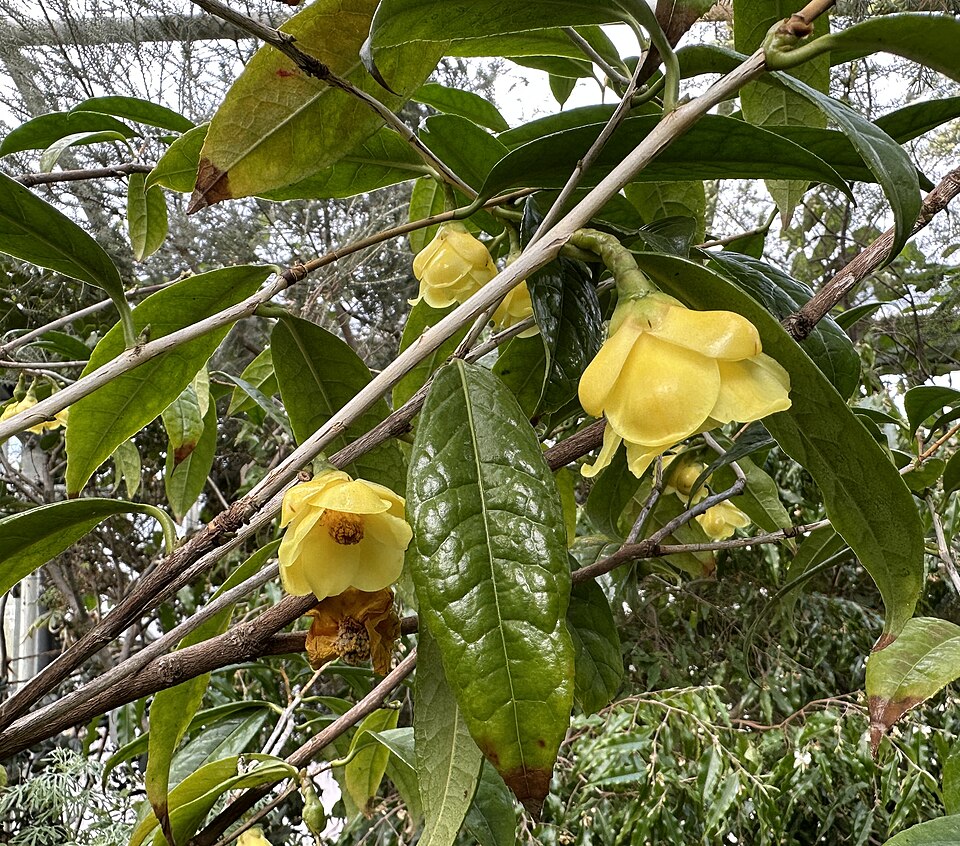
Ecologically, the natural distribution area of the Golden Camellia is quite limited. The plant grows exclusively in the wilderness of East Asia, stretching from Southern China to the mountainous areas of Northern Viet Nam. Its natural habitat lies in limestone forest ecosystems or karst areas with humid soil conditions rich in calcium. The specific environmental conditions prevent the plant from growing easily in just any location.
Physically, the Golden Camellia plant grows as a small tree or woody shrub with a relatively slow growth rate. The feature that sets it apart most clearly from other species is evident in the color of its petals. While the majority of Camellia species feature white or red petals, the plant produces naturally golden-yellow floral crowns. The bright yellow petals create a striking visual contrast amidst the dense tropical forest foliage.
Active Chemical Compounds of the Plant
As a plant utilized for herbal remedies, the flowers and leaves of the Golden Camellia store various groups of phytochemical compounds. The active compounds are distributed across the plant tissue with complementary metabolic functions.
The group of compounds dominating the flower portion consists of flavonoids. Within its floral crown, catechin and quercetin are present in the highest proportions compared to other types of flavonoids. Additionally, the flower tissue also contains luteolin and kaempferol. The flavonoid contents play a primary role as natural antioxidant agents.
Meanwhile, the leaves and stems of the plant are rich in triterpenoid saponins and polysaccharides. The saponin compounds in the tissue support fat metabolism in the body.
Beyond organic compounds, the Golden Camellia also absorbs various trace minerals from the soil in which it grows. The plant tissue holds essential trace minerals such as selenium, zinc, and germanium.
Processing into Herbal Tea
To process Golden Camellia, the selected raw materials are flower buds that have reached full bloom. Once harvested, the materials are cleaned step by step.
After cleaning, the flowers and leaves are dried using freeze-drying methods or low-temperature drying. The purpose of the step is to preserve the active chemical compounds inside so they do not degrade.
Once dried, the materials can proceed to the brewing stage using hot water. The infusion produces a clear yellow beverage with a gentle aroma.
Brewed Golden Camellia herbal tea offers a variety of health benefits for the body. The antioxidant content works to neutralize free radicals while reducing oxidative stress on cells.
In addition to protecting body cells, the active compounds in the flower play a role in the digestive system. The beverage helps inhibit the activity of fat-digesting enzymes, thereby suppressing cholesterol absorption and maintaining balanced blood lipid levels.
Another positive effect is observed in carbohydrate absorption. The active compounds in the plant are capable of inhibiting sugar-cleaving enzymes, which helps control spikes in blood glucose levels.
Reference:
Li, D., Li, Y., Liu, Y., Wu, X., Lu, Y., Zou, R., Tang, J., Wei, X., & Zhu, C. (2026). Chemical constituents and pharmacological effects of Camellia petelotii (Merr.) Sealy: A review. International Journal of Pharmacology, 22(3), 47944. https://doi.org/10.31083/IJP47944