

Despite the rapid expansion of the internet over the past two decades, billions of people around the world still remain disconnected from the digital economy. Internet access has become essential for education, healthcare, business, and communication, yet the benefits of digital connectivity are still unevenly distributed.
According to the Digital 2026 Global Overview report by DataReportal, around 2.21 billion people worldwide remain offline as of early 2026. While global internet penetration has reached approximately 73.2%, large parts of the population—particularly in developing regions—still lack reliable or affordable internet access.
India Leads the World in Offline Population
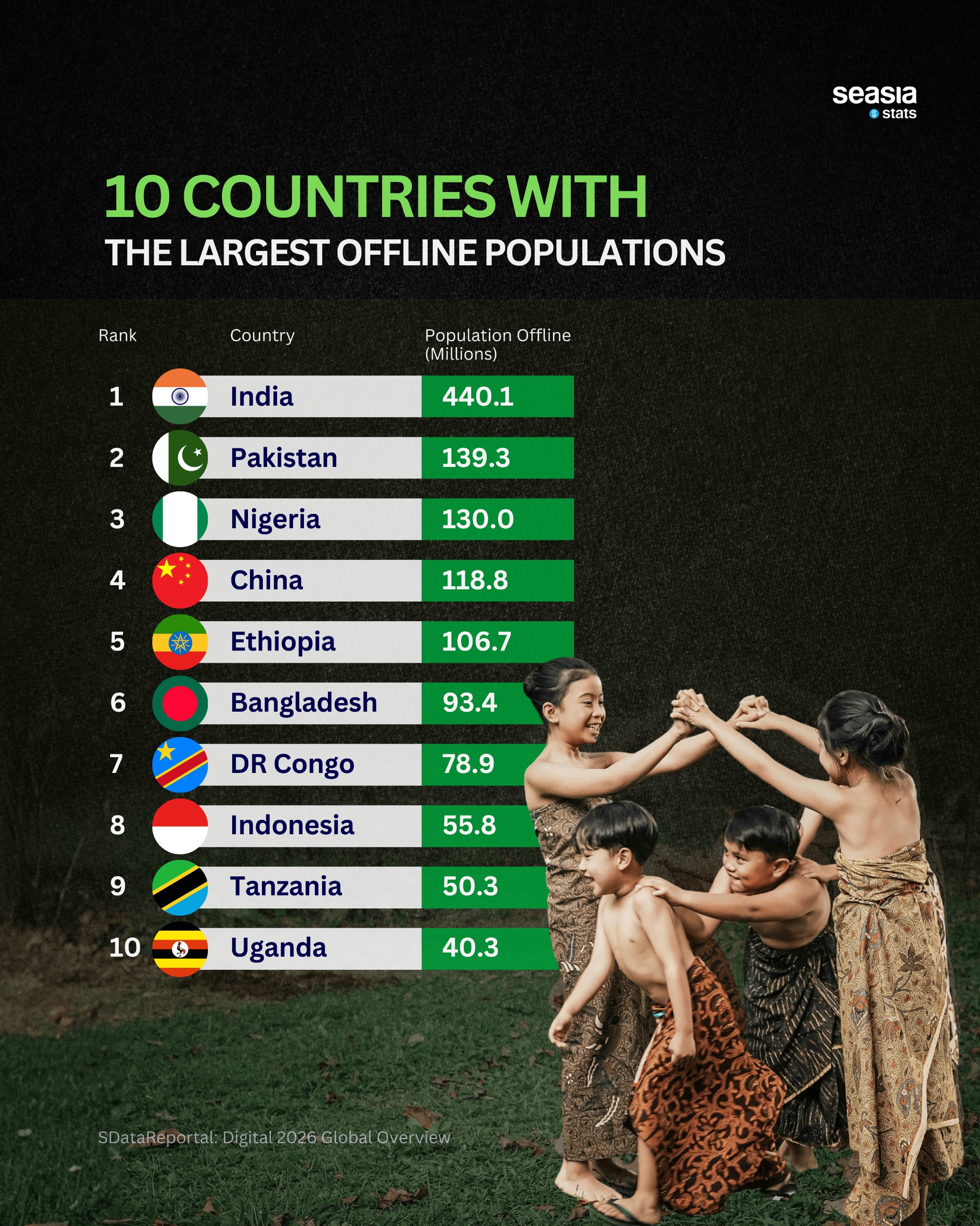
The country with the largest number of people without internet access is India, with 440.1 million citizens still offline. This figure highlights the enormous scale of India’s population and the persistent challenges of expanding digital infrastructure across rural and remote areas.
Although India has already surpassed one billion internet users, a large portion of its population—particularly in rural regions—still lacks stable connectivity, affordable data services, or digital literacy. Bridging this gap remains one of the central priorities for the country’s ongoing digital transformation.
Following India is Pakistan, with 139.3 million people offline, and Nigeria, where 130 million people remain disconnected. These countries face similar challenges involving infrastructure limitations, affordability issues, and uneven rural access.
Major Economies Still Face Connectivity Gaps
Even some of the world’s largest economies continue to struggle with digital inclusion. China, for example, ranks fourth on the list with 118.8 million people still offline, despite having one of the world’s largest internet user bases.
Meanwhile, Ethiopia ranks fifth with 106.7 million offline citizens, representing one of the highest percentages of unconnected populations globally. In many African nations, connectivity challenges are compounded by limited infrastructure, high data costs, and electricity shortages in rural communities.
South Asia and Africa Dominate the Rankings
The remainder of the top ten countries with the largest offline populations are primarily located in South Asia and Africa, regions where internet infrastructure continues to expand but has yet to reach all communities.
The countries included in the ranking are Bangladesh with 93.4 million people offline, the Democratic Republic of the Congo with 78.9 million, Tanzania with 50.3 million, and Uganda with 40.3 million.
These numbers reflect the broader reality that digital access remains uneven globally, especially in regions where economic development, infrastructure investment, and political stability vary widely.
Indonesia and the Southeast Asian Digital Gap
In Southeast Asia, Indonesia appears on the list with 55.8 million people still offline, ranking eighth globally. As the world’s largest archipelagic nation, Indonesia faces unique geographic challenges in delivering internet connectivity across more than 17,000 islands.
While major urban centers such as Jakarta, Surabaya, and Bandung enjoy high internet penetration and advanced digital services, many remote areas—especially in eastern Indonesia—still struggle with limited connectivity and digital infrastructure.
Across Southeast Asia more broadly, countries like Vietnam, Thailand, and Malaysia have achieved relatively high internet penetration rates thanks to expanding fiber networks and mobile broadband coverage. However, rural communities throughout the region still face barriers related to affordability, infrastructure development, and digital skills training.
Closing the Digital Divide
Reducing the global digital divide remains one of the major development challenges of the 21st century. Access to the internet increasingly determines whether individuals can participate in modern economies, access education, or benefit from government services.
Efforts to close this gap—through investments in broadband infrastructure, satellite internet technology, affordable devices, and digital literacy programs—are critical to ensuring that the benefits of the digital age reach everyone.
As global connectivity continues to expand, the challenge is no longer simply building networks, but ensuring inclusive digital access for all communities worldwide.


